An artificial intelligence (AI) technology designed to assist in the music creation process has been developed in South Korea. This technology was created so that AI can serve as a 'colleague' who provides practical support to creators as they explore musical directions.
KAIST announced on May 7 that the research team led by Professor Sungjoo Lee from the School of Electrical Engineering and Computer Science has developed an AI-based music creation support system called 'Amuse.' The team recently received the Best Paper Award at the CHI (ACM Conference on Human Factors in Computing Systems), an international conference on human-computer interaction held in Yokohama, Japan.
The Best Paper Award at CHI is given only to the top 1% of all submitted papers.
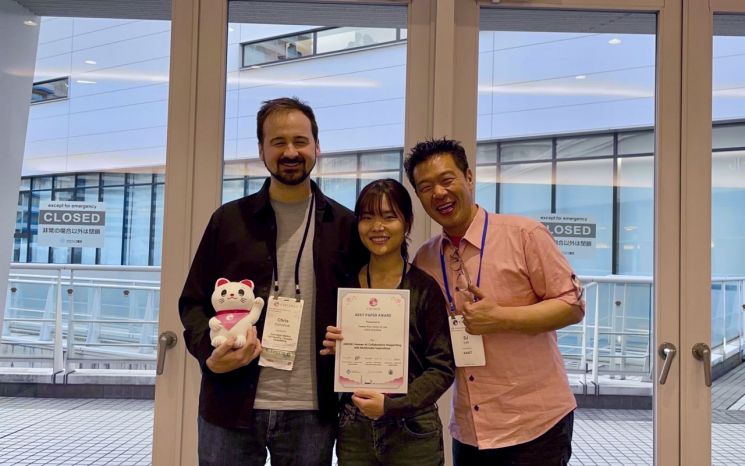 (From left) Professor Chris Donahue, Carnegie Mellon University; Yeawon Kim, PhD candidate, KAIST; Professor Sungjoo Lee. Provided by KAIST
Amuse, developed by the research team, is an AI-based system that supports composition by converting creators' inspirations?entered in the form of text, images, or audio?into harmonic structures (chord progressions).
For example, if a creator inputs a phrase such as "memories of a warm summer beach," an image, or a sound clip, Amuse automatically generates and suggests a chord progression that matches the creator's inspiration.
Unlike conventional generative AI, Amuse is distinguished by its interactive approach, which respects the creator's flow and allows for flexible integration and modification of AI suggestions, thereby encouraging creative exploration.
The core technology of Amuse is a hybrid generative approach. It uses a large language model to generate suitable musical chords based on the user's prompt, and then employs an AI model trained on actual music data to filter out unnatural or awkward results through a process called rejection sampling. These two methods are naturally combined and reproduced in the system.
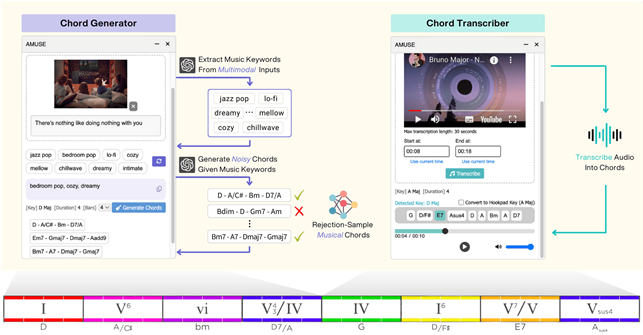
The research team conducted user studies with real musicians and found that Amuse is highly likely to be used not just as a simple music-generating AI, but as a co-creative AI?a creative partner that collaborates with humans.
Professor Sungjoo Lee explained, "Recently, there have been concerns that generative AI technology may infringe on creators' copyrights by directly imitating copyrighted content, or produce results in a single direction regardless of the creator's intent. Our research team recognized these issues and focused on designing a creator-centered AI system by paying close attention to what creators actually need."
He added, "Amuse is an attempt to maintain the creator's autonomy while exploring the possibilities of collaboration with AI. We expect that this will serve as a starting point for suggesting creator-friendly directions in the development of future music creation tools and generative AI systems."
This research was supported by the National Research Foundation of Korea with funding from the Ministry of Science and ICT. The paper, completed by Yeawon Kim, a PhD candidate at KAIST's School of Electrical Engineering and Computer Science, Professor Sungjoo Lee, and Professor Chris Donahue from Carnegie Mellon University, is also recognized for demonstrating the potential of creative AI system design to both academia and industry.
© The Asia Business Daily(www.asiae.co.kr). All rights reserved.
![Clutching a Stolen Dior Bag, Saying "I Hate Being Poor but Real"... The Grotesque Con of a "Human Knockoff" [Slate]](https://cwcontent.asiae.co.kr/asiaresize/183/2026021902243444107_1771435474.jpg)
















