Vacuum in Economic Control Tower, Weakened Negotiation Channels with the U.S.
Political Uncertainty in Korea... Impact on Corporate Investment and Consumer Sentiment
"Do Not Doubt Rate Cuts, We Will Lower Them Sufficiently"
Growth Rate Needs Further Reduction This Year: "Data Must Come First"
Urgent Need for Countermeasures as Stablecoins Bypass Regulations
"It has truly been a difficult week."
This was the first comment made by Lee Changyong, Governor of the Bank of Korea, when he met with reporters on the 5th (local time) in Milan, Italy, where he is attending the Asian Development Bank (ADB) Annual Meeting, the Korea-Japan-China Finance Ministers and Central Bank Governors' Meeting, and the ASEAN+3 Finance Ministers and Central Bank Governors' Meeting. This remark reflects his feelings about the barrage of questions he received locally after Choi Sangmok, the former Deputy Prime Minister and Minister of Economy and Finance, who was scheduled to accompany him, resigned just before the meeting and did not attend. Lee explained, "At every bilateral meeting, people asked why the minister suddenly resigned and what is happening in Korea, but it is not easy to explain the domestic situation. Even when I say that we will be fine, everyone seems to find it odd, so from my perspective, it was an uncomfortable meeting."
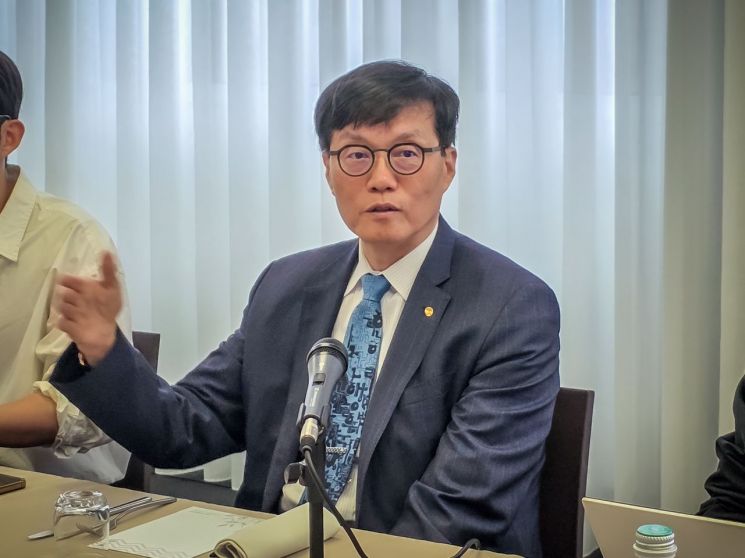 Lee Changyong, Governor of the Bank of Korea, is speaking with the domestic press corps in Milan, Italy, on the 5th (local time) during his visit to attend the Asian Development Bank (ADB) Annual Meeting. Bank of Korea
Regarding concerns that Choi's resignation has created a vacancy in the economic control tower and weakened negotiation channels with the United States, Lee pointed out, "Naturally, this is negative." He said, "Such uncertainty is never good. On July 9, the United States' 90-day tariff deferral ends, so Korea must work to achieve its objectives not only regarding reciprocal tariffs but also on issues such as aluminum and automobiles before then. From the perspective of those in charge of government affairs, it is important that, regardless of who forms the next administration, these negotiations are already underway and that we have worked to ensure that we do not suffer significant losses on July 9. In this situation, the negotiation system being shaken by Choi's resignation is a negative factor." Lee also predicted that this would impact investment in Korea.
He added, "I believe it is the responsibility of those who remain to do their utmost to fill the gap and work for the national interest, but I cannot deny that it is an uncomfortable situation. It is also true that morale has dropped significantly because someone who struggled alongside us has left." When asked whether there was any attempt to dissuade Choi from resigning, Lee replied, "Was there even time for that? The decision was made without time to intervene, and it was his own choice. If you insist on asking why I did not try to stop him, I doubt there would have been any practical benefit (between suspension after impeachment and resignation)."
Political Uncertainty in Korea Impacts Corporate Investment, Consumer Sentiment, and Government Execution
Lee assessed that Korea is currently facing significant domestic uncertainty, comparable to external risks such as tariff issues. He said, "After the election, policy uncertainty needs to end quickly. I did not expect this uncertainty to continue until June this year after the 12·3 Martial Law incident at the end of last year. Corporate domestic investment has been severely affected, and consumer sentiment has also been greatly impacted. Even when looking at the pace of government fiscal execution from January to March, it is clear that politics has had an effect." He continued, "Socially, now that the election is over, I hope that political conflicts will subside, and in the meantime, a major goal is to manage the financial markets so they remain stable."
"Do Not Doubt Rate Cuts, We Will Lower Them Sufficiently"
Regarding the policy of lowering interest rates, Lee stated firmly, "Do not doubt it." He emphasized, "We are lowering rates, and we will reduce them sufficiently in line with economic conditions." However, he explained that the pace and extent of the cuts will depend not only on household debt and exchange rates but also on uncertain external variables. In particular, ahead of the May rate decision and economic outlook, he said it is necessary to check consumption and investment data. He also stated that any adjustment to the number of rate cuts for the year would be based on data.
When asked whether Korea's domestic and external conditions are such that rates could fall to the lower end of the estimated neutral rate range, Lee said, "We are considering whether we need to lower rates further from the current level, or whether we need to lower them more quickly than expected." He added, "When the Monetary Policy Board forms a consensus on rate adjustments, we use various academic analyses, including the neutral rate, to check if our direction is correct. However, we do not set rates solely to match the neutral rate; it is just one reference indicator."
Growth Rate May Be Lowered This Year: "Data Must Come First"
Lee acknowledged that it is likely necessary to revise Korea's annual growth rate forecast downward in the Bank of Korea's May economic outlook. He said, "Not only because of the negative growth (-0.2%) in the first quarter but also because various current indicators suggest that the growth forecast should be lowered." He diagnosed that "depending on the growth outlook, many things such as the terminal rate will change." While there are many reasons to lower the forecast further, given ongoing exchange rate volatility and the need to monitor real estate trends during the rate cut cycle, he said the extent and timing of further cuts would be reviewed again when the May outlook is announced.
However, Lee warned that presenting an absolute target for economic growth is risky. He said, "We should decide what is appropriate for us based on global growth rates, not just assume that 2% or 3% is a basic requirement. The same applies to supplementary budgets; this year, we must consider not only the immediate stimulus effect but also the impact on next year when determining the scale."
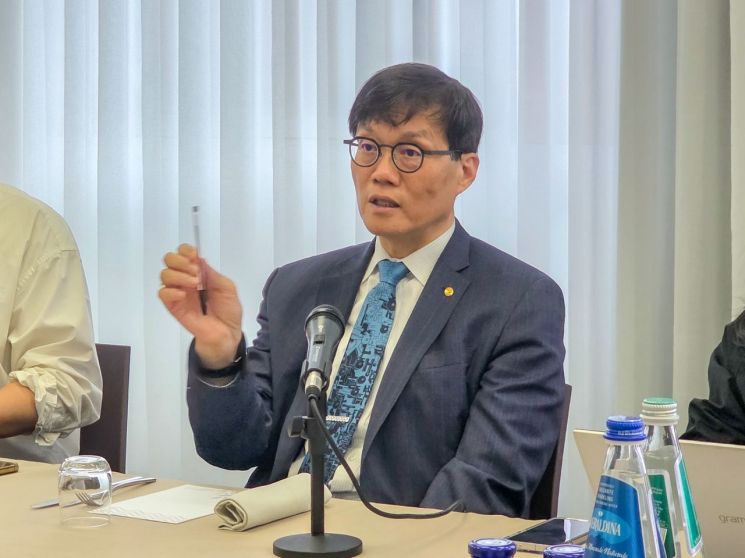 Lee Changyong, Governor of the Bank of Korea, is speaking with the domestic press corps in Milan, Italy, on the 5th (local time) during his visit to attend the Asian Development Bank (ADB) Annual Meeting. Bank of Korea
"Assessing U.S. Intentions... Exchange Rate Volatility Will Continue"
Lee assessed that uncertainty in the foreign exchange market will continue for the time being. He cautioned that it is necessary to pay attention to increased volatility not only on the upside but also on the downside. He explained, "The recent sharp drop in the exchange rate was primarily due to the market interpreting the U.S. discussing exchange rates with individual countries as a signal of appreciation pressure. Secondly, there was growing optimism about a possible resolution of the U.S.-China trade negotiations. If this sentiment suddenly shifts, there is potential for volatility to increase again." He added that it remains unclear whether the U.S. will make common demands on Asian countries or address each country individually regarding exchange rates, and that discussions with the Ministry of Economy and Finance are ongoing. Lee said, "Our current concern is that we do not know whether the U.S. wants a strong dollar or a weak dollar. We need to figure that out, and it should become clearer in the coming weeks."
Currency-Based Stablecoins Likely to Bypass Regulations... Urgent Need for Countermeasures
Regarding stablecoins, Lee explained that the Bank of Korea is particularly interested in those backed by the won or the U.S. dollar, as they can become substitutes for currency. He said, "Stablecoins such as USDT, which are backed by the dollar, are already being traded through exchanges in Korea. The potential for these to bypass Korea's capital and foreign exchange regulations has grown too great, so there is an urgent need to establish relevant regulations. We are discussing this extensively with the International Finance Bureau of the Ministry of Economy and Finance."
He added, "Global stablecoins denominated in U.S. dollars should be considered from the perspective of the Foreign Exchange Transactions Act. As for local stablecoins denominated in won, the Bank of Korea must first determine whether or not to permit them." Allowing stablecoins denominated in won essentially means permitting currency substitutes, and allowing issuance by non-bank financial institutions would mean permitting their narrow banking (a limited banking function that only provides payment services without lending).
Lee explained that the 'deposit tokens' issued by banks in the Bank of Korea's ongoing digital currency experiment, 'Project Hangang,' are also stablecoins backed by the won, issued by banks within the Bank of Korea's blockchain. He said, "What we are currently testing is the issuance of won-denominated stablecoins in the initial stage. Based on the results, we will gradually consider whether to allow banks to issue stablecoins outside the Bank of Korea's blockchain, and whether to allow non-bank institutions to issue them as well."
Structural Reform Reports Are Part of Bank of Korea Branding... "Recognized When It Comes from BOK"
Despite some criticism, Lee explained that the Bank of Korea's publication of structural reform reports on areas such as real estate, education, and care is part of its branding process to build trust. He said, "Some say we are trying to engage in politics, but that is not the case. At least from an economic perspective, the Bank of Korea needs to continuously publish research findings that are beneficial for the country. It is important to build a brand image that when the Bank of Korea speaks, it is politically neutral and speaks in the national interest. If we do not say anything, we cannot build our brand." He described this as a process of establishing such a reputation.
Lee added, "It is frustrating when the media treats the Bank of Korea and other (small private) research institutes with the same weight. I want the Bank of Korea to have a brand that no one else can easily challenge when we speak." He continued, "A report on the self-employed will be released soon, and I believe the recent report on extending the retirement age made a significant contribution. We will continue to build on this."
© The Asia Business Daily(www.asiae.co.kr). All rights reserved.


















