Most Important for the 2040 Generation: "Work"
Marriage and Children Take a Back Seat
A recent survey found that people in their 20s to 40s consider work to be the most important aspect of life, while marriage and children are seen as relatively less important.
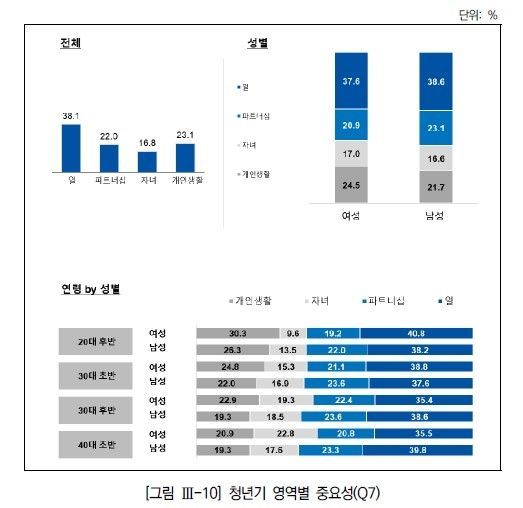
According to the report "Attitudes and Realities of Family and Labor Roles in 2040," released by the National Integration Committee on May 6, both men and women identified "work" (38.1%) as the most important task in early adulthood. This was followed by "personal life, such as leisure and self-fulfillment" at 23.1%, "partnerships, such as dating and marriage" at 22%, and "children" at 16.8%.
Regardless of age or gender, all groups responded that work was the most important. Except for women in their early 40s, the response rate for "children" was the lowest across all age groups. Even among those with children, as well as those without, all groups selected work as the top priority.
Among women with children aged 0 to 5, the response rates for work (30.6%) and children (29.1%) were nearly equal. However, among men with children of the same age, a higher proportion considered work (35.2%) to be more important than children (25.6%). Regarding the meaning of work, 78% of all respondents recognized that "one has no choice but to work to make a living."
When it came to priorities other than work, men and women gave different answers. For women, the order was work (37.6%), personal life (24.5%), partnership (20.9%), and children (17%). For men, the order was work (38.6%), partnership (23.1%), personal life (21.7%), and children (16.6%).

When asked whether they "want to be recognized at work and retire after a full career at a company," 62% of respondents agreed. In addition, 61.6% agreed with the statement, "I want to achieve economic success, even if it means working more."
Only 50.5% responded positively to the statement, "I want to do the minimum amount of work necessary to make a living and have plenty of my own time," and 39.3% agreed with "I want to do work that allows for self-fulfillment, even if it is not a stable job."
 Screenshot of the report "Attitudes and Realities of Family and Labor Roles in 2040." Photo by Yonhap News
Both men and women agreed on the necessity of women's participation in the labor market. Women showed a high agreement rate of around 80%, and about 70% of men also agreed. Both men and women largely disagreed with the statement that a mother's work has a negative impact on her children.
Regarding men's participation in housework and childcare, both men (about 70%) and women (about 80%) showed high levels of agreement. In particular, in dual-income households, men actually participated significantly in housework and caregiving.
This survey was conducted online with 2,690 men and women aged 25 to 44, from January 31 to February 14 of this year.
The report stated, "Since both men and women show high agreement with the changing gender roles of strengthening women's labor roles and expanding men's participation in family life, this is the right time to maximize the effectiveness of policies in this direction." It also suggested, "Policies that assume full-time housewives will become increasingly ineffective, so it is necessary to strengthen policy support based on women's participation in the labor market."
© The Asia Business Daily(www.asiae.co.kr). All rights reserved.
![Clutching a Stolen Dior Bag, Saying "I Hate Being Poor but Real"... The Grotesque Con of a "Human Knockoff" [Slate]](https://cwcontent.asiae.co.kr/asiaresize/183/2026021902243444107_1771435474.jpg)
















