Appeasing Hardliners and Targeting Trump's Middle East Visit
Israel, which has officially declared its intention to occupy the territory of the Gaza Strip, has launched retaliatory airstrikes targeting the Iran-aligned Houthi rebels in distant Yemen.
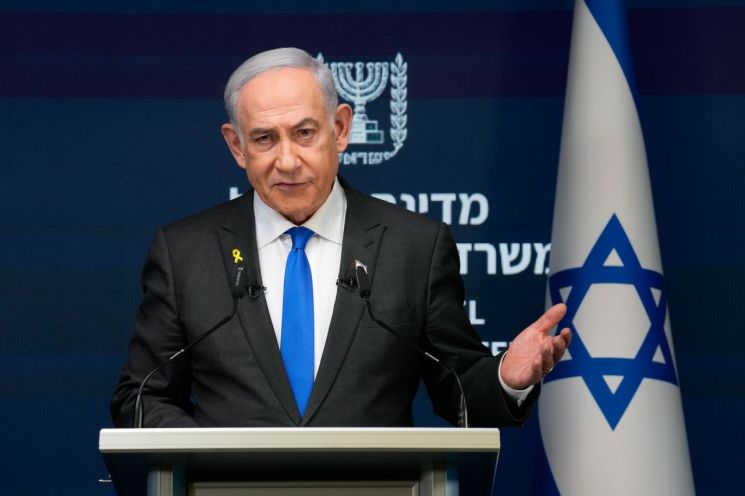
According to international media reports on the 5th (local time), Israel's security cabinet unanimously approved the "Chariots of Gideon" operation plan during a meeting chaired by Prime Minister Benjamin Netanyahu the previous day.
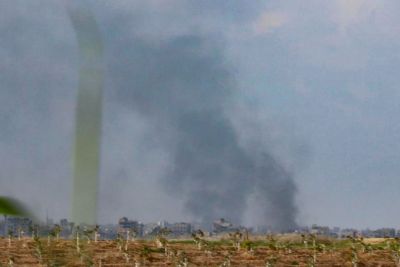 On the 17th (local time), smoke rose from the Gaza Strip beyond the barrier as a result of Israeli military shelling, viewed from southern Israel. Photo by Yonhap News
This operation plan includes Israel's intention to occupy the Gaza Strip and maintain control over the territory.
On this day, Prime Minister Netanyahu officially confirmed the occupation plan by stating on social media platform X (formerly Twitter), "One thing is clear. (The Israeli military) will not go in and then come out."
Until now, Israel had repeatedly bombed the Gaza Strip, while its ground troops remained stationed only in buffer zones near major corridors, carrying out attacks on Hamas strongholds and then withdrawing.
If the new operation plan is implemented, it would mark a departure from the previous strategy, as Israel would continue to occupy captured strongholds, thereby completely blocking Hamas from rebuilding. The number of troops mobilized for this operation is expected to reach tens of thousands in the long term.
On the same day, Israel also carried out an airstrike on the port of Hodeidah, a western coastal city in Yemen controlled by the Houthis, deploying 20 fighter jets and dropping 50 bombs.
According to the Associated Press, the Houthi-controlled Ministry of Health stated that at least one person was killed and 35 were injured in this attack.
This is the first time in about four months, since January of this year, that Israel has directly targeted the Houthis. In particular, it is the first such strike since the United States under the Donald Trump administration began airstrikes against the Houthis in March.
This expansion of Israeli military activity is seen, first and foremost, as an effort to appease hardliners within the country who are dissatisfied with the current situation.
The New York Times (NYT) analyzed, "It appears to be a message from Prime Minister Netanyahu to some of his hardline supporters who are disappointed by the failure to eradicate Hamas," adding, "Escalating the war situation could be politically advantageous domestically."
The airstrike on the Houthis was carried out in retaliation for the missile attack on Tel Aviv Ben Gurion International Airport the previous day. This was the first time Israel failed to intercept a Houthi missile, resulting in multiple casualties and injuries.
Externally, it is also seen as a deterrent message to Iran and Iran-aligned forces in the region.
Through the attack on the Houthis, Israel once again demonstrated its overwhelming military capability to carry out immediate retaliation as far as 2,000 kilometers away.
However, there are significant questions about the actual effectiveness of the expanded military operations.
Tamir Heyman, who served for years as Israel's military intelligence chief, told the NYT that attempts to pressure Hamas with overwhelming military force have become futile as the war has dragged on for a year and a half.
He pointed out that it would be extremely difficult to completely eliminate Hamas, which operates as a terrorist group, using military force alone.
Due to the expansion of military operations, there is a possibility that tensions will only escalate while many hostages remain held by Hamas. There are also concerns that large-scale displacement of Gaza residents and other humanitarian harm to civilians could worsen.
The United States and Israel have struggled to suppress Houthi missile and drone attacks, and the Wall Street Journal (WSJ) noted that repeated U.S. strikes have also failed to stop Houthi maritime activities in the Red Sea.
© The Asia Business Daily(www.asiae.co.kr). All rights reserved.


















