333 Strategy and Ten Key Tasks Proposed
"AI Capabilities Must Be Concentrated Over the Next Three to Four Years"
Need to Ease Power Supply Regulations
Amid intensifying international competition in artificial intelligence (AI), the Korea Chamber of Commerce and Industry (KCCI) has proposed concrete policy recommendations for Korea to become one of the world’s top three AI powerhouses. The KCCI emphasized that, in order to establish Korea as a leading AI nation, the country must concentrate its national capabilities on the deployment of energy, data, and talent. It also stressed the need for comprehensive government support, including the development of a Korean large language model (LLM) and the relaxation of regulations related to power supply.
On May 6, the KCCI released its “Strategy Proposal for Building Korea’s AI Ecosystem,” outlining the ‘333 Strategy’ and ten key tasks. The strategy aims to ensure a stable supply of the three main AI input factors?energy, data, and talent?and to create value across the three major value chains: infrastructure, models, and AI transformation.
The KCCI noted that while Korea has significant AI potential, with strong capabilities in semiconductors, energy, and modeling, its AI investment volume is much lower than that of major countries. The organization expressed concern that Korea could fall behind in the global AI power race if this trend continues.
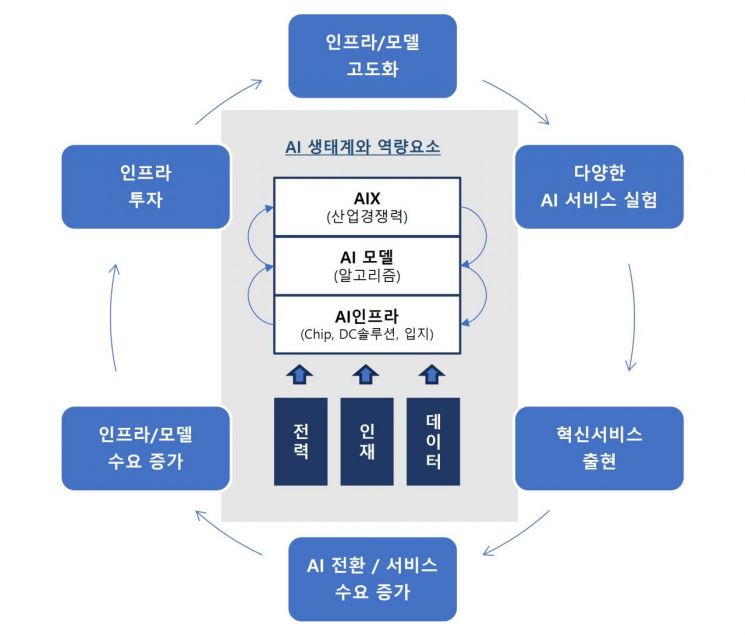
The policy proposal stated, “The reason Korea was able to rise as an IT powerhouse was because the country concentrated its resources on the IT sector for three to four years following the International Monetary Fund (IMF) crisis. AI investment should take this as a lesson. The next three to four years represent a golden opportunity for Korea to become one of the world’s top three AI nations, so national capabilities must be focused on the AI sector.”
The first key task identified was the establishment of AI data centers (AIDC). The KCCI estimated that the construction of the first phase of AIDC would require approximately 6.5 trillion won, and therefore argued for measures such as securing initial demand, streamlining permits and approvals, and expanding tax benefits. To achieve this, the KCCI recommended the creation of an “AI Computing Access Fund” and the introduction of a “permit timeout system.” It also suggested that tax incentives currently limited to manufacturing facilities should be expanded to include computing infrastructure and power supply facilities related to AIDC.
The proposal further warned that, as American and Chinese companies currently possess overwhelmingly superior AI models, excessive reliance on foreign LLMs could reduce Korea to an AI-dependent nation. Therefore, the development of a Korean LLM is an urgent task. The KCCI explained that, to develop a Korean LLM, domestic companies must pool their data and technological capabilities, creating a collaborative environment where each can complement the strengths and weaknesses of the others.
To generate demand for LLMs, the proposal emphasized the importance of increasing use cases for Korean LLMs in the short term, starting with public services closely related to daily life, such as civil complaints and administration, and expanding to address social issues like aging and environmental challenges.
The proposal also highlighted the need to secure successful AI use cases in the manufacturing sector. The Bank of Korea estimates that the introduction of AI could increase Korea’s gross domestic product (GDP) by up to 12.6 percent, but the AI adoption rate in manufacturing remains low at 2.7 percent. The KCCI called for the formation of patient capital, which is invested over the long term, and the prompt enactment of the government’s “Advanced Strategic Industry Fund.” The KCCI stressed, “For the AI ecosystem to function smoothly, it is crucial to ensure a stable supply of input factors such as energy, data, and talent. Since it is difficult for the private sector to handle these areas alone, the government’s role is extremely important. In particular, the efficient supply of large-scale electricity is an essential element for AI activation.”
To establish a stable supply base for large-scale electricity, the KCCI argued for the relaxation of power supply regulations, such as easing restrictions on electricity transactions from self-generation plants and suspending power grid impact assessments within AI-specialized zones in each region.
The recommendations also included expanding data usage rights and fostering the data industry, introducing a MyData distribution platform, creating AI-specialized zones, and implementing preferential visa policies to attract and retain talent. In terms of institutional design, the KCCI called for innovation-driven policies through approaches such as “negative regulation” and the “regulatory sunset system.”
Kang Seokgu, head of the KCCI’s Economic Research Division, stated, “The AI ecosystem must be based on market functions to enable virtuous cycles and continuous innovation. However, there are obstacles to ecosystem development that cannot be overcome by market mechanisms alone, such as shortages in the supply of the three main input factors and enormous investment costs. The government should focus on comprehensive policy support, including infrastructure investment and AI demand creation, to drive these virtuous cycles.”
© The Asia Business Daily(www.asiae.co.kr). All rights reserved.
![Clutching a Stolen Dior Bag, Saying "I Hate Being Poor but Real"... The Grotesque Con of a "Human Knockoff" [Slate]](https://cwcontent.asiae.co.kr/asiaresize/183/2026021902243444107_1771435474.jpg)















