PAP Wins 87 Out of 97 Seats
Blocks Opposition from Expanding Seat Count
Singapore's ruling People's Action Party (PAP) secured an overwhelming victory in the general election held on May 3, solidifying its long-standing dominance as the leading party.
According to local media such as The Straits Times and international outlets including the Associated Press, the ruling PAP won 87 out of 97 seats, while the opposition Workers' Party (WP) secured 10 seats. Compared to the 2020 general election, when the PAP held 83 out of 93 seats, the party gained four additional seats, reflecting the increase in constituencies.
This election was the first to be held since Prime Minister Lawrence Wong took office in May of the previous year, and is seen as having secured new momentum for his administration. Given that the PAP has maintained uninterrupted rule for 60 years since Singapore's independence in 1965, the party's victory was widely expected. The main question was the scale of the PAP's win.
The PAP, founded by Singapore's founding father and first Prime Minister Lee Kuan Yew, has never lost power, winning every general election since independence in 1965. However,
In the 2020 general election, the PAP's share of parliamentary seats dropped below 90% for the first time, reaching 89.2%. Its vote share also fell sharply from 69.9% in the 2015 election to 61.2%, a decrease of 8.6 percentage points, prompting some to describe the result as a "virtual defeat" for the PAP. Although Singapore was legally required to hold the general election by November of this year, Prime Minister Wong had previously requested an early dissolution of parliament to secure renewed political momentum.
In this election, while the ruling party failed to regain a 90% share of parliamentary seats, it managed to increase its vote share by 4.3 percentage points and prevent the opposition from expanding its seat count. This performance is being viewed as stronger than expected. After winning his constituency, Prime Minister Wong said, "I am grateful for the strong support, and I will work even harder to repay the trust you have placed in me."
Eugene Tan, a professor at Singapore Management University (SMU), told the Associated Press, "It is surprising that the opposition failed to win more seats than in the 2020 general election," adding, "Voters have demonstrated their trust in the ruling party that has governed Singapore for a long time."
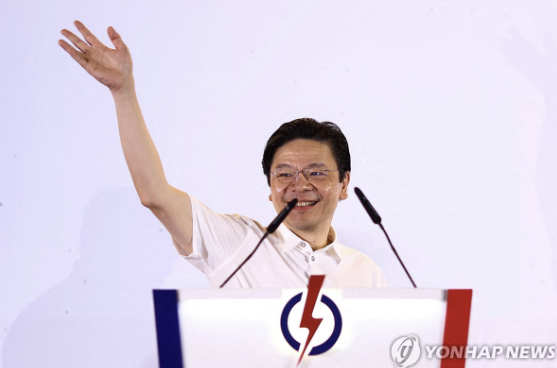
There are also observations that growing global economic uncertainty, such as U.S. President Donald Trump's tariff policies, contributed to the PAP's victory by bolstering support for the stable ruling party. Prime Minister Wong also commented on this, saying, "The people have given the government a strong mandate," and added, "This result will place Singapore in a better position in an increasingly turbulent world."
This election also marks the completion of the transition to the leadership of Prime Minister Wong, who is the second prime minister not from the Lee Kuan Yew family, following former Prime Minister Goh Chok Tong. With his first general election since taking office resulting in a decisive victory, Prime Minister Wong is expected to gain further political momentum in the future.
© The Asia Business Daily(www.asiae.co.kr). All rights reserved.
![Clutching a Stolen Dior Bag, Saying "I Hate Being Poor but Real"... The Grotesque Con of a "Human Knockoff" [Slate]](https://cwcontent.asiae.co.kr/asiaresize/183/2026021902243444107_1771435474.jpg)















