CubeSat to Be Loaded onto Crewed Lunar Mission 'Artemis II'
Cosmic Radiation Measurement Mission... Verification of Semiconductor Radiation Tolerance
A CubeSat developed by South Korea will be loaded onto the Artemis II crewed lunar mission spacecraft of the National Aeronautics and Space Administration (NASA) of the United States.
The Korea Aerospace Administration (KASA) announced on the morning of May 2 at the National Science and Technology Advisory Council in Jongno-gu, Seoul, that it had signed an implementation agreement with NASA to load the CubeSat K-RadCube (RadCube) onto Artemis II.
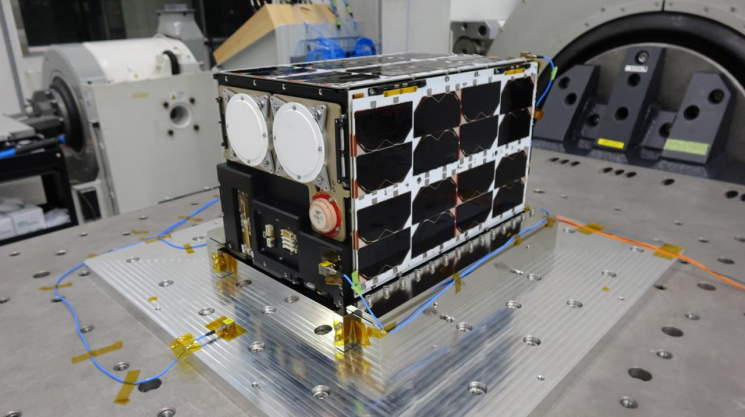
Under this agreement, NASA will mount K-RadCube onto Artemis II and handle its launch. NASA will also establish the environment necessary for loading K-RadCube onto Artemis II. KASA plans to complete the development and flight certification of K-RadCube by July and then deliver it to NASA. After launch, KASA will also be responsible for operating K-RadCube.
Artemis II is scheduled for launch in April next year, and both agencies are preparing the entire schedule, including the transportation of K-RadCube. The cost of manufacturing and transporting the satellite will be covered by South Korea, while the United States will bear the launch costs.
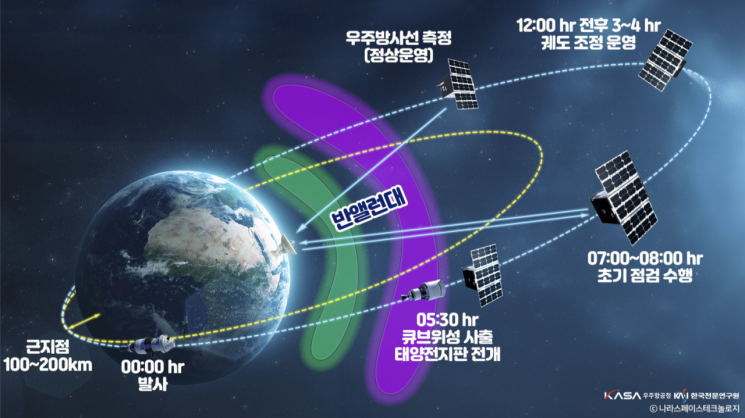
K-RadCube is a CubeSat that will carry out scientific missions by measuring cosmic radiation in the Earth's radiation belt, known as the Van Allen radiation belt, and analyzing the effects of this radiation on astronauts. It will also verify the radiation tolerance of semiconductor devices developed by domestic companies in the space environment by mounting these devices on the CubeSat.
K-RadCube is being developed under the leadership of the Korea Astronomy and Space Science Institute, with Nara Space participating in the development of the satellite body. Kang Kyungin, Director of the Space Science Exploration Division at KASA, explained, "K-RadCube is the first domestic satellite from Korea to reach an altitude above 36,000 kilometers."
The Artemis program, led by NASA, is the first mission to send humans to the Moon since the Apollo program. Artemis II, which will carry K-RadCube, will have four crew members and will conduct a test flight of NASA's Space Launch System (SLS) and the Orion spacecraft. Four astronauts will orbit the Moon, attempt a 'swing-by' maneuver using the Moon's gravity to adjust their trajectory, and then return to Earth.
The United States has established the 'Artemis Accords' as the international cooperation framework for the Artemis program, and South Korea is the 10th country to join the Artemis Accords. Following South Korea's signing of the Artemis Accords in 2021, KASA also signed a research agreement with NASA on Artemis in October last year.
K-RadCube is scheduled to be mounted on the Orion Stage Adapter (OSA). The OSA is a device that connects the Orion spacecraft and the SLS, and it ensures that the spacecraft and other payloads are safely launched into space.
The scientific data obtained from K-RadCube will be made available to relevant researchers. KASA expects that these data will play an important role in future international deep space exploration cooperation.
Yoon Youngbin, Administrator of KASA, stated, "With the signing of this implementation agreement, we expect even closer cooperation between KASA and NASA in the field of deep space exploration beyond the Moon."
© The Asia Business Daily(www.asiae.co.kr). All rights reserved.
![Clutching a Stolen Dior Bag, Saying "I Hate Being Poor but Real"... The Grotesque Con of a "Human Knockoff" [Slate]](https://cwcontent.asiae.co.kr/asiaresize/183/2026021902243444107_1771435474.jpg)
















