When Services Trade Is Included, US Deficit Shrinks
EU to Purchase LNG, Soybeans, and Agricultural Products Accordingly
Indicates Need to Further Lower Tariffs Below 10%
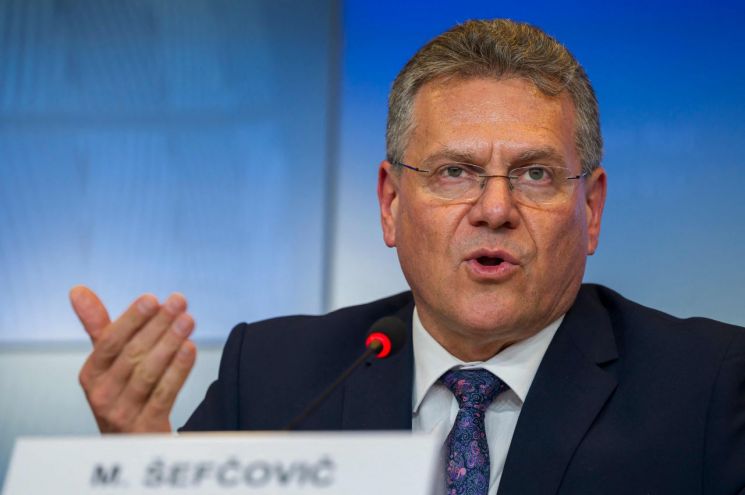 Maro? ?ef?ovi?, European Union (EU) Executive Vice President for Trade, stated in an interview with the Financial Times (FT) in the UK on the 1st (local time) that there are plans to purchase an additional 50 billion euros worth of US products during trade negotiations with the United States. Photo by AFP Yonhap News
The European Union (EU), which is currently engaged in reciprocal tariff negotiations with the United States, announced on the 1st (local time) that it plans to purchase an additional 50 billion euros (approximately 81 trillion won) worth of US products as a form of incentive. US liquefied natural gas (LNG) and agricultural products, including soybeans, are expected to be among the targeted items. However, the EU made it clear that the US proposal to maintain a 10% tariff on European products does not constitute the "fair compromise" Europe seeks, and emphasized that tariffs should be reduced to a lower level.
The Goal Is a "Balanced and Fair Agreement"
Maro? ?ef?ovi?, the EU Executive Vice President for Trade, stated in an interview with the Financial Times (FT) in the UK on this day that the EU wants to increase purchases of US products to address "issues" in the bilateral trade relationship.
?ef?ovi? explained that after US President Donald Trump imposed, then suspended, a 20% tariff on the EU, a certain degree of progress was made through several rounds of in-person and phone negotiations. He added that his goal remains to reach a "balanced and fair agreement" with the White House.
The reason for setting the purchase amount at 50 billion euros lies in the calculation of the trade deficit between the two sides. If the US trade deficit with the EU is calculated to include the services sector, in which the US has a surplus, the deficit amounts to only 50 billion euros. He said, "If we look at the issue with a deficit of 50 billion euros, we believe we can resolve this very quickly by purchasing US LNG and soybeans, among other products." This position has also been communicated to Jamison Greer, the US Trade Representative, and Howard Lutnick, the Secretary of Commerce.
On April 2, President Trump imposed reciprocal tariffs on virtually all US trading partners, basing the tariff rates on the size of the trade deficit with each country. The EU posted a trade surplus of $235.6 billion (about 348 trillion won) with the US in the previous year, leading to a 20% reciprocal tariff. However, the EU argues that the actual surplus is much smaller when trade in services is included. ?ef?ovi? described this figure as "astronomical" and said, "We made it clear to the US that this is unfair and not equitable."
10% Tariff Floor Set by the US Is "Very High"
When asked whether the EU is willing to accept the 10% base tariff set by President Trump as the "floor" below which tariffs cannot be lowered, he responded that the EU considers this to be "a very high level." The FT interpreted this as an indication that the EU will not agree to a deal that simply reduces tariffs to 10%.
He also expressed the EU's willingness to cooperate with the US in addressing issues such as oversupply from China. "We believe that we can achieve a great deal together, particularly in tackling steel and aluminum overproduction, cooperating in the semiconductor sector, and overcoming critical raw material dependence on China," he said.
Meanwhile, on April 14, the EU began full-scale tariff negotiations with the US and decided to suspend retaliatory measures against the US?which had imposed a 25% tariff on EU steel and aluminum?for 90 days until July 14. Prior to this, on April 10, President Trump announced a 90-day suspension of reciprocal tariffs on most countries except China, and as a result, most EU goods imported into the US are currently subject to a 10% base tariff.
© The Asia Business Daily(www.asiae.co.kr). All rights reserved.

















