Reconstructing Urban Identity Through Humanities Policy
Presenting the City's Future with Libraries and Eco College
The past decade has seen a global surge in the popularity of K-culture. Korean music, film, and literature have transcended borders to become a universal cultural code. In particular, author Han Kang's Nobel Prize in Literature in 2024 marked a turning point, making reading culture 'hip' again and signaling changes in urban policy.
Amid this trend, Suncheon City, as Korea's leading ecological city, has chosen a new direction. Moving beyond simple environmental protection, the city has actively implemented a humanities-based urban philosophy called 'ecological culture' as official policy.
The 2023 Suncheonman International Garden Expo, which attracted 9.8 million visitors, demonstrated not only the city's physical resources but also the level of civic consciousness among its residents.
The process of removing utility poles, changing rice farming methods, and creating the National Garden involved numerous conflicts. However, Suncheon is regarded as a rare city that has achieved 'ecological consensus' by resolving these issues one by one through citizen empathy and cooperation.
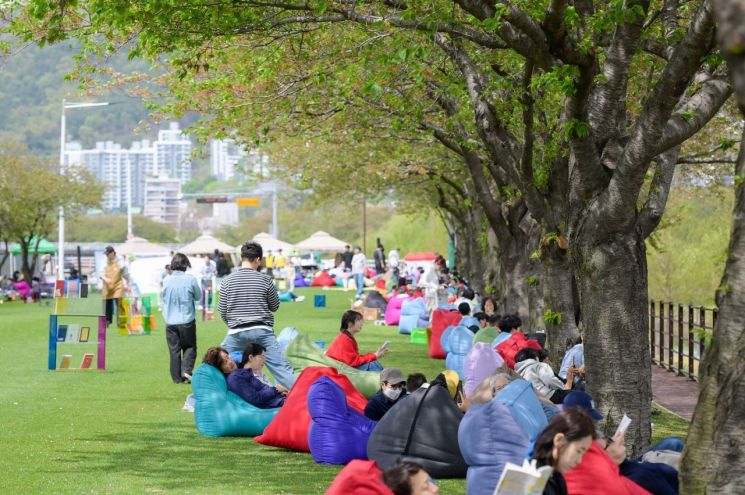
The most notable change in Suncheon since the start of the eighth popularly elected administration has been in its libraries. The annual number of library users, which stood at 690,000 in 2022, soared to 1,008,000 in 2024?a remarkable 146% increase. This figure is overwhelmingly higher than the national average.
Behind this growth is the 'redefinition of the library's role.' The city is transforming libraries from mere repositories of materials into spaces where culture flows and books become part of daily life.
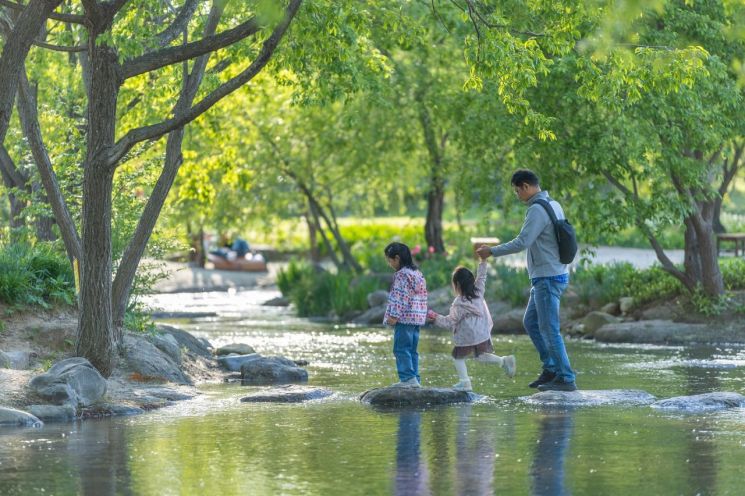 Children crossing the stepping stones on the creek path at the National Garden. Provided by Suncheon City
With the opening of new facilities such as Sindae Library (2023) and Eoullim Library (2024), the number of municipal libraries has increased to ten. Various citizen participation programs are being held, including book picnics, animation concerts, and author exhibitions.
In addition, the designation as a Special Education Development Zone has enabled one-to-one reading and humanities programs matching schools and libraries, youth book projects in collaboration with local bookstores, and the 'One City One Book' campaign?all of which are spreading a 'culture of living with books' throughout the city.
In 2025, Suncheon will become the first local government in Korea to pilot an 'Eco College' for the transition to ecological civilization. This experimental school aims to foster 'ecological sensitivity,' seeking sustainability through harmony with nature rather than a human-centered city.
After a six-month pilot period, Suncheon Eco College is scheduled to launch officially next year. It aims to go beyond simple civic education to become a platform where citizens grow as policy partners. Its curriculum, which breaks the mold of traditional learning by taking students out of the classroom to learn directly from national experts, is designed to foster dynamic learning experiences.
Through this process, the city hopes to cultivate 'empathic administrative momentum' to address complex crises such as climate change, biodiversity, and the ecological economy. As ecological awareness improves, administrative conflicts and costs decrease, while urban competitiveness increases.
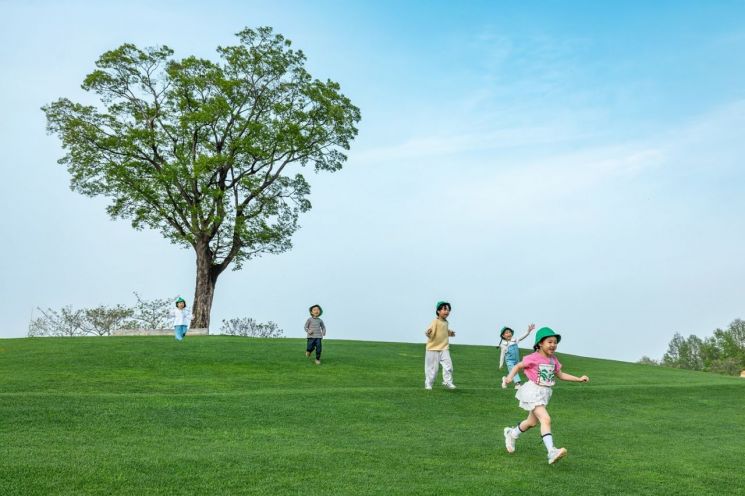
Suncheon is bringing gardens, books, and ecological education into everyday urban life, making the vision of a 'city living with nature' a reality. Libraries are evolving into complex cultural spaces, and Eco College is becoming a testing ground where citizens can grow as agents of ecological civilization.
Most importantly, these changes are taking place not through top-down administration but through empathy and partnership with citizens. It was the citizens who helped protect Suncheonman by removing utility poles and who broke down the boundaries between the city and its gardens.
Now, Suncheon's ecological culture policies are entering a new phase. More people are experiencing nature in their daily lives, and a cyclical structure is taking root in which individuals reflect on themselves and their city through books.
Ecology is not about preservation but a way of life, and culture is not about exhibition but a language of sharing. Suncheon's commitment to this philosophy is becoming a 'green preview' of the path that future cities must follow.
© The Asia Business Daily(www.asiae.co.kr). All rights reserved.



















