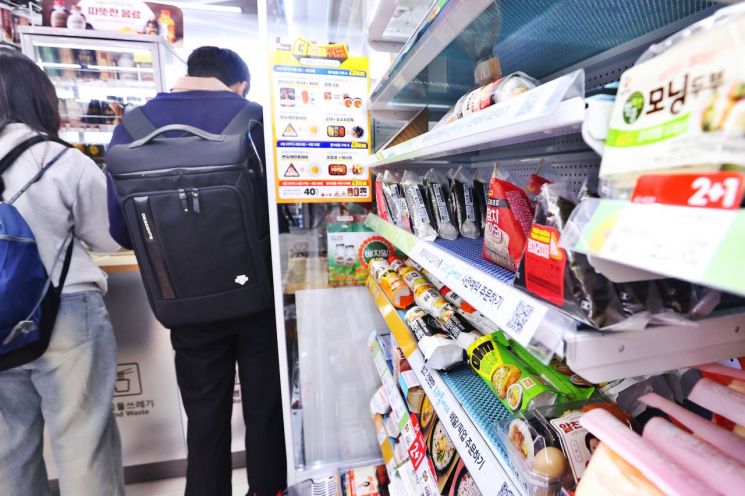
Although prices for dining out, processed foods, livestock products, and seafood have risen significantly, the overall consumer price inflation rate has remained stable in the low 2% range for four consecutive months.
According to the "April Consumer Price Trends" report released by Statistics Korea on May 2, the consumer price index last month increased by 2.1% compared to a year earlier. The consumer price inflation rate hit a low of 1.3% in October 2023, then rose to 1.5% in November and 1.9% in December, and has remained in the low 2% range for four consecutive months since returning to the 2% range at the start of the new year.
Recently, the strong won-dollar exchange rate has been passed on to the prices of imported raw materials and factory prices, leading to a marked increase in the prices of processed foods and dining out.
The personal services sector rose by 3.3% year-on-year, contributing 1.12 percentage points to overall consumer price inflation. Among personal services, dining out costs in particular rose by 3.2%. This was due to higher raw material costs caused by the strong exchange rate and increased labor costs. This rate of increase is the highest since March 2023, when it was 3.4%.
Processed foods also continued their upward trend. Prices for processed foods rose by 4.1%, raising overall inflation by 0.35 percentage points. This is the highest increase in 16 months, since 4.2% in December 2023. The upward trend in processed foods has been widening since the end of last year, driven by the ongoing strong exchange rate. Bread rose by 6.4% compared to the same month last year, while herbal medicine (8.9%), kimchi (20.7%), and coffee (8.0%) also recorded high rates of increase.
Among agricultural, livestock, and fishery products, seafood prices rose by 6.4%. This is the largest increase in 25 months, since 7.4% in March 2023. Gim, which has seen continuous price increases since last year, rose by 25.5% last month, while mackerel (11.6%), hairtail (6.0%), and squid (3.0%) also saw sharp increases. Livestock products rose by 4.8%, marking the highest increase in 33 months. Pork prices rose by 6.8%, and domestic beef increased by 4.2%.
Indicators categorized by spending purpose also showed a marked increase in food and non-alcoholic beverages. Edible oils, for example, rose from just 2.1% in April 2024 to 7.8% in one year. During the same period, meat prices shifted from -0.2% to 4.7%, and bottled water and soft drinks from -0.8% to 6.7%.
In contrast, the fresh food index, which includes fish, vegetables, and fruits, fell by 1.9% compared to the same month last year, marking a negative trend for three consecutive months. Compared to a year ago, fresh fruit prices fell by 5.5% and fresh vegetables by 1.9%. However, compared to the previous month, both rose by 2.4% and 9.2%, respectively.
Petroleum product prices turned downward, falling by 1.7%, due to the recent decline in international oil prices.
The core inflation rate, which shows the underlying trend of prices, continued to rise. The domestic standard index, which excludes agricultural products and petroleum, rose by 2.4% year-on-year, up from 2.1% in the previous month. The index excluding food and energy, which is used as a standard by the Organisation for Economic Co-operation and Development (OECD), also rose by 2.1% compared to a year earlier, up from 1.9% in the previous month.
Lee Doowon, Director General for Economic Trend Analysis at Statistics Korea, said, "The decline in prices of vegetables, fruits, and petroleum products is not reflected in core inflation, which is why the core rate is higher than the overall consumer price inflation." He added, "We cautiously predict that the current price level will likely be maintained."
The government stated that it will jointly inspect the distribution situation of major items closely related to people's livelihoods with relevant ministries, and will prepare countermeasures if necessary. To this end, the government had planned to hold a price-related vice ministerial meeting on the morning of May 2, chaired by First Vice Minister of Economy and Finance Kim Bumseok, but the meeting was canceled due to the resignation of Deputy Prime Minister and Minister of Economy and Finance Choi Sangmok the previous night.
© The Asia Business Daily(www.asiae.co.kr). All rights reserved.
![Clutching a Stolen Dior Bag, Saying "I Hate Being Poor but Real"... The Grotesque Con of a "Human Knockoff" [Slate]](https://cwcontent.asiae.co.kr/asiaresize/183/2026021902243444107_1771435474.jpg)















