US Economy Contracts by 0.3% in Q1
Manufacturing Slump Continues... Unemployment Claims Exceed Expectations
Yellen: "Likelihood of Recession Has Increased Significantly"
Besant Also Pressures Powell to Cut Rates
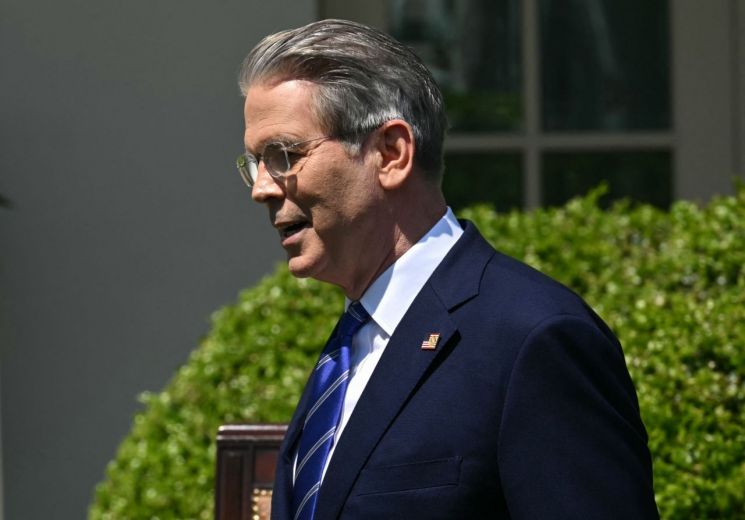
Following the contraction of the U.S. economy in the first quarter, both manufacturing and employment indicators have worsened. Analysts note that signs of an economic slowdown are intensifying due to President Donald Trump's tariff policies. Janet Yellen, former Treasury Secretary and the 'economic commander' under the previous Joe Biden administration, has warned of a possible recession, while current Treasury Secretary Scott Besant has called on the Federal Reserve (Fed) to cut interest rates.
According to the Institute for Supply Management (ISM) on May 1 (local time), the Manufacturing Purchasing Managers' Index (PMI) for April was recorded at 48.7. A figure above 50 indicates economic expansion, while below 50 signals contraction. While last month's manufacturing PMI was higher than the forecast of 48, it was below the previous month's figure of 49, indicating that the contraction in the manufacturing sector has deepened.
In detail, the manufacturing production index fell by 4.3 points from the previous month to 44. This decline is the largest since 2020. Manufacturing orders decreased for the third consecutive month, and order backlogs shrank at an even faster pace due to weak demand. Analysts attribute the worsening conditions in the factory sector to President Trump's tariff policies, which have led to a decline in corporate orders, delivery delays, and increased inventories.
Timothy Fiore, chair of the ISM Manufacturing Business Survey Committee, explained, "As companies respond to an uncertain economic environment, both demand and production have declined, and layoffs have continued." He added, "Tariffs have somewhat accelerated price increases, and there have been new order backlogs, supplier delivery delays, and increases in manufacturing inventories."
Employment indicators also performed worse than expected. According to the U.S. Department of Labor, the number of continuing unemployment benefit claims?those filed for at least two weeks?stood at 1,916,000 for the week of April 13-19, the highest in three and a half years since November 2021. This suggests that it is taking longer for the unemployed to find new jobs. The number of initial unemployment benefit claims reached 241,000 during the spring break week of April 20-26. This was the highest since the end of February, but seasonal factors were reflected.
These manufacturing and employment indicators were released amid growing concerns about a recession, as the U.S. economy posted negative growth in the first quarter following President Trump's return to office. According to the U.S. Department of Commerce the previous day, the first-quarter gross domestic product (GDP) growth rate was -0.3% on an annualized quarter-over-quarter basis. This marks the first contraction in three years since the first quarter of 2022 (-1.0%), when the economy was severely hit by the COVID-19 pandemic. The ongoing concerns about a recession in the U.S. economy are attributed to companies stockpiling imports ahead of the implementation of tariffs and a reduction in government spending.
Former Secretary Yellen also expressed concern about a potential recession triggered by tariffs. In an interview with the Financial Times, she said that tariffs on major trading partners would have "tremendously negative consequences" for U.S. consumers and businesses. She added, "It is not yet time to say that I am predicting a recession, but certainly the likelihood of a recession has increased significantly."
Meanwhile, Secretary Besant has called on the Federal Reserve (Fed) to cut interest rates ahead of its benchmark interest rate decision scheduled for May 7. In an interview with Fox News, he pointed out that the yield on the two-year U.S. Treasury note is currently lower than the federal funds rate, saying, "This is a signal that the market believes the Fed should cut rates."
The yield on the two-year U.S. Treasury note is highly sensitive to the Fed's monetary policy. Currently, the two-year Treasury yield is in the mid-3% range, below the benchmark interest rate (4.25-4.5% per annum). Based on this, Secretary Besant argues that the Fed should lower rates to a level the market deems appropriate. The Fed now faces a dilemma in its monetary policy operations, as it must simultaneously address inflationary pressures caused by tariff uncertainties and a slowdown in growth.
Secretary Besant has repeatedly emphasized the Fed's independence and stated that he would focus on the decline in the 10-year Treasury yield, the global benchmark for bond rates. However, after the disappointing first-quarter growth data was released the previous day and President Trump renewed his pressure on Fed Chair Jerome Powell to "lower rates," Besant also joined the call for rate cuts.
Despite Secretary Besant's remarks, U.S. Treasury yields are rising as the market sees more than a 93% chance that the Fed will keep rates unchanged. The yield on the 10-year Treasury note, the global benchmark, rose by 4 basis points (1bp=0.01 percentage point) from the previous trading day to 4.21%, while the two-year Treasury yield, which is sensitive to monetary policy, climbed by 7 basis points to 3.69%.
© The Asia Business Daily(www.asiae.co.kr). All rights reserved.

















