With 10 Million Tourists
On January 1, Uljin County experienced a historic turning point.
For the first time since Uljin began to leave its mark on history, a railway line has opened. Until now, Uljin had a strong reputation as a remote area with poor transportation. Mangyangjeong in Uljin, described as one of the Gwandong Palgyeong by Songgang Jeong Cheol (1537?1594), boasts some of the most beautiful scenery in Korea. However, for visitors who spent more than half a day traveling from Seoul, Uljin often felt no different from an exile destination.
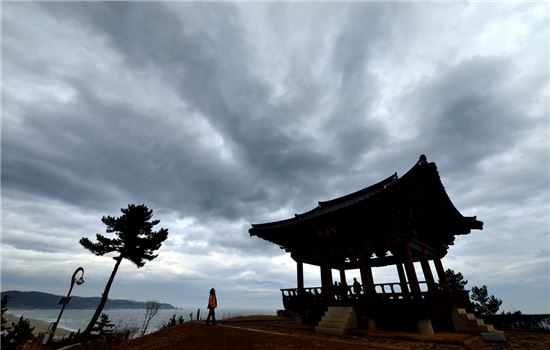 Mangyangjeong, which King Sukjong of the Joseon Dynasty called 'Gwandongjeilru.' It is the starting point of the Gwandong Palgyeong Trail connecting Mangyangjeong and Wolsongjeong.
However, such hardships are now a thing of the past. Thanks to the opening of the Donghae Line, trains running along the newly constructed railway are now bringing many tourists to Uljin quickly and safely every day. If the planned introduction of KTX is realized, Uljin is expected to finally shed its reputation as a place of exile for good.
With this rosy future in mind, let us take a look at the current situation in Uljin, a little over three months after the Donghae Line opened, and what travelers should know when planning a railway trip to Uljin.
▲ Current Status of Uljin Station
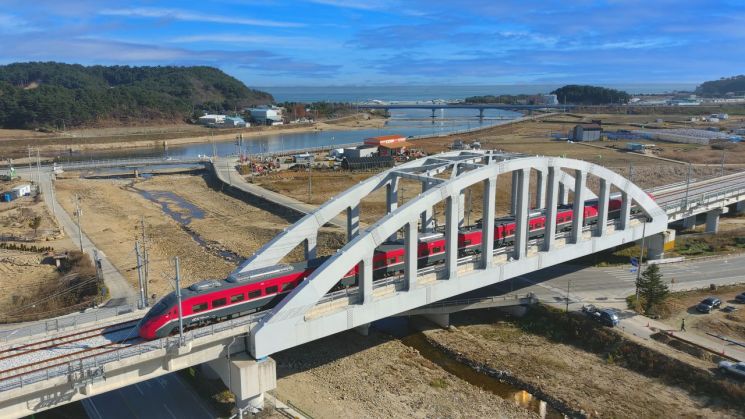
With the opening of the Donghae Line, Uljin now has a total of seven stations: Uljin Station, Heungbu Station, Jukbyeon Station, Maehwa Station, Giseong Station, Pyeonghae Station, and Hupo Station.
Except for Uljin Station, the other six stations are unmanned. There are three main routes in operation: toward Gangneung (via Samcheok and Donghae), toward Dongdaegu (via Yeongdeok, Pohang, Seogyeongju, and Yeongcheon), and toward Bujeon (Busan) (via Yeongdeok, Pohang, Gyeongju, and Bukulsan). Express trains such as ITX-Maum and Nuriro are currently serving passengers on these routes.
In terms of travel time, it now takes 1 hour 42 minutes to Gangneung, 53 minutes to Donghae, 36 minutes to Samcheok, 51 minutes to Yeongdeok, 1 hour 19 minutes to Pohang, 1 hour 50 minutes to Gyeongju, 1 hour 59 minutes to Yeongcheon, 2 hours 26 minutes to Dongdaegu, 3 hours 11 minutes to Bukulsan, and 3 hours 18 minutes to Bujeon. Compared to the previous use of express buses, traveling to Busan now saves more than two hours.
Since transfers are no longer necessary when traveling to and from the aforementioned regions, both time and convenience have improved significantly. As a result, passengers report that Uljin has become much more accessible.
▲ Status of Railway Tourists
With the emergence of the new theme of "train travel," which was previously unavailable in Uljin, local residents interested in travel and leisure have shown great enthusiasm for using the railway.
When planning a weekend train trip to Busan, it is now necessary to book at least a week in advance, and this level of demand has continued for over four months since the line opened.
Some passengers have commented that "unlike buses or cars, trains have less shaking, so there is less motion sickness and fatigue," while elderly passengers who are not suited to driving have expressed high satisfaction, saying that "it is now much easier to reach large city hospitals in Gangneung, Daegu, and Busan."
The introduction of the railway as a means of transportation is expected to have a major impact on tourism in Uljin. In January, the total number of railway passengers reached 33,248, which is more than double the previous monthly average for intercity bus passengers in Uljin. If bus and train passengers are combined, the number of tourists using public transportation has increased to about three times the previous year.
Given that the estimated total number of tourists visiting Uljin in 2024 is 8.01 million, it appears that Uljin County's key goal of reaching 10 million tourists is now within reach.
▲ Efforts to Enhance Railway Tourism Convenience
While the opening of the Donghae Line has greatly reduced travel time to Uljin, the lack of transportation options for getting around tourist sites once in Uljin could be seen as a drawback. To address this, Uljin County is providing several special support programs this year to enhance the convenience of tourists visiting Uljin.
First, there is the "Uljin Tourism Taxi, Running with Joy" program. Typically, local governments operate shuttle buses for tourist transportation, but these often force travelers into a standardized itinerary based on the bus schedule, limiting the ability to visit desired destinations in a preferred order. To cater to tourists seeking unique, personalized travel experiences, Uljin has chosen to support taxis instead of buses as the main means of transportation.
The Uljin Tourism Taxi program covers 60% of taxi fares for up to eight hours a day, with a minimum usage of four hours required. Since its launch on the 10th, the program has attracted a lot of attention. One important note is that advance reservations are mandatory at least three days prior to use.
Next is the "Full Free Rural Bus Service" program. While the county covers most of the cost for the tourism taxi, some expense still falls on the user, and there are also travelers who prefer the sentimental experience of mingling with locals on rural buses. To support these travelers, Uljin County fully subsidizes all fares for rural buses in the area, allowing anyone to ride without restriction, even without any cash on hand.
In addition, Uljin County is accelerating the development of railway-linked tourism products. One example is the "Sea-wonhan Uljin Marine Leisure Sports Tour" offered by the Uljin Marine Leisure Sports Center, which provides experiences such as yachting, freediving, and scuba diving in Uljin's pristine sea. Up to 80% of the experience fee is subsidized when combined with railway travel, making it an exceptionally attractive offer. This product can be found on the Korail train travel website or by contacting the Uljin Marine Leisure Sports Center.

▲ Uljin County's Vision
This is not the only vision that Uljin County is pursuing. Any project requires a review of economic feasibility before planning, but until now, many of Uljin's tourism revitalization projects have been hampered by poor transportation infrastructure.
With transportation now improved, Uljin County is happily re-examining existing projects and discovering new ones. With its natural environment and diverse tourist facilities, Uljin has gained "wings" in the form of the railway, and attention is now focused on whether Uljin can become the top tourist destination on the East Coast.
County Governor Son Byeongbok stated, "Uljin is now emerging as the center of East Coast tourism through the railway," and added, "We will focus all administrative efforts on revitalizing the local economy and attracting tourists so that we can realize our bold vision of reaching the era of 10 million tourists."
© The Asia Business Daily(www.asiae.co.kr). All rights reserved.


















