Survey of 4th to 6th Grade Elementary Students Nationwide by KTU
"30% of 6th Graders Return Home After 8 p.m."
A recent survey found that more than 6 out of 10 children can only play for two hours or less per day.
On May 1, the Korean Teachers and Education Workers Union (KTU) announced the results of a survey conducted from April 9 to 22, targeting 2,804 elementary school students in grades 4 to 6 nationwide ahead of Children's Day on May 5. In this survey, when asked "How much time do you usually have to play each day?", 62% of respondents answered "two hours or less," and 15.8% said "I don't even have one hour a day to play."
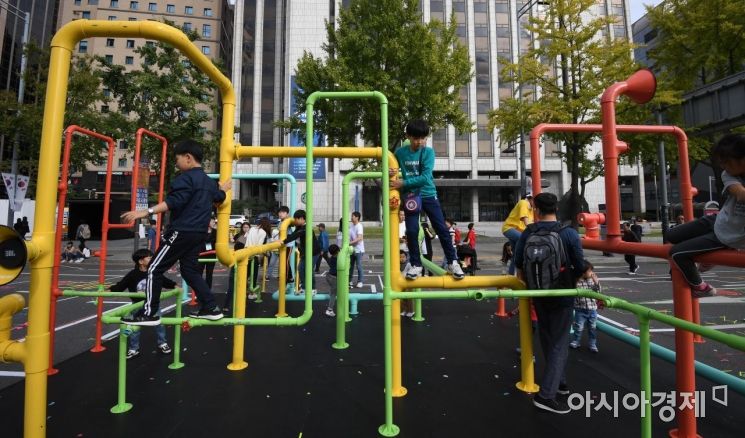 Children are enjoying their time at the 'Urban Playground' in Seoul. This is unrelated to the specific content of the article. Photo by Asia Economy DB
When asked which activities they would most like to do if they had free time (multiple answers allowed, up to two), 54.6% of children chose "playing with friends," and 33.5% selected "playing games with friends." This was followed by "watching videos such as YouTube" (29.2%), "exercising" (23.6%), and "spending time with family" (21.2%). Notably, 15.3% of children answered "sleeping."
Children not only lack time to play, but also tend to return home late. Among sixth graders, 30% said they could only return home after 8 p.m. once all their scheduled activities were finished, and 4% reported returning home after 10 p.m. In contrast, 70% of children considered 4 to 6 p.m. to be an appropriate time to return home.
Regarding "elementary medical school classes" and advanced studies for middle and high school curricula, 31.1% responded that "starting early is good," while 27.8% answered that "children should not be made to study such subjects at a young age," indicating a coexistence of positive and negative perceptions. Additionally, 16.6% said "there's no choice if parents want it," reflecting the reality that children often have to follow their guardians’ decisions rather than their own wishes.
The biggest concern among elementary school students revealed in this survey (multiple answers allowed) was "studies" (69%). Other major concerns included "relationships with friends" (33%), "appearance" (24%), and "bullying" (14%). The social issue that elementary students worried about the most (multiple answers allowed) was "war" (62.5%). This was followed by "low birth rate" (65.9%), "climate crisis" (53.2%), "jobs" (38.6%), and "discrimination against people with disabilities" (31.3%).
Regarding the results of this survey, Lee Sohee, chair of the KTU elementary committee, emphasized, "It is time for adults to change, so that we can create a society where children can feel the joy of growing up, rather than a poor society that only values academic background or appearance." She added, "We must stop pushing policies that increase the time children spend at school and drive them into endless competition."
© The Asia Business Daily(www.asiae.co.kr). All rights reserved.
![Clutching a Stolen Dior Bag, Saying "I Hate Being Poor but Real"... The Grotesque Con of a "Human Knockoff" [Slate]](https://cwcontent.asiae.co.kr/asiaresize/183/2026021902243444107_1771435474.jpg)















