Hanwha Systems Selected as Radar Developer for LAMD
Contract Valued at 131.5 Billion KRW
The radar system developer for the domestic Long-range Artillery Interception System (LAMD) has been selected. LAMD, often referred to as the "Korean Iron Dome," relies on its radar as its eyes.
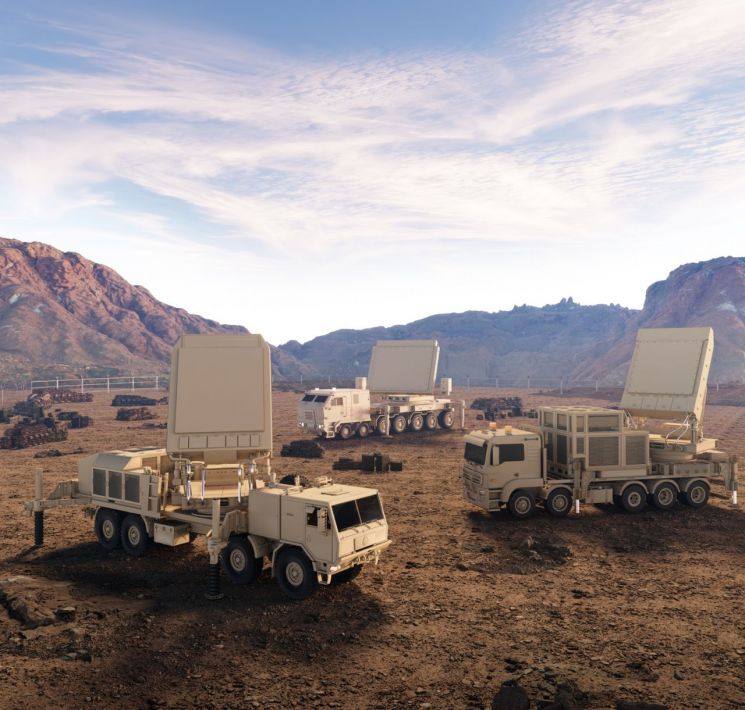
On April 30, Hanwha Systems announced that it had been selected as the prototype developer for the radar of the Long-range Artillery Interception System (LAMD), a project overseen by the Agency for Defense Development. The project is valued at 131.5 billion KRW, with the development period set until November 2028.
The Long-range Artillery Interception System, designed as a short-range, low-altitude air defense weapon, is capable of specifically defending against North Korean long-range artillery that can attack in swarms and simultaneously. Within the Korean Air and Missile Defense (KAMD) system, LAMD is expected to serve as the "last shield" against the threat posed by North Korean long-range artillery and missiles, which are heavily deployed near the Demilitarized Zone and aimed at the Seoul metropolitan area.
The Defense Acquisition Program Administration and the Agency for Defense Development stated that they plan to develop a Long-range Artillery Interception System with superior performance, capable of engaging more targets simultaneously than the Iron Dome, which was used by Israel in actual combat during the war with Hamas and gained global recognition. They added that the project is scheduled for completion by 2028 with a budget of approximately 479.8 billion KRW.
The radar, which serves as the "eyes" of the Long-range Artillery Interception System, must be capable of individually identifying and tracking hundreds of incoming long-range artillery shells clustered in a narrow airspace, and detecting and tracking them in real time. This requires one of the highest levels of radar technology in the world.
Following the export successes in the Middle East market with the export version of Cheongung-II (M-SAM-II, a medium-range surface-to-air missile system), and growing global interest in Korea's air defense systems including the Long-range Surface-to-Air Missile system (L-SAM), expectations are high that the Long-range Artillery Interception System will become another major K-defense export item once it is deployed.
Park Hyuk, Head of Hanwha Systems' DE Division, stated, "The original name of the Patriot missile actually stands for 'Phased Array Tracking Radar for Intercept on Target,' which shows that it is impossible to imagine an advanced air defense network without radar." He added, "Hanwha Systems will continue to develop cutting-edge radar technology to strengthen the defense capabilities of the Korean Peninsula, seek ways to expand into overseas markets, and broaden our lineup of multifunctional radars (MFR) for surface-to-air missile systems."
Hanwha Systems has developed multifunctional radars not only for surface-to-air missile systems, but also for the Korean next-generation destroyer (KDDX), the latest FFX Batch-III frigates, and the AESA (Active Electronically Scanned Array) radar, which serves as the "eyes" of the KF-21 Korean supersonic fighter jet, thus contributing to the land, sea, and air security assets of South Korea.
© The Asia Business Daily(www.asiae.co.kr). All rights reserved.
![Clutching a Stolen Dior Bag, Saying "I Hate Being Poor but Real"... The Grotesque Con of a "Human Knockoff" [Slate]](https://cwcontent.asiae.co.kr/asiaresize/183/2026021902243444107_1771435474.jpg)















