The Catholic University of Korea announced on April 30 that a research team led by Professors Keon Na and Minho Kang from the Department of Biomedical Chemical Engineering has developed a technology that effectively detects copper ion concentrations in vivo using sulfur-doped carbon dots.
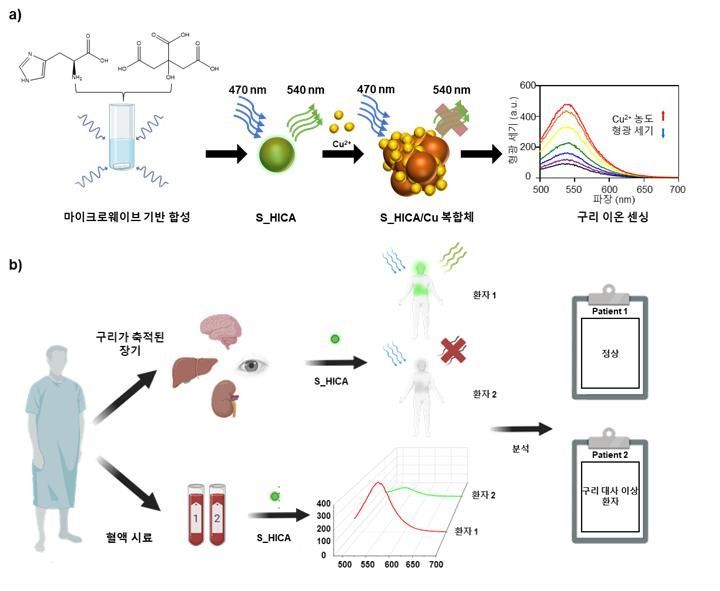
The research team developed a highly sensitive nanomaterial called "sulfur-doped carbon dots" (S_HICA). This technology enables rapid and precise measurement of copper ions without the need for complex preprocessing or expensive equipment.
Carbon dots are nanomaterials with excellent biocompatibility and fluorescence properties. The sulfur-doped carbon dots developed by the Catholic University research team are synthesized using a microwave method, making them easy to manufacture. They also allow for stable detection across a wide pH range (1-11) and temperature range (20-80°C).
Experimental results showed that copper ion concentrations could be measured in real time by monitoring changes in fluorescence intensity in various biological environments, including cells, blood, and animal models. The team also confirmed that the binding between copper ions and carbon dots reduces fluorescence intensity through a static quenching mechanism.
Professor Na stated, "We have overcome the limitations of conventional copper ion detection. This technology could be applied to various clinical and commercial diagnostic platforms," adding, "We expect its range of applications to expand to point-of-care diagnostics and medical devices."
In addition to Professors Na and Kang, Minyoung Jin, a doctoral student, and Hyundo Jung, a professor at Hanyang University, participated in this research. The results were published in the international journal 'Small' (IF=13.0), which covers the fields of micro and nanotechnology.
© The Asia Business Daily(www.asiae.co.kr). All rights reserved.
![Clutching a Stolen Dior Bag, Saying "I Hate Being Poor but Real"... The Grotesque Con of a "Human Knockoff" [Slate]](https://cwcontent.asiae.co.kr/asiaresize/183/2026021902243444107_1771435474.jpg)















