25% of Total Project Cost, 240.7 Billion KRW in Government Funding Secured
Construction in Two Phases by 2034
Transformation into a Smart Hospital: "Model for the Hospital of the Future"
Concerns Over Management Due to 700 Billion KRW in Self-Funding
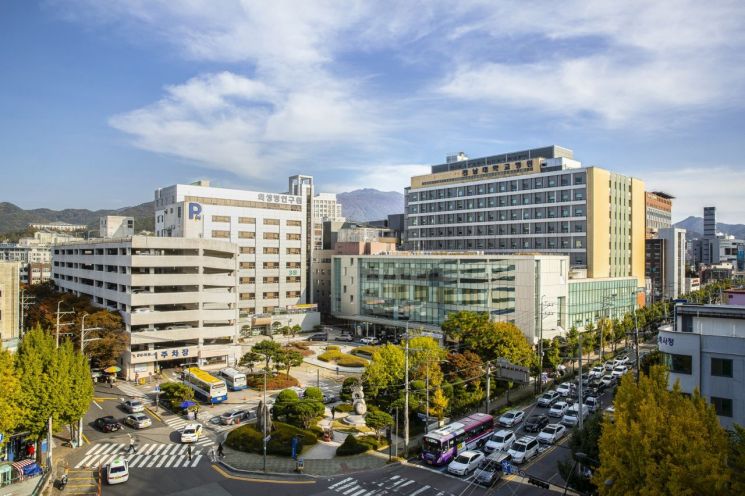
The long-awaited project of Jeonnam National University Hospital, the "Future-oriented New Smart Hospital Construction Project," has become the first among national university hospitals to pass the final preliminary feasibility study by the Ministry of Economy and Finance. With this, Jeonnam National University Hospital will be able to further strengthen essential regional medical infrastructure and establish an ICT-based smart hospital, presenting a model for the hospital of the future.
According to Jeonnam National University Hospital on the 30th, the Ministry of Economy and Finance recently held the 4th Fiscal Project Evaluation Committee meeting and, after reviewing the agenda for the new hospital construction project, approved it in the preliminary feasibility study. Of the total project cost of 962.9 billion KRW, Jeonnam National University Hospital has secured at least 240.7 billion KRW (25%) in government funding. The new hospital will be built in two phases on the current hospital site and the Jeonnam National University Medical School Hakdong Campus and Nursing College sites, with completion targeted by 2034.
◇ Success after 2 years and 4 months since application for preliminary feasibility study
The Future-oriented New Smart Hospital Construction Project began in January 2021 with the launch of the New Hospital Construction Promotion Group. In December 2022, it was selected as a candidate for the preliminary feasibility study by the Ministry of Economy and Finance. It passed the final review 2 years and 4 months after the start of the official evaluation. Although it was once excluded from the list of candidate projects, it ultimately secured budget support from the Ministry of Economy and Finance.
As a result, the new hospital will feature 1,070 beds, a total area of 220,000 square meters (67,400 pyeong), and a project cost of 962.9 billion KRW. Jeonnam National University Hospital plans to immediately begin gathering input from all staff to establish the basic plan for the new hospital, followed by the basic design and related procedures. In the first phase (East Wing), a new building with 900 beds will be constructed on the Jeonnam Medical School Hakdong Campus and Nursing College site by 2030. Most of the hospital’s core functions, including major clinical services, operating rooms, and the regional emergency center, will be relocated there.
The second phase (West Wing) will be completed by 2034, following the demolition of the existing Buildings 1, 2, 3, and 5, as well as Parking Lot 1. A new building will be constructed on this site, housing 170 beds, educational and research facilities, and an advanced medical commercialization support center.
◇ Presenting a model for future hospitals and strengthening essential medical capabilities
The new hospital will be transformed into an ICT-based smart hospital, creating a "model for the hospital of the future." The hospital plans to implement various medical IT technologies, such as a "remote intensive care unit system" that enables real-time monitoring of vital signs and emergencies for ICU patients both within the hospital and at partner institutions, and a "real-time location information system" that allows tracking of staff and patients throughout the facility.
To address the shortage of essential medical services, the hospital will significantly expand its emergency room and intensive care unit capacity. For infectious disease response, the hospital will establish an immediate response system in cooperation with the regional infectious disease specialized hospital and build a smart infection control system, including real-time location tracking. A new Early Cancer Diagnosis Center will be created to implement a Fast-Track system, and an early rehabilitation system will be operated to shorten patient treatment periods. Additionally, a rehabilitation-research linkage process will be established, enabling clinical care and research to take place in a single space.
◇ Expansion of research functions, including AI-Bio Convergence Medical Cluster and research-oriented hospital
The new hospital will further strengthen its research capabilities, establishing a comprehensive regional medical system as a core national university hospital and contributing to the activation of the hospital-centered advanced bioindustry. In particular, through the establishment of the "Gwangju-Jeonnam AI-Bio Convergence Medical Cluster," the hospital will serve as a demonstration center for the development and commercialization of innovative therapies that combine advanced regenerative medicine and AI.
Furthermore, as a research-oriented hospital recognized for its research capabilities, Jeonnam National University Hospital will actively foster interdisciplinary talent and conduct research to secure core technologies in the medical field, aiming to become a leading institution in future-oriented bio research and innovation.
◇ Focused development of five key areas: cardiovascular, stroke, respiratory, emergency trauma, and organ transplantation
The new hospital will also focus on establishing a differentiated future medical system. Of the nine major disease groups expected to account for about 59% of global deaths, the hospital has identified five key areas?cardiovascular, stroke, respiratory, emergency trauma, and organ transplantation?based on an assessment of regional healthcare needs, and will concentrate its resources on these fields.
Accordingly, the Stroke Center aims to achieve a 90% intervention rate within the golden hour by strengthening collaborative care systems and establishing a 24-hour thrombectomy support system to enhance the quality of care. The hospital also plans to significantly expand its respiratory rehabilitation clinic. As the only university hospital in the Honam and Chungcheong regions capable of performing four types of solid organ transplants, it will play a central role in organ transplantation. In addition, to provide rapid and specialized care, the hospital will activate the Acute Cardiovascular Center, and the Emergency Trauma Center will work to achieve a 100% final treatment delivery rate.
◇ More than 50% government funding is "desperately needed"
Although the new hospital construction project passed the preliminary feasibility study and secured 25% of the total project cost in government funding according to the current Ministry of Education standards for national university hospitals, the remaining 75%?amounting to 722.1 billion KRW?must be self-financed. This excessive burden of more than 700 billion KRW could force the hospital to shift to a profit-driven operation, ultimately leading to reduced access to regional healthcare and a weakening of public healthcare services. Additionally, it could undermine the stability of hospital management and result in delays or suspension of the construction project, potentially worsening medical service gaps.
According to the Ministry of Education's standards for government funding of national university hospitals, up to 25% of the total project cost is provided for new hospital construction, and up to 75% for educational and research facilities. However, even when applying the ratio of educational and research facility area in the new hospital, overall government support remains severely insufficient. As national university hospitals not only serve educational and research functions but also act as the last bastion of essential and public healthcare in the region, there is a growing call to significantly increase the proportion of government funding. Consequently, there is a pressing need to raise the government funding ratio for new hospital construction from the current 25% to at least 50%.
Jeong Sin, Director of Jeonnam National University Hospital, stated, "The government is well aware of the importance of regional and essential healthcare, so active government support and strong backing from local residents are urgently needed to maximize government funding. We will do our utmost to expedite the schedule and complete the new hospital as early as possible to minimize inconvenience for local residents."
© The Asia Business Daily(www.asiae.co.kr). All rights reserved.

















