Full Bench Verdict Set for 3 p.m. on May 1
Unprecedented Speed in Proceedings...
If Acquitted, Lee's Presidential Bid Gains Momentum
The Supreme Court's full bench verdict on the election law violation case involving Lee Jaemyung, the Democratic Party candidate, which is expected to have a significant impact on the presidential election scheduled for June 3, will be delivered at 3 p.m. on the 1st of next month. The Supreme Court's ruling, taking place just ten days before the candidate registration period (May 10?11), is poised to become a major variable in the political landscape, regardless of the outcome. The Supreme Court will reach its decision just nine days after the case was referred to the full bench, and 36 days after the appellate court acquitted Lee?a pace that is unprecedentedly swift.
On April 22, the day Chief Justice Cho Hee-dae referred the case to the full bench, the Supreme Court held its first conference of justices, followed by a second session on April 24. The fact that the verdict will be delivered just a week after the second session suggests that a decision was already reached during the April 24 deliberations, with subsequent time spent drafting the judgment. The justices' deliberations are conducted under strict confidentiality, without any official minutes or recorders. During the process, the most junior justice states their opinion first, followed by others in order, and the decision is reached by majority vote. For this case, 12 justices, including Chief Justice Cho Hee-dae, are participating. In the event of a 6-6 tie, which does not occur, the Chief Justice, who holds the casting vote, traditionally sides with the majority when opinions are closely divided.
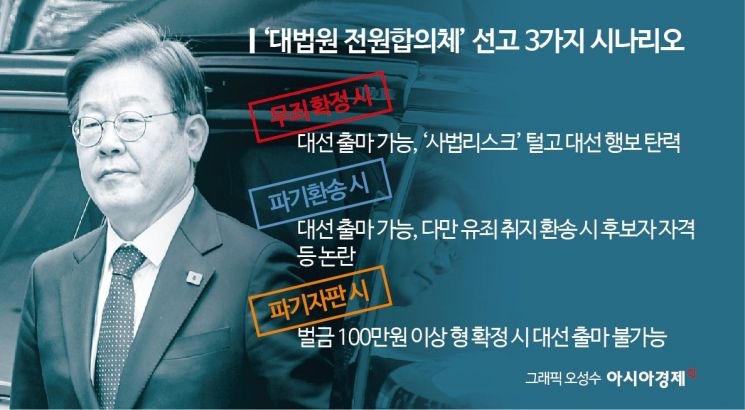
The full bench has three possible conclusions. First, it may dismiss the appeal, thereby upholding the appellate court's acquittal. In this scenario, Lee would face the presidential election with far fewer constraints. A lawyer who previously served as a Supreme Court research judge commented, "It appears the Supreme Court has moved unusually quickly to avoid being drawn into political issues, likely aiming to minimize confusion. This is similar to the recent situation in the United States, where the judiciary refrained from intervening in former President Trump's legal risks, emphasizing that the decision should be left to the people."
The second possibility is that the full bench overturns the acquittal and remands the case to the Seoul High Court for resentencing, with the appellate court tasked with determining the penalty. Since lower courts must follow the Supreme Court's rulings, the appellate court cannot acquit Lee against the full bench's decision. However, since the threshold for disqualification from office and loss of eligibility is a sentence of "a fine of 1 million won or more," the fate of "politician Lee Jaemyung" will depend on the sentence handed down by the Seoul High Court upon remand. In this scenario, the case could be appealed to the Supreme Court again, making it virtually impossible for a final decision to be reached before the presidential election. As a result, Lee would have to run for president under the burden of a "guilty" verdict, leaving the ultimate choice to the voters.
The final scenario is that the Supreme Court itself overturns the appellate acquittal, determines the sentence, and finalizes the verdict. Such a "direct sentencing" by the Supreme Court is extremely rare, so this outcome is considered unlikely. However, a lawyer who previously served as a presiding judge at the Seoul High Court noted, "Many legal professionals believe the appellate acquittal is clearly erroneous, so confirming the acquittal would entail significant risk for the justices. I believe the Supreme Court proceeded quickly to deliver a sentence of 1 million won or more through direct sentencing, thereby allowing the Democratic Party time to replace its candidate."
If the Supreme Court finalizes a sentence of a fine of 1 million won or more through direct sentencing, Lee would be ineligible to run for president, as he would lose his eligibility to stand for election. In this case, the Democratic Party would have no choice but to field a new candidate. Conversely, if the sentence is less than 1 million won, Lee would face no restrictions on his presidential candidacy.
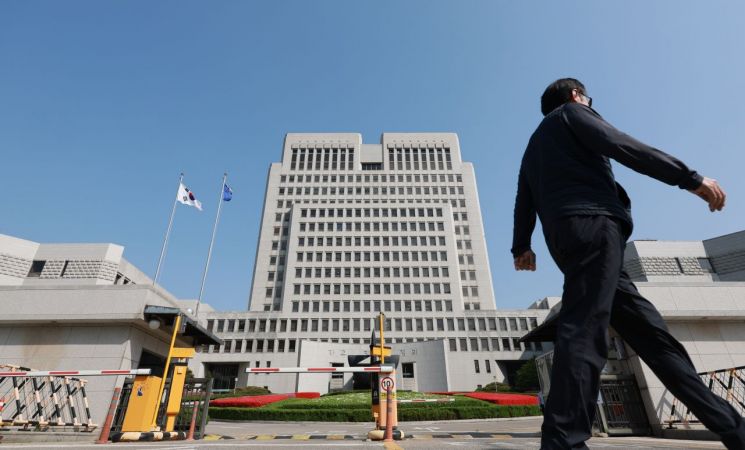
Meanwhile, the Supreme Court has decided to broadcast the verdict of this appeal live on television. The ruling, to be delivered in the Supreme Court's Grand Courtroom, will be accessible to anyone via television and the Supreme Court's YouTube channel. Lee will not attend the court session, as defendants are not required to be present for Supreme Court appeals. The Democratic Party has also stated that Lee will not be present. The lower courts reached sharply different conclusions: the first trial found Lee guilty and sentenced him to one year in prison, suspended for two years, while the appellate court meticulously distinguished Lee's statements as mere "recognition" or "expression of opinion," acquitting him of all charges.
© The Asia Business Daily(www.asiae.co.kr). All rights reserved.
![Clutching a Stolen Dior Bag, Saying "I Hate Being Poor but Real"... The Grotesque Con of a "Human Knockoff" [Slate]](https://cwcontent.asiae.co.kr/asiaresize/183/2026021902243444107_1771435474.jpg)
















