'Wolyeong-dong?Changwon City Hall?Jinhae District Office' Line
Rated as the Highest Priority
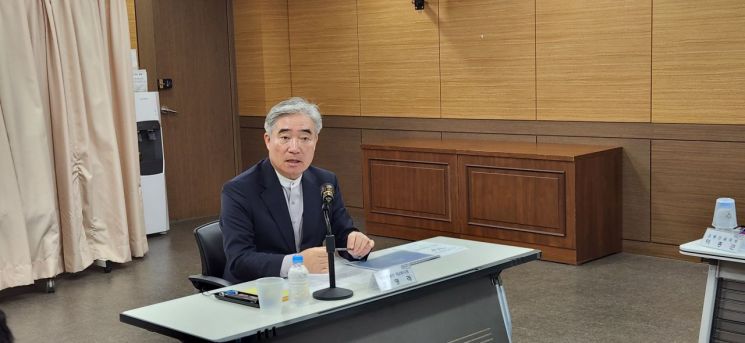
On April 30, Changwon Special City in South Gyeongsang Province held the final briefing meeting for the 'Pre-feasibility Study Service for Changwon Urban Rail Transit' in the meeting room on the second floor of the City Hall's Second Annex.
The meeting, presided over by Second Deputy Mayor Jomyungrae, was attended by urban transportation experts and related public officials. They shared the results of the feasibility study for the three lines of the Changwon Urban Rail Transit (tram) and discussed future directions for the project.
The Changwon Urban Rail Transit (tram) project includes three lines that were incorporated into the 'Gyeongsangnam-do Urban Rail Network Construction Plan' and received approval from the Ministry of Land, Infrastructure and Transport in May 2023. Since January 2024, the city has been conducting the 'Pre-feasibility Study Service for Changwon Urban Rail Transit,' closely examining the feasibility of each line.
According to the study, the 'Wolyeong-dong?Changwon City Hall?Jinhae District Office' line is expected to have the highest demand and can connect the Masan, Changwon, and Jinhae areas. In terms of overall factors such as economic viability, financial soundness, and balanced regional development, this line was evaluated as having the highest priority among the three lines.
However, as the tram project cost increased from 681.9 billion won to 1.0606 trillion won (a 1.5-fold increase), and operating costs rose by 1.7 times, the study concluded that it is necessary to establish more realistic implementation plans to ensure fiscal soundness.
Additionally, while sections where trams and BRT are mixed offer advantages in terms of transfer efficiency, the lack of legal regulations regarding such mixed operation remains an issue that requires legislative amendments.
Accordingly, experts suggested that the city should not limit itself to hydrogen trams, which are track-based systems, but also consider applying various operating systems, such as trackless rapid transit (TRT), which recently passed the mobility regulatory sandbox demonstration exemption.
Going forward, the city plans to establish a comprehensive direction for the project by resolving issues related to the parallel implementation of trams and BRT, improving relevant laws and systems, securing public acceptance of tram introduction, and developing measures to ensure project viability and fiscal soundness.
In addition, the city intends to promote the establishment of a rail network that organically connects both internal and external areas, including the stop at Jungni Station on the 'Bujeon?Masan double-track railway' and the construction of the new Sinhangman Station (Yongwon) on the 'Gadeokdo New Airport Access Railway.'
Second Deputy Mayor Jomyungrae stated, "Urban rail transit not only functions as a major transportation corridor within the city, but is also a key project that will innovate the transportation system and drive balanced regional development. Given the large budget involved, we will develop implementation plans that comprehensively consider the future transportation environment and fiscal conditions."
© The Asia Business Daily(www.asiae.co.kr). All rights reserved.
![Clutching a Stolen Dior Bag, Saying "I Hate Being Poor but Real"... The Grotesque Con of a "Human Knockoff" [Slate]](https://cwcontent.asiae.co.kr/asiaresize/183/2026021902243444107_1771435474.jpg)















