Korea Health Industry Development Institute Survey: Pharmaceutical Sales Reach 53 Trillion Won
R&D Expenditure Rises 18.5% Year-on-Year to 7.5 Trillion Won
In 2023, the total sales of domestic companies in the biohealth sector?including pharmaceuticals, cosmetics, and medical devices?amounted to 133.3685 trillion won, a decrease of 0.7% compared to the previous year.
According to the Biohealth Industry Survey conducted by the Korea Health Industry Development Institute and released on April 30, as of the end of 2023, the number of employees at domestic biohealth companies stood at 352,784, marking a 3.1% increase from the previous year (342,167).
The largest workforce was in the cosmetics sector, with 132,347 employees, up 1.7%. The number of employees in the medical device sector increased by 7.5% to 118,296, while the pharmaceutical sector saw a 0.2% rise to 102,141 employees.
Total sales in the biohealth industry in 2023 reached 133.3685 trillion won, a 0.7% decrease from the previous year's 134.2929 trillion won.
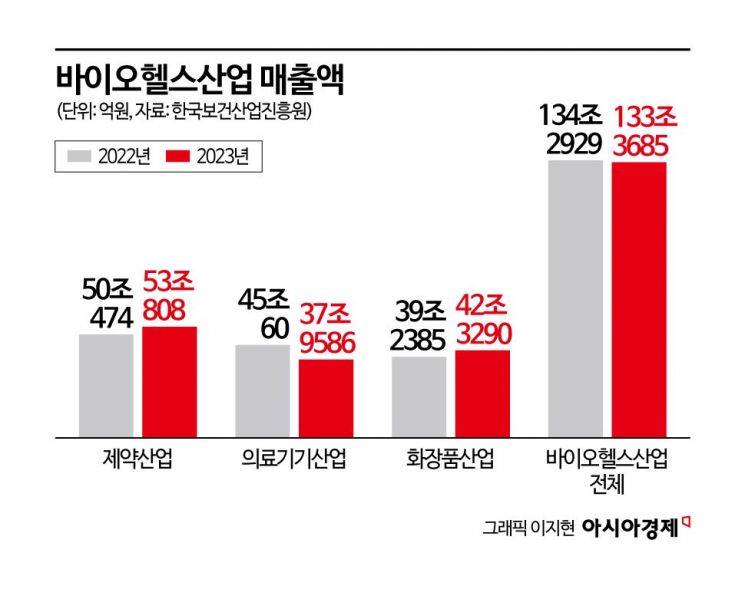
By sector, pharmaceutical sales were the highest at 53.0808 trillion won, a 6.1% increase from the previous year. Among specific pharmaceutical items, synthetic finished pharmaceuticals (drugs manufactured into specific formulations for administration to humans) accounted for the largest share at 60.6%. Sales of synthetic pharmaceuticals among active pharmaceutical ingredients surged by 81.4% year-on-year to 7.5574 trillion won, showing a marked increase. In contrast, sales of active biopharmaceutical ingredients dropped by 25.6% to 1.3808 trillion won.
Cosmetics sales increased by 7.9% from the previous year to 42.329 trillion won. Basic skincare products accounted for 60.7%, followed by personal cleansing products at 13.5% and color cosmetics at 10.7%.
Sales of medical devices amounted to 37.9586 trillion won, a 15.7% decrease from the previous year. While sales of instruments and machinery, which make up the largest share, increased by 9.6%, in vitro diagnostic medical devices declined by 68.8%, and medical software fell by 40.5%.
Research and development expenditures related to biohealth increased by 18.5% to 7.4729 trillion won. R&D expenses accounted for 5.6% of total sales, with the pharmaceutical sector leading at 4.1748 trillion won.
Among biohealth companies, 27.1% were exporting products overseas. Companies that entered into strategic alliances with local firms accounted for 2.8%, while those that established independent local business sites made up 1.8%.
Lee Byungkwan, head of the Biohealth Innovation Planning Division at the Korea Health Industry Development Institute, stated, "The biohealth industry is emerging as a key national strategic industry amid rapidly changing environments such as technological convergence, demographic shifts, and the reorganization of global supply chains." He added, "We will continue to expand the statistical infrastructure for the biohealth industry by systematically advancing classification systems and strengthening survey foundations to enhance the connectivity and reliability of industry-wide statistics."
© The Asia Business Daily(www.asiae.co.kr). All rights reserved.


















