Formation of Working Group and Specification of Consultation Schedule
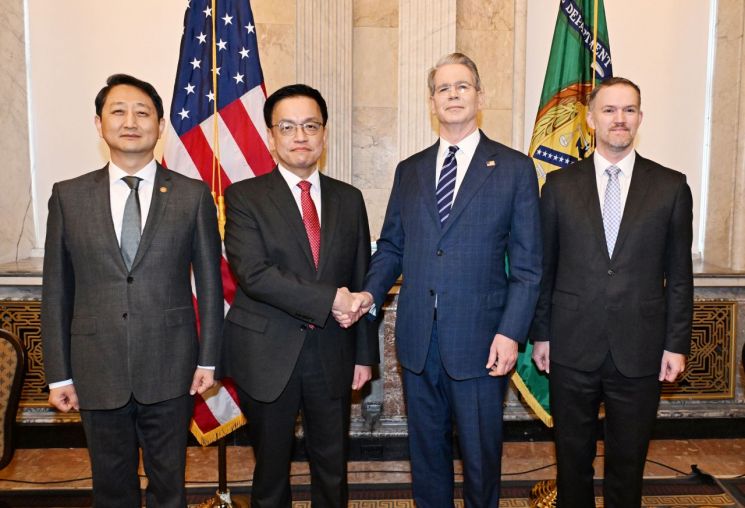
The South Korean government has begun technical discussions with the United States regarding tariffs.
The Ministry of Trade, Industry and Energy announced that from April 30 to May 1, it will visit Washington, D.C., to hold technical discussions with the United States Trade Representative (USTR) concerning U.S. tariff measures against South Korea.
This round of discussions is a follow-up measure based on the consensus reached at the Korea-U.S. "2+2 Trade Talks" and the ministerial meeting between the Ministry and the USTR held on April 24. At that time, both sides agreed to set a negotiation deadline of July 8 and to work towards producing a "July Package" within that period. The current technical discussions are intended to establish a practical framework to make this goal more concrete, drawing attention to whether this could serve as a turning point in tariff issues between the two countries.
The working-level discussions are being led by Jang Seonggil, Director General for Trade Policy at the Ministry of Trade, Industry and Energy. Jang stated, "Through these technical discussions, we plan to outline the basic framework for discussions on U.S. tariff measures," adding, "We will request exemptions for reciprocal tariffs and high tariffs on specific items that impose a substantial burden on Korean companies." In particular, the strategy is to proactively address not only Korea's key export items such as automobiles and steel, but also any new tariffs that may be imposed in the future.
The government has stated that, above all, it will prioritize the national interest as the guiding principle in responding to tariff measures. The Ministry has continuously conveyed Korea's concerns about industrial damage and its rationale for responding to changes in the trade environment to the U.S. side through ministerial-level discussions. These technical discussions are significant as they represent the first real test in shifting from diplomatic engagement to substantive negotiations.
Depending on the outcome of the bilateral discussions, the full-scale negotiations scheduled for early July are expected to further clarify the scope and criteria for tariff exemptions, as well as the timing of their application. The government plans to use these technical discussions as a basis to develop tailored response strategies for key export items, including automobiles and steel, with the aim of minimizing damage to Korean companies.
© The Asia Business Daily(www.asiae.co.kr). All rights reserved.
![Clutching a Stolen Dior Bag, Saying "I Hate Being Poor but Real"... The Grotesque Con of a "Human Knockoff" [Slate]](https://cwcontent.asiae.co.kr/asiaresize/183/2026021902243444107_1771435474.jpg)















