Semiconductor Production Surges 13.3%
Positive Growth for Two Consecutive Months
Last month, semiconductor production saw its largest increase in 19 months, leading to a slight rise in total industrial production. However, key indicators reflecting domestic demand continued to show sluggishness.
According to the 'March Industrial Activity Trends' released by Statistics Korea on the 30th, total industrial production in March increased by 0.9% compared to the previous month. After plummeting by 1.6% in January and turning negative, total industrial production has now recorded a modest positive trend for two consecutive months, with a 1.0% increase in February followed by March's rise.
Amid the Donald Trump administration's announcement of reciprocal tariffs and item-specific tariffs on semiconductors and pharmaceuticals, manufacturing production increased by 3.2%. Notably, production in semiconductors rose by 13.3% and in pharmaceuticals by 11.8% compared to the previous month. In particular, semiconductor production recorded its largest increase in 19 months since August 2023 (13.6%).
Lee Dowoon, Director of Economic Trend Statistics at Statistics Korea, explained, "Semiconductor production increased significantly in March, and there is a tendency to ship contracted volumes at the end of the quarter," adding, "We do not believe this is due to stockpiling in anticipation of tariffs." Semiconductor production was -1.1% in January and 1.4% in February. For pharmaceuticals, which saw their largest increase in 10 months since May last year (19.5%), the continued rise in contract manufacturing for the U.S. market was cited as a factor. Cho Sungjoong, Director of Economic Analysis at the Ministry of Economy and Finance, also noted, "The global market has improved, supported by robust demand for artificial intelligence (AI) servers."
With the Trump administration imposing a 25% tariff on steel products starting in March, primary metal production also increased by 3.1% from the previous month. For automobiles, which were set to face a 25% tariff starting in April, production increased by 1.8% in March, compared to 0.2% in January and 0.7% in February.
Indicators reflecting domestic demand all continued to show sluggishness. Domestic shipments declined by 0.4% in March, following -3.2% in January and 2.0% in February. Service industry production also followed a similar trend, with -0.9% in January, 0.9% in February, and -0.3% in March.
Retail production also turned negative, decreasing by 3.5% in March. Sectors such as finance and insurance (-2.1%) and information and communications (-2.1%) also saw declines in production. Director Lee explained, "In February, retail production increased by 6.2% due to the launch of new mobile phones (Galaxy S25) and the implementation of electric vehicle subsidies," adding, "This month, the base effect seems to have played a role." The Ministry of Economy and Finance also cited the base effect from February's sharp increase, as well as delayed recovery in economic sentiment due to external uncertainties.
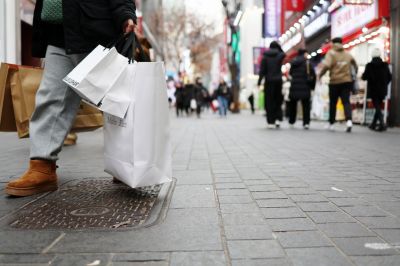
Consumption indicators continued to show a sluggish trend. Retail sales, which reflect consumption trends, decreased by 0.3% compared to the previous month. After rebounding by 1.9% in February, retail sales turned negative again within a month. Sales increased for non-durable goods such as food and beverages (2.8%) and semi-durable goods such as clothing (2.7%), but decreased for durable goods such as communication devices and computers (-8.6%). By retail type, sales decreased compared to a year earlier at department stores (-4.2%) and duty-free shops (-10.3%).
However, compared to the same month last year, the retail sales index increased by 1.5%, marking the largest increase in 21 months since June 2023 (1.5%). On a quarterly basis, the first quarter ended a streak of 11 consecutive quarters of decline and turned flat. Director Lee commented, "Based on retail sales, the previous downward trend appears to have stabilized," adding, "It remains to be seen whether this is a fundamental improvement or a temporary change." Director Cho also explained, "Looking at March alone, retail sales turned positive, so domestic demand does not appear to be in a very poor state."
Construction output also declined by 2.7% from the previous month (2.4%), as both building construction (-1.5%) and civil engineering (-6.0%) decreased. This was due to ongoing adjustments following past overinvestment, as well as temporary factors such as a bridge collapse.
Director Cho explained, "Around 2020 to 2021, real estate prices rose significantly, leading to a surge in project financing (PF), but since 2022, rising construction costs and interest rates have worsened project profitability," adding, "This trend is appearing with a time lag, and in February, a bridge collapse caused a significant number of construction sites to halt." Construction orders (current prices) increased in building construction such as housing (33.8%) but decreased in civil engineering such as machinery installation (-70.5%), resulting in an overall 8.7% decrease compared to the same month last year.
Facility investment also decreased by 0.9% compared to the previous month, as investment increased in transportation equipment such as automobiles (3.4%) but decreased in machinery such as agricultural, construction, and metal machinery (-2.6%). The coincident index of cyclical indicators, which reflects the current economic situation, rose by 0.3 points from the previous month to 98.8. After declining for seven consecutive months, the coincident index rebounded by 0.1 points last month. The leading index of cyclical indicators, which forecasts future economic trends, rose by 0.2 points from the previous month to 100.6.
© The Asia Business Daily(www.asiae.co.kr). All rights reserved.

















