"Unlike Previous U.S. Administrations...
Unpredictable Developments"
CNBC reported on April 29 (local time) that Europe has been deeply shaken by escalating turmoil in trade and geopolitics during the first 100 days since Donald Trump became President of the United States. The Trump administration has imposed high tariffs on the European Union (EU), a traditional ally, and has taken unpredictable actions in the Russia-Ukraine war, which has increased both political and economic uncertainty.
Kaja Kallas, the EU's High Representative for Foreign Affairs and Security Policy, said on CNBC's "Europe Early Edition" that the first 100 days of President Trump's term have been "unlike anything we've seen from a U.S. administration before," adding, "It has been a very intense and disruptive period, and there have been many unpredictable developments."
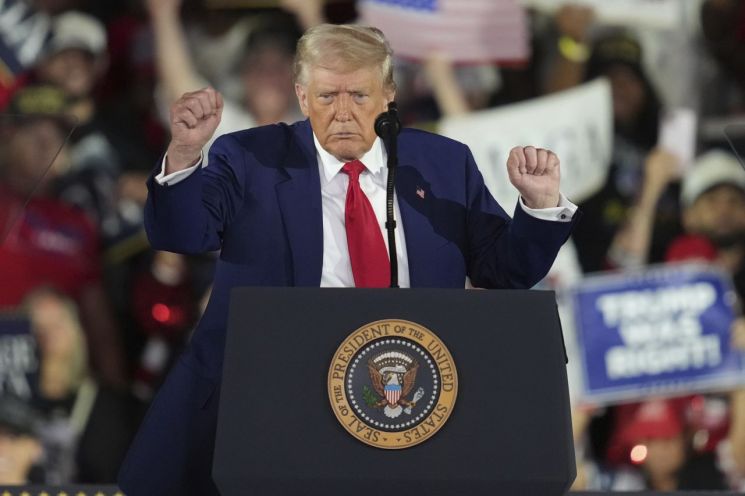
CNBC pointed out that the policies introduced by the Trump administration have heightened uncertainty for Europe in two main areas: trade and the Russia-Ukraine war.
After taking office, President Trump imposed a 20% tariff on EU exports to the United States. However, out of concern for the fallout from a tariff war, he announced earlier this month that a basic tariff of 10% would be applied to imports from all countries. If negotiations with the United States do not progress by the end of a 90-day grace period, a reciprocal tariff of 20% will be imposed on EU goods.
Since tariff negotiations with the United States are still ongoing, uncertainty over tariffs remains, depending on the outcome of the talks. The European Commission estimated that reciprocal tariffs could affect EU exports worth 290 billion euros (approximately 470 trillion won). It has been reported that the EU is still deliberating on how to respond to reciprocal tariffs on automobiles.
The longer and deeper the tariff war becomes, the more inevitable the damage to the EU economy. At the International Monetary Fund (IMF) and World Bank (WB) Spring Meetings held from April 21 to 26, European Central Bank (ECB) officials predicted that trade conflicts would stall European economic growth and assessed that the impact of trade conflicts on inflation remains uncertain.
Robert Holzmann, Governor of the Austrian Central Bank, said, "This level of uncertainty is something we haven't seen in years," adding, "As long as the uncertainty persists, we have no choice but to postpone several decisions until the right course of action becomes clear, and we still do not know which direction monetary policy should take."
Klaas Knot, Governor of the Dutch Central Bank, compared the current situation to the early days of the COVID-19 pandemic, stating, "In the short term, it is very clear that the unpredictability stemming from U.S. government tariff measures is a strong negative factor for growth."
As the United States bypasses Europe in negotiations to end the Russia-Ukraine war, the security alliance between the U.S. and Western Europe is also weakening. Since taking office, President Trump has promised to end the Russia-Ukraine war and has pursued separate negotiations with Russia, launching ceasefire talks without involving Europe, which is directly affected by the conflict. In response, the EU convened an informal security meeting and began seeking its own countermeasures.
The United States has also declared that it will step back from its role as the world's policeman, pressuring the EU to increase its defense spending. As the U.S. retreats from European security, the EU announced last month that it would complete its "rearmament" by mobilizing 800 billion euros.
© The Asia Business Daily(www.asiae.co.kr). All rights reserved.

















