At the AACR 2025, the world's largest cancer research event
Korean pharmaceutical and biotech companies
Showcase next-generation anticancer technologies
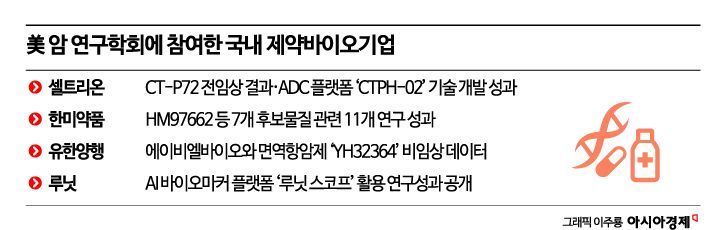
At the American Association for Cancer Research (AACR 2025), the world's largest cancer research event, which concluded on the 30th (local time), Korean pharmaceutical and biotech companies showcased a wide range of next-generation anticancer drug research achievements. Companies such as Celltrion, Hanmi Pharmaceutical, ABL Bio, and Lunit drew global attention with their multi-target antibodies, antibody-drug conjugates (ADCs), and artificial intelligence (AI)-based technologies.
In the ADC sector, often referred to as the "guided missile" of cancer therapy, a number of next-generation ADCs were introduced that utilize various payloads (drugs) and linker technologies to enhance efficacy while reducing toxicity. Celltrion presented a new drug candidate developed through its proprietary ADC platform. The multi-antibody-based immuno-oncology drug candidate "CT-P72," for which preclinical results were announced at this conference, is a T-cell engager (TCE) therapy co-developed by Celltrion and the US biotech company Abpro. It is designed to target both the HER2 (human epidermal growth factor receptor 2) antigen on the surface of cancer cells and the CD3 protein on the surface of immune T cells simultaneously, thereby connecting the two cells so that T cells can directly attack cancer cells. In preclinical in vitro and animal studies, CT-P72 consistently maintained anticancer efficacy, and in primate toxicity tests, it demonstrated safety that was 180 times superior to comparative substances.
Hanmi Pharmaceutical unveiled the largest number of preclinical research results among domestic companies at this year's AACR, presenting 11 studies and demonstrating its broad anticancer pipeline. Hanmi Pharmaceutical introduced several innovative new drug candidates again this year, including a "selective HER2 inhibitor" being developed as an oral therapy for HER2-mutant cancers, following its achievements last year. The industry is also speculating about the possibility of licensing out (technology export) these candidates.
Yuhan Corporation announced phase 1 clinical trial results for the immuno-oncology drug candidate YH32367, developed through joint research with ABL Bio. This drug candidate is a bispecific antibody that enhances tumor-specific immune activation and simultaneously inhibits tumor cell growth by increasing the anticancer activity of immune cells. In the phase 1 clinical trial, it showed excellent safety, with no dose-limiting toxicities observed at any dose level. The discovery of anticancer biomarkers using AI technology has also accelerated. Lunit, in collaboration with AstraZeneca, presented an AI-based model for predicting EGFR (epidermal growth factor receptor) mutations, demonstrating high accuracy and clinical applicability.
An industry official stated, "With a series of recent success stories, global big pharma companies are paying even greater attention to new technology platforms such as ADCs and multi-antibodies. Through this conference, some companies are expected to advance discussions on joint research or licensing agreements."
© The Asia Business Daily(www.asiae.co.kr). All rights reserved.
![Clutching a Stolen Dior Bag, Saying "I Hate Being Poor but Real"... The Grotesque Con of a "Human Knockoff" [Slate]](https://cwcontent.asiae.co.kr/asiaresize/183/2026021902243444107_1771435474.jpg)
















