Project Cost Soars to 1 Trillion Won, Construction Yet to Begin
KSmart Aquaculture Holds Only 8.66 Million Won in Current Assets
Financial Support Unavoidable... Dongwon Industries Faces Growing Financial Burden
The salmon farming business, which Dongwon Group Chairman Kim Namjung has identified as a future growth engine and is personally spearheading, has been unable to gain momentum. KSmart Aquaculture, established by Dongwon Industries in 2020, had planned to develop an eco-friendly Atlantic salmon farming complex in Yangyang-gun, Gangwon Province. However, the project has stalled without even breaking ground due to a sharp increase in project costs and delays in government funding.
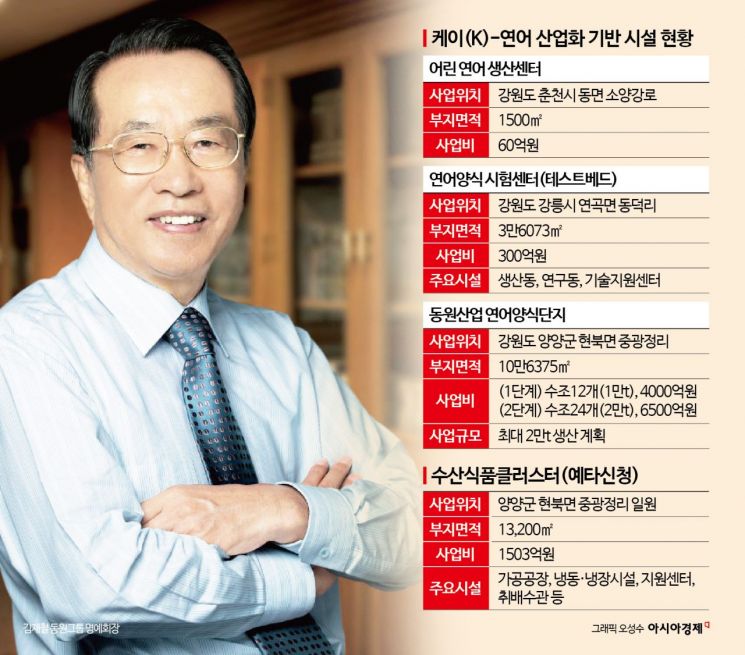
According to Gangwon Special Self-Governing Province and the Ministry of Oceans and Fisheries on April 30, Gangwon Province is building a salmon industrialization belt centered around Chuncheon, Gangneung, and Yangyang. The goal is to create a cluster that integrates all processes, from the production of juvenile salmon to processing, distribution, and bio-manufacturing.
In Chuncheon, a center is being built with an investment of 6 billion won to produce 2 million juvenile salmon. In Gangneung, 30 billion won is being invested in a salmon aquaculture test center (testbed) for breed research and pilot production, which is scheduled to begin operations in the second half of the year. In Yangyang, private capital is being invested to establish the nation’s first and largest land-based salmon farming complex.
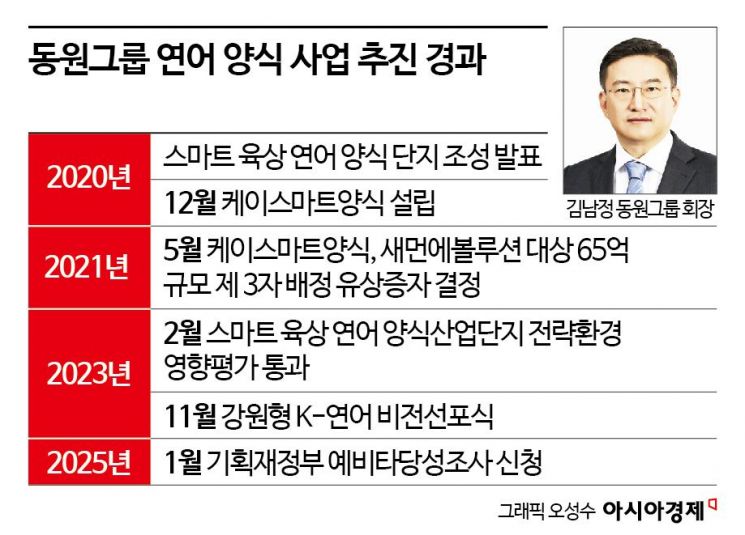
Dongwon Industries established KSmart Aquaculture for this purpose and agreed to cooperate with Salmon Evolution, a global salmon farming company from Norway. The plan was to start construction in August 2023, complete the work by the end of last year, and begin shipping up to 20,000 tons of Atlantic salmon annually starting this year.
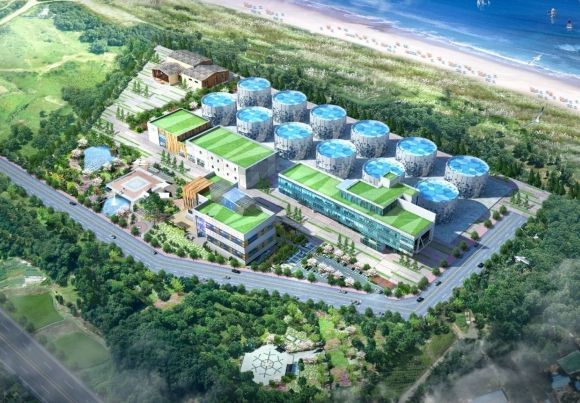 Perspective view of the land-based salmon farming complex being developed by Dongwon Group in Junggwangjeong-ri, Hyeonbuk-myeon, Yangyang-gun.
 [Photo by Yangyang-gun]
Project cost surges more than threefold to 1 trillion won
However, the project faced setbacks as project costs soared due to worsening international conditions and rising raw material prices. The initial project cost, estimated at 200 billion to 300 billion won, more than tripled due to additional facility reinforcement required by differences in seawater temperature.
Gangwon Province requested 105.2 billion won in government funding as part of the fisheries food cluster initiative and is currently awaiting the results of the first preliminary feasibility study by the Ministry of Economy and Finance. A government official stated, "Because this is a new project with significant risks, we have been in discussions with Dongwon Industries about government funding options for over a year," adding, "The results of the feasibility study in the second half of the year will be crucial."
Dongwon Industries is also closely monitoring whether the project passes the feasibility study. If it fails, the entire project will have to be reconsidered from scratch. Pushing forward without government funding would inevitably result in large-scale deficits from the outset. A Gangwon Province official said, "The total project cost is about 1 trillion won, with Dongwon Industries planning to invest about 780 billion won."
KSmart Aquaculture faces liquidity crisis... "Questions about ability to continue as a going concern"
The reality is grim. The surge in project costs and uncertain environment are also weighing on Dongwon Industries. According to the audit report, KSmart Aquaculture, which is 51% owned by Dongwon Industries and 49% by Salmon Evolution Asia, recorded a net loss of 1.325 billion won last year without any revenue. Despite two consecutive years of zero revenue, fixed costs such as labor expenses, depreciation, and service fees have amounted to 1.3 to 1.4 billion won annually.
As of the end of last year, KSmart Aquaculture's current assets were only 8.66 million won, while current liabilities reached 18.48918 billion won. This means current liabilities exceeded current assets by 18.481 billion won, indicating structural insolvency. Cash and cash equivalents stood at around 7.9 million won, meaning operating funds have effectively run out.
The burden of borrowings is also significant. KSmart Aquaculture has raised 16.72 billion won from Shinhan Bank and Korea Development Bank, all of which mature within one year. When including vehicle lease liabilities, the financial burden increases further. The interest on borrowings is also substantial, with fixed rates ranging from 4.3% to 5.6%.
In its audit report, Samil PwC stated, "There are significant uncertainties that raise substantial doubt about KSmart Aquaculture's ability to continue as a going concern." However, because parent company Dongwon Industries has agreed to provide operating and investment funds for the next 12 months, the auditor was able to issue an unqualified opinion.
The problem lies beyond that period. If additional support is not provided after 12 months, KSmart Aquaculture may find it difficult to continue operating. As a result, the company's survival now depends on securing government funding and additional capital injections from Dongwon Industries.
Will Honorary Chairman Kim Jaecheol's long-cherished project be derailed?
Land-based salmon farming is the long-cherished project of Dongwon Group Honorary Chairman Kim Jaecheol. His vision was to prepare for the future of the fisheries industry by expanding from "catching" to "farming." Chairman Kim Namjung is personally leading the project. Dongwon Group has focused on salmon farming because of its growth potential. The global salmon market is worth 60 trillion won (about 4.8 million tons), with more than 80% consisting of farmed salmon. The Asian market, including Korea, China, and Japan, is growing by more than 10% annually, so there is still significant potential for market expansion.
Dongwon Industries identified Gangwon Province, with its stable water temperatures influenced by the North Korean cold current, as the optimal location for salmon farming and began pioneering the domestic salmon market. However, if the company cannot overcome the obstacles of soaring project costs and financial uncertainty, the long-cherished project that has been years in the making may be derailed. A Dongwon Group official said, "Land-based salmon farming is a public-private partnership project aimed at national food security," adding, "It has been selected for the preliminary feasibility study and is proceeding according to procedure."
However, Dongwon Group has too many ongoing projects to "go all in" on the salmon farming business solely based on its symbolic significance and growth potential. Dongwon Industries and Dongwon F&B have a combined liquidity (including cash and short-term financial assets) of about 570 billion won. If additional investment is needed for the land-based salmon farming business, the overall financial burden on the group could increase. Depending on whether government funding is approved, not only the continuation of KSmart Aquaculture’s business but also Dongwon Group’s overall global food strategy may need to be adjusted.
Dongwon Group has set a goal to increase the proportion of overseas sales in its food business from the current 22% to 40% by 2030. To achieve this, it has launched a "Global Food Division" by integrating Dongwon F&B, Dongwon Home Food, US-based StarKist, and Senegal-based S.C.A.S.A., and is actively targeting the North American, Latin American, and European markets. For global expansion, Dongwon Group is also pursuing large-scale food company mergers and acquisitions (M&A). To pursue the salmon business and M&A simultaneously, the group will need to raise significant funds through large-scale borrowing or paid-in capital increases.
© The Asia Business Daily(www.asiae.co.kr). All rights reserved.
![Clutching a Stolen Dior Bag, Saying "I Hate Being Poor but Real"... The Grotesque Con of a "Human Knockoff" [Slate]](https://cwcontent.asiae.co.kr/asiaresize/183/2026021902243444107_1771435474.jpg)


















