Re-evaluation of AOC When Fleet Size Exceeds Certain Thresholds
Higher Safety Scores in Route Allocation
Improving Airport Infrastructure Safety
Enhancing Airline Maintenance Capabilities
Independent Aviation Safety Agency Excluded Despite Expert Calls
Additional Measures to Be Developed Based on Accident Investigation Results
Going forward, airlines will be required to undergo a fresh Air Operator Certificate (AOC) review from scratch each time the number of aircraft in their fleet surpasses certain thresholds. The AOC is a government-issued certificate that verifies whether an airline meets the safety requirements for operation; if an airline’s certificate is suspended or revoked, it cannot operate flights. Airlines that increase their investment in safety, such as maintenance personnel, will have a greater advantage in route allocation.
The Ministry of Land, Infrastructure and Transport announced this aviation safety innovation plan on April 30, 2025. Following the passenger plane disaster last December, the government has been reviewing safety improvement measures with the Aviation Safety Innovation Committee, comprised of civilian experts. The plan includes measures to upgrade airport infrastructure for safety and to encourage airlines to invest in maintenance and safety. It also contains steps to strengthen the government’s oversight and air traffic control functions.
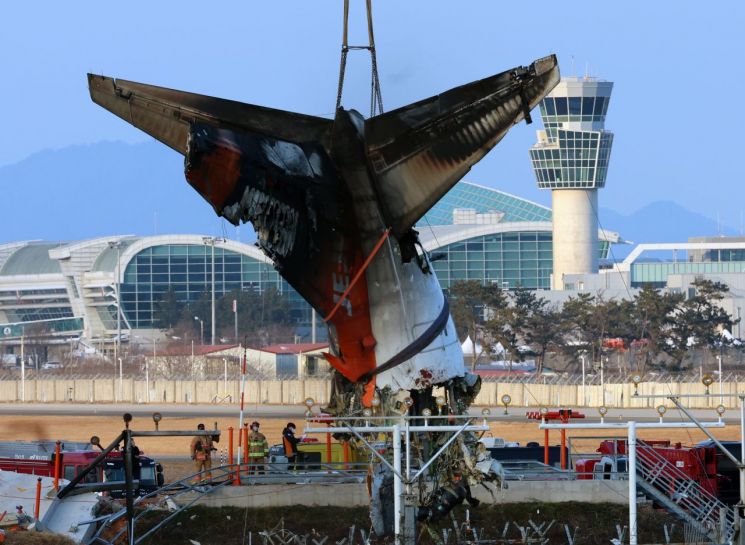 After the Jeju Air passenger plane disaster, in January, the tail wing section of the fuselage was being salvaged at the accident site. Photo by Yonhap News
Re-evaluation of AOC When Fleet Size Exceeds Certain Thresholds
Higher Safety Scores in Route Allocation
Currently, an AOC is re-evaluated only if an airline suspends operations for more than 60 days. For example, during the COVID-19 pandemic, Eastar Jet halted operations and underwent re-examination, but generally, once certified, airlines retain their AOC. The new policy will require re-evaluation as airlines grow in size.
For instance, if the number of aircraft exceeds 20, 40, or 80, the government will conduct a rigorous review as it did during the initial certification. Airlines will need to expand related personnel, equipment, and facilities. The government will also enhance its safety oversight by increasing the number of aviation safety inspectors.
An official from the Ministry of Land, Infrastructure and Transport explained, "At the time of the recent passenger plane disaster, Jeju Air had a fleet of about 40 aircraft, and Asiana Airlines had about 80 aircraft during the San Francisco accident. This means that once an airline reaches a certain size, we will thoroughly review all safety areas, such as maintenance, to the same level as the initial certification."
Airlines involved in accidents resulting in fatalities will be excluded from route allocation for one year. Accidents caused by external factors such as terrorism or natural disasters are excluded. After one year, if the airline passes a safety system evaluation, it will be eligible for route allocation again; if not, it must wait an additional six months.
The safety and security evaluation score for route allocation will be raised from 35 to 40 points. Route rights are awarded to the applicant airline with the highest total score across various categories, and the score gap between the highest and lowest is typically only 3 or 4 points, so 5 points is significant. For quantitative evaluation, the number and growth rate of maintenance personnel per aircraft will be included; for qualitative evaluation, new indicators such as safety training efforts will be added. Airlines will receive extra points for efforts such as securing spare aircraft and hangars, introducing new aircraft, and hiring pilots and maintenance engineers.
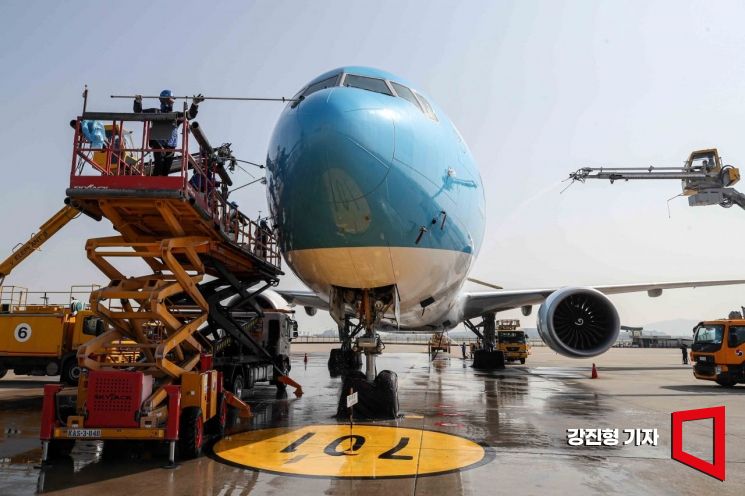 On the 24th, Korean Air officials were cleaning the aircraft fuselage with the new CI applied at the Korean Air aircraft maintenance hangar in Jung-gu, Incheon. 2025.4.24. Photo by Kang Jinhyung
Improving Airport Infrastructure Safety
Enhancing Airline Maintenance Capabilities
Airport infrastructure will also be improved to prioritize safety, such as redesigning approach lighting systems to be ground-based or breakable. All airports nationwide will be required to secure a runway end safety area of at least 240 meters; if this is not possible, an Engineered Materials Arrestor System (EMAS) will be installed. Runway operational performance will be enhanced as needed, and anti-drone systems will be introduced to counter security threats.
Starting with a pilot operation of bird detection radar at Muan Airport in the second half of this year, the system will be sequentially introduced at Incheon, Gimpo, and Jeju airports (all by 2026). Initially, drones will be used to deter birds, and in the mid- to long-term, drones equipped with artificial intelligence (AI) for bird analysis and detection will be developed. Dedicated personnel and equipment to prevent bird strikes will also be increased. Airport operation certificates will now require re-inspection every five years, with the Ministry of Land, Infrastructure and Transport periodically evaluating whether airports have established safe operational systems. An airport safety evaluation system will be introduced in the second half of this year and implemented from next year.
Measures to enhance airline maintenance capabilities are also included in the plan. For the B737 model, known for frequent malfunctions, pre- and post-flight inspection times will be increased from 73 minutes to 80 minutes, and intermediate inspections from 28 to 30 minutes. For the A320F model, intermediate inspection times will be extended from 18 to 25 minutes. Inspection standards for other models will also be increased by June.
To expand maintenance personnel, the minimum experience requirement for calculating the minimum number of maintenance staff will be raised from the current two years to three years. Airlines operating scheduled flights at overseas airports five times a week or more will be required to establish local maintenance systems. In addition, to encourage investment by small and medium-sized domestic maintenance companies, the scope of eligibility for land lease fee reductions in the Incheon Advanced Aviation Complex will be expanded.
Furthermore, a comprehensive MRO (maintenance, repair, and overhaul) plan, including shared maintenance facilities for low-cost carriers, will be announced in the second half of this year. Currently, airlines only disclose the total amount invested in safety, but under the new plan, this will be standardized according to airline size and flight distance. The government will also raise the minimum capital requirement, which is used to assess safety investment capability when issuing new licenses. The current standard is 15 billion won for international passenger airlines and 5 billion won for domestic passenger or cargo airlines, but as these were set in the past, the government sees a need to update them.
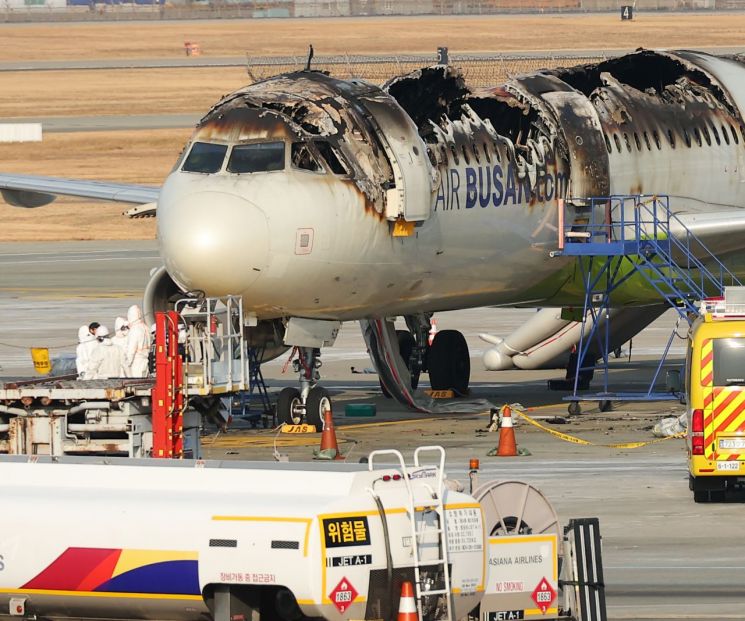 A joint investigation team is conducting a safety inspection ahead of a joint fire examination on the Air Busan aircraft that caught fire last January. Photo by Yonhap News
Independent Aviation Safety Agency Excluded Despite Expert Calls
Additional Measures to Be Developed Based on Accident Investigation Results
The establishment of a separate aviation safety agency, which has been consistently requested by the Aviation Safety Innovation Committee and other experts, was not included in this plan. Although organizations with similar functions exist within the International Civil Aviation Organization (ICAO) and in major countries abroad, the need for a separate agency such as an Aviation Safety Administration (provisional name) has been repeatedly emphasized by the committee. There have also been many calls to enhance the independence of the Aviation and Railway Accident Investigation Board, which currently operates as a separate consultative body, but this was not reflected in the plan.
A member of the Aviation Safety Innovation Committee stated, "Although aviation safety deals with extremely risky and important matters, the organization and personnel are not properly aligned. In the past, measures were established, but due to unresolved budget and staffing issues, they were eventually forgotten and not properly implemented over time."
The Ministry of Land, Infrastructure and Transport announced that it will promptly recruit more air traffic controllers and aviation safety inspectors, and in the mid- to long-term, reorganize the roles of the government and its affiliated agencies to enhance aviation safety capabilities. Minister Park Sangwoo stated, "We will institutionalize the various improvement tasks included in the plan as soon as possible to enhance aviation safety. We will closely monitor safety oversight and, once the results of the accident investigation are available, develop additional supplementary measures accordingly."
© The Asia Business Daily(www.asiae.co.kr). All rights reserved.
![Clutching a Stolen Dior Bag, Saying "I Hate Being Poor but Real"... The Grotesque Con of a "Human Knockoff" [Slate]](https://cwcontent.asiae.co.kr/asiaresize/183/2026021902243444107_1771435474.jpg)


















