538 More Students Than in 2026
Early Admissions Expanded to 80.3%, Regular Admissions Reduced to 19.7%
Higher Proportion of Regular Admissions in the Seoul Metropolitan Area, Early Admissions Dominate Outside the Metropolitan Area
The total number of students to be admitted through the 2027 university entrance process, which current second-year high school students will take, has been set at 345,717. This is an increase of 538 compared to the 2026 academic year.
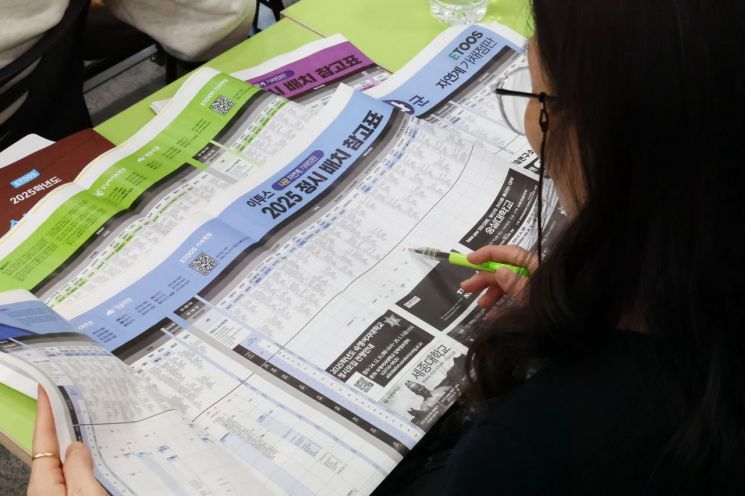
According to the "2027 University Admissions Implementation Plan" announced by the Ministry of Education and the Korean Council for University Education (Kcue) on the 30th, the proportion of early admissions among the total intake will be 80.3% (277,583 students), up 0.4 percentage points from the previous year. The proportion of regular admissions will be 19.7% (68,134 students), down 0.4 percentage points. As a result, 1,735 more students will be admitted through early admissions, and 1,197 fewer through regular admissions.
Although both universities in the Seoul metropolitan area and those outside the metropolitan area are increasing their early admissions, by type of admissions process, universities in the metropolitan area have the highest proportion of "regular admissions based on the College Scholastic Ability Test (CSAT)."
According to an analysis by Jinhaksa of Kcue data, about one-third (32.1%) of universities in the metropolitan area will select students primarily through regular admissions based on the CSAT. This is followed by early admissions based on comprehensive student records (29.0%), and early admissions based on academic records (20.9%).
Outside the metropolitan area, 60.8% of students will be selected through early admissions based on academic records. The proportion of regular admissions based on the CSAT is 9.4%.
Woo Yeoncheol, head of the admissions strategy research center at Jinhaksa, said, "Even though the proportion of early admissions has increased, universities in the metropolitan area still have a high proportion of regular admissions. For universities with high preference, the regular admissions rate often exceeds 40%, so it is advisable to prepare for both early and regular admissions rather than focusing solely on early admissions."
 On the 14th, the day of the 2025 College Scholastic Ability Test, examinees are waiting for the exam to start at Gyeongbok High School in Jongno-gu, Seoul. Photo by Joint Press Corps
The total number of students to be admitted through the social integration admissions process (opportunity balance and regional balance) is 51,196. Specifically, opportunity balance admissions will account for 37,324 students, a decrease of 876 from the previous year, while regional balance admissions will account for 13,872 students, an increase of 786. The regional talent admissions process will admit 27,730 students, an increase of 952 from the previous year.
The admissions industry expects competition for university entrance in the 2027 academic year to be fierce. This is because, with the university admissions system set to undergo a major overhaul starting in the 2028 academic year, many repeat test-takers (N-susaeng) may view the 2027 academic year as their "last chance" and flood the process. In the 2028 College Scholastic Ability Test (CSAT), elective subjects in Korean, mathematics, social studies, and science will be eliminated, and both liberal arts and science students will take the same exam.
Lim Seongho, CEO of Jongro Academy, said, "The number of third-year high school students in the 2027 academic year is expected to be 444,434, a decrease of 9,378 from the previous year's 453,812. However, there are concerns about an increase in repeat test-takers and possible changes in the number of admissions for medical schools."
© The Asia Business Daily(www.asiae.co.kr). All rights reserved.
![Clutching a Stolen Dior Bag, Saying "I Hate Being Poor but Real"... The Grotesque Con of a "Human Knockoff" [Slate]](https://cwcontent.asiae.co.kr/asiaresize/183/2026021902243444107_1771435474.jpg)
















