Verdict to Be Delivered at 3 p.m. on May 1 in the Supreme Court Main Courtroom
Chief Justice Cho Hee Dae Personally Refers Case to En Banc Panel
Two En Banc Sessions Held Before Setting the Date for the Verdict
The Supreme Court en banc will deliver its verdict on the appeal of Lee Jae Myung, presidential candidate of the Democratic Party of Korea, regarding his alleged violation of the Public Official Election Act on May 1. This decision comes 34 days after the case was filed with the Supreme Court on March 28, and just 9 days after it was referred to the en banc panel on April 22.
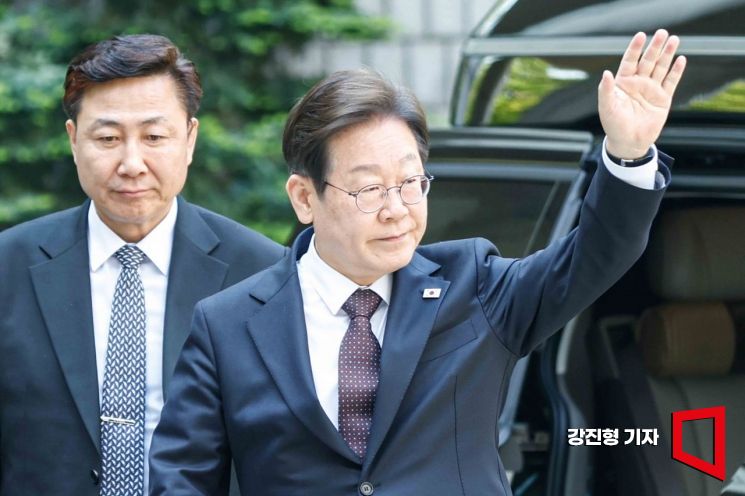
On April 29, the Supreme Court announced that it would pronounce its ruling on the appeal concerning Lee's alleged violation of the Public Official Election Act at 3 p.m. on May 1 in the Supreme Court's main courtroom.
Chief Justice Cho Hee Dae decided to refer the case to the en banc panel just two hours after it was assigned to a smaller panel on April 22. Immediately after the referral, the first deliberation session was held with all 12 justices, including Chief Justice Cho, and the second session took place on April 24.
According to the Court Organization Act and related laws, the en banc panel hears cases when there is a recognized need to change the Supreme Court's previous interpretation or application of the Constitution, laws, orders, or rules (precedent change), as well as cases where the justices on a smaller panel cannot reach a consensus, or cases of significant public interest. The Chief Justice presides over the panel, and the final decision is made by majority vote.
The en banc panel is composed of the Chief Justice (as presiding judge) and 12 justices, excluding the head of the National Court Administration, who does not participate in adjudication. In this case, Justice Noh Tae Ak, who also serves as the chairperson of the National Election Commission, recused himself to avoid any controversy over neutrality in election management, resulting in a panel of 12 including the Chief Justice.
Regardless of the outcome, the verdict is expected to have a significant impact on the presidential election scheduled for June 3. The Supreme Court may either dismiss the appeal and confirm Lee's acquittal, or overturn the previous ruling and remand the case to the High Court for retrial on the grounds of guilt. If the case is remanded for a guilty verdict, the High Court will be responsible for determining the sentence while upholding the conviction. The threshold for invalidating an election victory and revoking eligibility to run for office is a fine of 1 million won. In the event of a remand, a further appeal is possible after the High Court's retrial, making it unlikely that a final decision will be reached before the presidential election. Lastly, the Supreme Court could directly determine the sentence itself, but such direct sentencing by the Supreme Court has been extremely rare in its history.
Lee is accused of making false statements by claiming, during a 2021 television appearance as a presidential candidate, that he did not know the late Kim Moon Ki, former head of Development Division 1 at Seongnam Development Corporation, and by stating during a parliamentary audit that the Ministry of Land, Infrastructure and Transport had exerted pressure during the rezoning process of the Korea Food Research Institute site in Baekhyeon-dong, Seongnam. In the first trial, Lee was sentenced to one year in prison with a two-year suspended sentence, but was acquitted on appeal. The main issues in this appeal are expected to be the meaning of Lee's statements and whether they constitute the crime of making false public statements.
© The Asia Business Daily(www.asiae.co.kr). All rights reserved.
![Clutching a Stolen Dior Bag, Saying "I Hate Being Poor but Real"... The Grotesque Con of a "Human Knockoff" [Slate]](https://cwcontent.asiae.co.kr/asiaresize/183/2026021902243444107_1771435474.jpg)















