"We Will Follow the Ministry’s Decision; Difficult to Transfer National IP to Industry"
Fourth Nuriho Launch Scheduled for 1 a.m. in Mid-November
On April 29, Sangchul Lee, President of the Korea Aerospace Research Institute (KARI), addressed the ongoing intellectual property (IP) dispute with Hanwha Aerospace regarding the next-generation launch vehicle. He stated, "Both Hanwha and KARI agree that the issue can no longer be postponed and that both sides must make concessions to improve their relationship." He added, "We are making efforts, including meetings and discussions with the CEO of Hanwha Aerospace, and I believe we will be able to share good news soon."
However, he made it clear that KARI will not transfer the IP to Hanwha Aerospace. Lee emphasized, "The transfer of technology to private companies will be determined by the Ministry of Science and ICT in accordance with the Science and Technology Innovation Act," and stressed, "It is not possible for KARI to unilaterally alter this process."
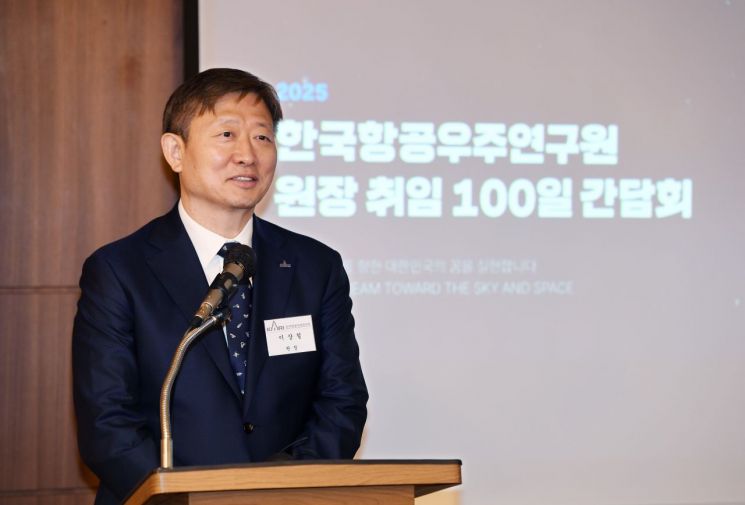 Sangchul Lee, President of Korea Aerospace Research Institute. Provided by Korea Aerospace Research Institute
During a press conference marking his 100th day in office, Lee said, "It is necessary to boldly transfer technology to increase private sector participation. Once industry secures the technology and begins marketing it, we should transfer the technology to industry and focus on investing in future technologies for the next 10, 20, or 50 years."
Regarding this matter, Youngmin Han, Director of KARI's Space Launch Vehicle Research Center, stated, "We have met with Hanwha Aerospace several times to pursue discussions and agreements." However, he also made it clear, "Although this is a joint development project, it is difficult to transfer the IP to the industry."
Another KARI official commented, "We view this as a process of transferring technology to private companies, similar to NASA's 'spinoff' model in the United States." He argued, "However, it is not appropriate for Hanwha Aerospace, as an individual company, to hold the IP exclusively."
This official added, "NASA's spinoff model involves individual companies purchasing NASA technology for a certain fee. While we acknowledge that Hanwha has invested significantly in the development of the launch vehicle, it is not reasonable for a single company to claim exclusive ownership of technology developed with national (government) funding."
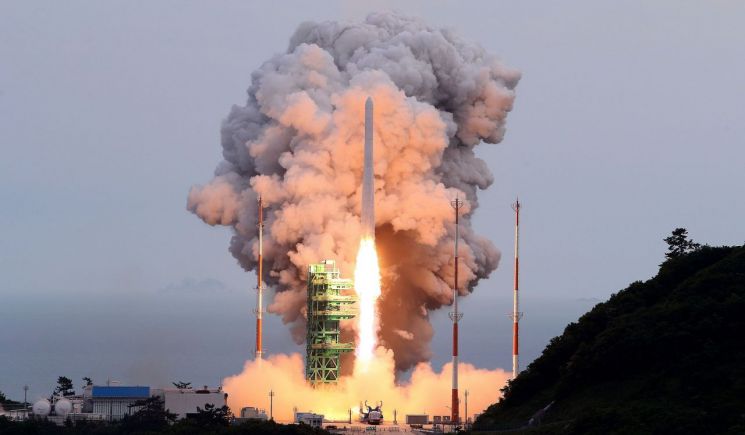
With the fourth Nuriho launch scheduled for November, KARI believes it is not desirable to waste any more time on this issue, as all efforts should be focused on ensuring a successful launch.
Regarding the long-standing issue of KARI's technology leakage, Lee stated, "There has been no actual leakage of industrial technology." He explained, "It was not a case of technology being leaked, but rather a violation of internal regulations during the process of taking internal materials outside the institute. Since this was a repeated action by a small number of researchers and may have violated internal rules, KARI has requested a police investigation and is awaiting the results."
The fourth Nuriho launch is scheduled for 1 a.m. in mid-November. Preparation for the fourth launch began in October two years ago, and the final pre-launch rehearsal is planned for September. In order to determine the fuel and other payload details, the final launch date must be set in early to mid-August. If all processes proceed as planned, Nuriho will carry the third next-generation medium-sized satellite and a CubeSat into space around mid-November.
Nuriho has typically targeted a 4 p.m. launch on the day of launch. However, this year, considering the launch trajectory and the fact that it will be carrying the third next-generation medium-sized satellite and a CubeSat, the launch time has been changed to 1 a.m., which is considered the most efficient time window.
© The Asia Business Daily(www.asiae.co.kr). All rights reserved.
![Clutching a Stolen Dior Bag, Saying "I Hate Being Poor but Real"... The Grotesque Con of a "Human Knockoff" [Slate]](https://cwcontent.asiae.co.kr/asiaresize/183/2026021902243444107_1771435474.jpg)

















