Busan, Gwangju, and Ulsan Values Revised Downward
Additional Objections Accepted Until May 29
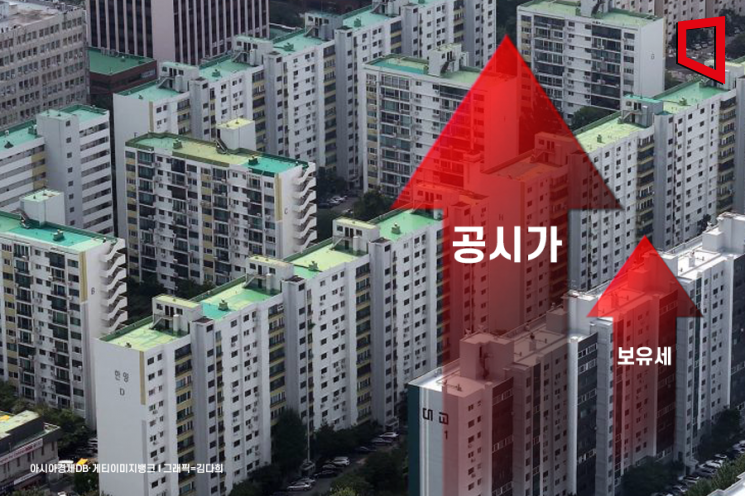
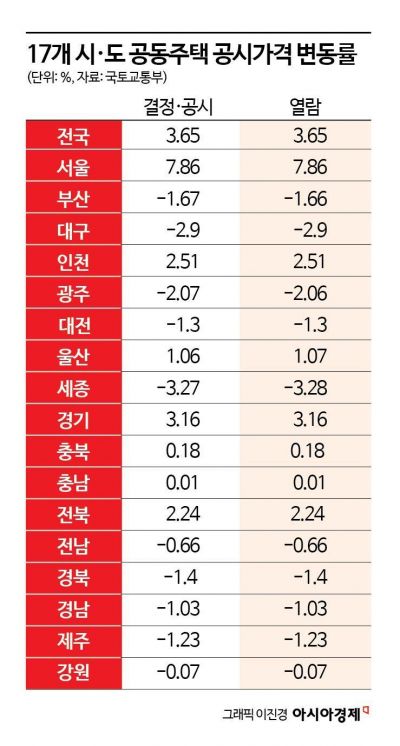
The Ministry of Land, Infrastructure and Transport announced on April 29 that this year's officially assessed value increase rate for apartment complexes nationwide has been finalized at 3.65%, the same as the preliminary assessment. After releasing the preliminary figures on March 13, the ministry accepted objections until April 2.
Out of 4,132 submitted opinions, 1,079 cases-accounting for 26.1%-were reflected in the final adjustments to the official property values. The number of submissions (4,132) decreased by 35.1% compared to the previous year, marking the lowest level in the past five years.
Among the 17 provinces and major cities, adjustments were made in four regions: Busan, Gwangju, Ulsan, and Sejong. The rates for Busan, Gwangju, and Ulsan were each revised downward by 0.01 percentage points, while Sejong was adjusted upward by 0.01 percentage points. As a result, this year’s official apartment values decreased by 1.67% in Busan and 2.07% in Gwangju compared to last year. In Ulsan, the value increased by 1.06%, while in Sejong, it fell by 3.27%.
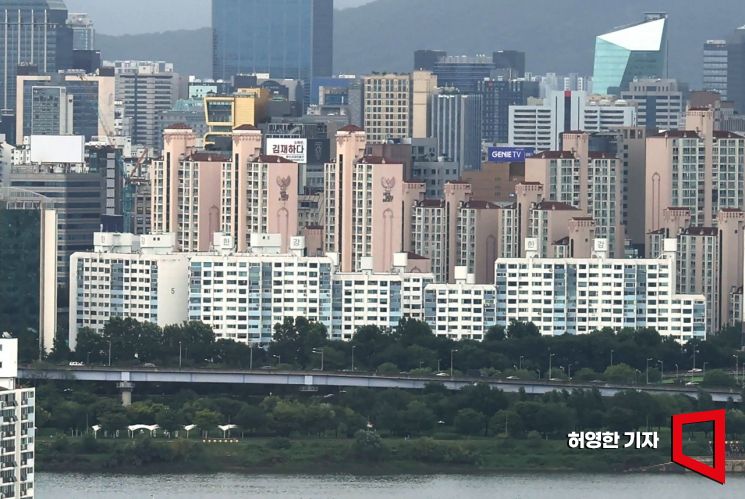
In Seoul, where housing prices surged last year, the officially assessed value rose by 7.86%. Seocho District saw a 12% increase, Gangnam District 11%, and Songpa District 10%, with all three districts recording double-digit growth rates.
Looking at individual complexes, for example, the 84-square-meter unit at Raemian One Bailey in Banpo-dong, Seocho District, saw its officially assessed value rise by 3.436 billion won, resulting in a property holding tax of 18.2 million won-an increase of 4.8 million won (35.9%) from last year. For the 111-square-meter unit at Shinhyundai 9th Complex in Apgujeong-dong, the official value rose from 2.76 billion won last year to 3.476 billion won this year, causing the holding tax to increase from 13.28 million won to 18.48 million won-an increase of 5.2 million won (39.2%).
The higher the apartment price, the greater the holding tax burden becomes. Property tax increases progressively as the officially assessed value exceeds certain thresholds, and if the value exceeds 1.2 billion won (for single-home owners), the comprehensive real estate holding tax is also imposed.
The holding tax for apartments in Mapo, Yongsan, and Seongdong districts is also expected to rise by more than 10% this year. For instance, the 84-square-meter unit at Mapo Raemian Prugio in Ahyeon-dong, Mapo District, was not subject to the comprehensive real estate holding tax last year, with an official value of 1.145 billion won. However, this year, the value increased by 14.9% to 1.316 billion won, making it subject to the tax. Accordingly, the holding tax is expected to rise by 430,000 won (17.5%) from 2.44 million won to 2.87 million won.
This year, there are 317,998 homes (2.04%) with officially assessed values exceeding 1.2 billion won, making them subject to the comprehensive real estate holding tax for single-home owners. This is an increase of 51,218 homes from last year’s 266,780 homes (1.75%). Compared to the previously announced figure of 318,308 homes last month, the number has decreased by 310 homes. The downward revisions in Busan, Gwangju, and Ulsan brought some properties below the 1.2 billion won threshold for the comprehensive real estate holding tax.
The officially assessed values for apartment complexes can be checked starting April 30 on the ‘Real Estate Price Information’ website or at the civil service offices of local city, county, and district governments. If there are objections to these values, opinions may be submitted until May 29. Korea Real Estate Board will review any additional objections and notify applicants of the results by mail or other means by June 26.
© The Asia Business Daily(www.asiae.co.kr). All rights reserved.
![Clutching a Stolen Dior Bag, Saying "I Hate Being Poor but Real"... The Grotesque Con of a "Human Knockoff" [Slate]](https://cwcontent.asiae.co.kr/asiaresize/183/2026021902243444107_1771435474.jpg)

















