Spain and Portugal Hit by Massive Blackout
Transportation and Infrastructure Paralyzed
"State of Emergency Declared"
About 50% Restored by Night of the 28th
"No Signs of Cyberattack"
A massive blackout occurred around noon on the 28th (local time) in Spain and Portugal, plunging the entire Iberian Peninsula into chaos. In most areas, including the Spanish capital Madrid and Barcelona, as well as in parts of the Portuguese capital Lisbon and the second-largest city Porto, the blackout paralyzed key infrastructure such as transportation and communications. The Spanish government declared a national state of emergency and began recovery operations.
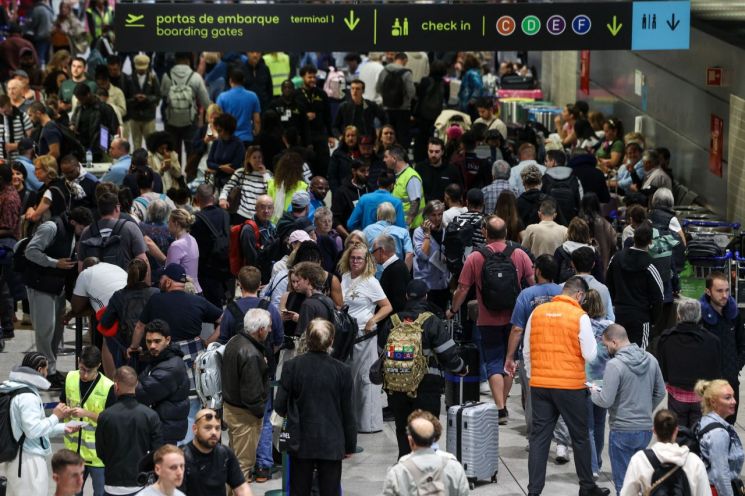
According to the British daily The Guardian and AP News, Spanish Prime Minister Pedro Sanchez announced in a late-night TV address that half of the power grid had been restored. Sanchez stated, "According to power grid data, nearly 50% of the electricity supply has already been restored, and our goal is to continue the recovery over the next few hours." He also said that Spain is currently receiving electricity from neighboring France and Morocco.
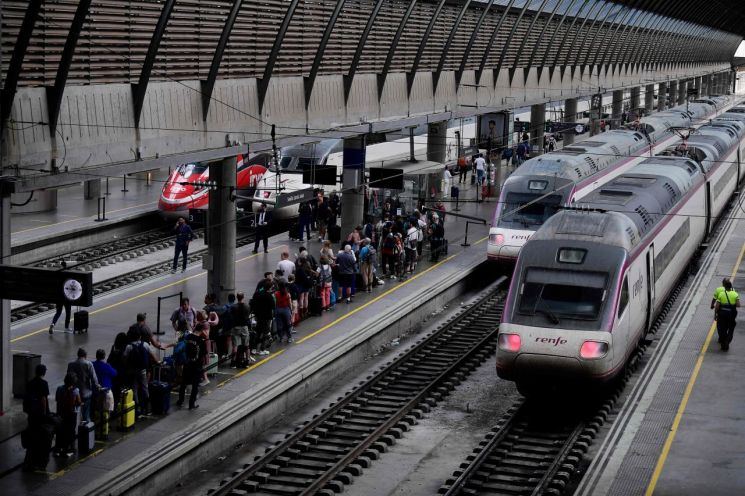
Due to the blackout, trains and subways in Spain and Portugal came to a halt, and about 300 flights were canceled. In Spain, 35,000 people were trapped on about 100 trains and evacuated along the tracks. As of that day, evacuation operations for 11 trains had not yet been completed. With the subways stopped, hundreds of citizens escaped dark tunnels relying on their mobile phone flashlights. Traffic lights went out, causing severe traffic congestion on the roads, and police controlled traffic with hand signals. Hundreds of people were also trapped in elevators. Telephone connections and internet access were cut off, and ATMs could not be used.
In Portugal, after the water utility company EPAL announced that water supply might be interrupted, crowds rushed to supermarkets and other stores to buy emergency supplies such as bottled water and flashlights.
Jose Luis Martinez-Almeida, the mayor of Madrid, urged citizens to minimize movement and remain where they were. The Madrid Open tennis tournament, which was scheduled to be held that day, was suspended.
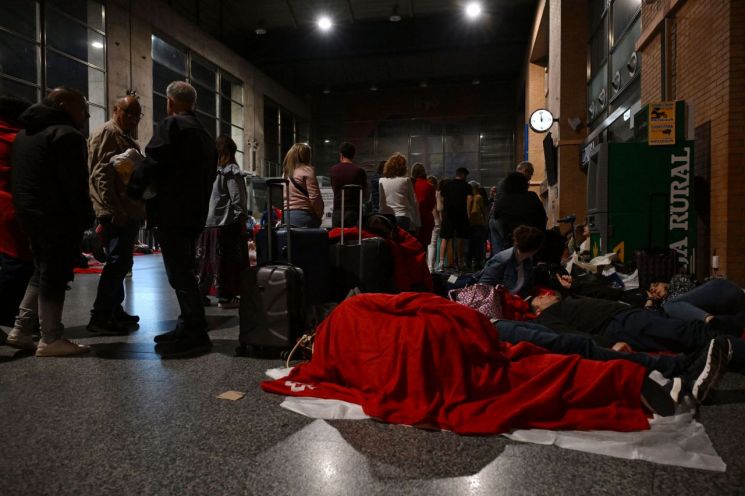 On the 28th (local time), a large-scale blackout occurred in Spain and Portugal, leaving stranded travelers lying on the floor covered with blankets at the Cordoba train station in Spain. The blackout paralyzed major infrastructure, including the stoppage of about 100 trains that day. Photo by AFP Yonhap News
Prime Minister Sanchez declared a level 3 state of emergency in 8 out of the 17 autonomous communities, including Madrid and Andalusia. He stated that the goal was to fully restore the power grid by the 29th. Regarding the cause of the blackout, he said, "We are keeping all possibilities open and analyzing potential causes," and added, "We are taking every possible measure." He also remarked, "It will be a long night," but emphasized, "We will continue to work to return to normal as quickly as possible."
As of around 10 p.m. that day, 421 out of 680 substations in Spain had been restored, meeting 43.3% of electricity demand. In Portugal, 85 out of 89 substations nationwide had restored power. Initially, Spain’s power company Red Electrica estimated that it would take 6 to 10 hours to normalize service, but recovery efforts have been delayed. In some areas, power supply has begun to resume. In regions where electricity was restored, residents erupted in cheers.
Portuguese Prime Minister Luis Montenegro said that the cause of the blackout has not yet been identified. He noted, "We are interconnected with Spain (in the power grid), and the overall situation suggests that all of this originated in Spain, but I do not want to speculate."
The Portuguese National Cybersecurity Center stated in a release that there were no signs the blackout was caused by a cyberattack. Antonio Costa, former Prime Minister of Portugal and President of the European Parliament, also stated there was no indication of a cyberattack.
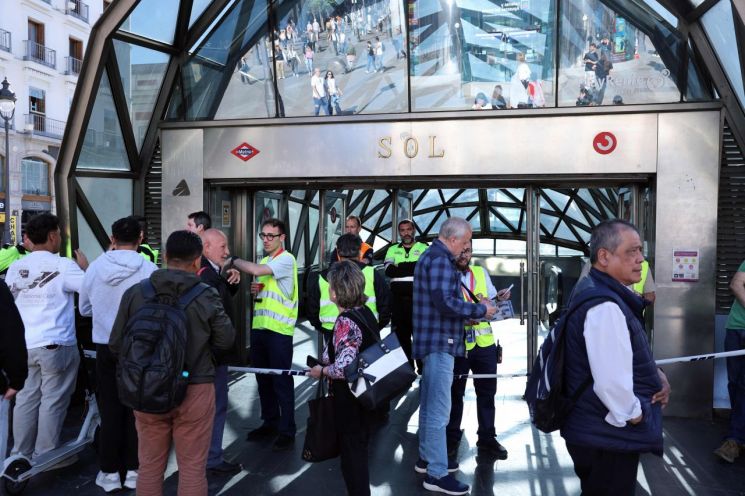 Due to a massive blackout causing the suspension of subway operations in Spain, subway staff and citizens are having a conversation in front of a subway station in Madrid. Photo by AFP Yonhap News
Portugal’s power grid operator REN explained that the blackout was caused by a rare atmospheric phenomenon. Extreme temperature fluctuations in Spain caused abnormal vibrations in high-voltage power lines, which led to a failure in synchronization between power systems and triggered a chain of malfunctions across the entire grid. A Portuguese government official told the national news agency Lusa that the blackout appeared to be a distribution network issue and was believed to have originated in Spain.
© The Asia Business Daily(www.asiae.co.kr). All rights reserved.
![Clutching a Stolen Dior Bag, Saying "I Hate Being Poor but Real"... The Grotesque Con of a "Human Knockoff" [Slate]](https://cwcontent.asiae.co.kr/asiaresize/183/2026021902243444107_1771435474.jpg)

















