Permissible Floor Area Ratio Eased to 238.4%
Low-rise Spaces Created Using Elevation Differences
Residential Complex with Six Buildings up to 24 Stories to Be Developed
The area around 382 Majangdong, Seongdong-gu, Seoul, which was previously filled with aging buildings, will be transformed into a topography-adaptive residential complex with 262 households.
On the 28th, the Seoul Metropolitan Government announced on the 29th that it held the 3rd Urban Planning Committee meeting and approved, with modifications, the maintenance plan decision and the designation of the maintenance area for the 'Housing Maintenance Redevelopment Project in the Majangdong 382 Area.'
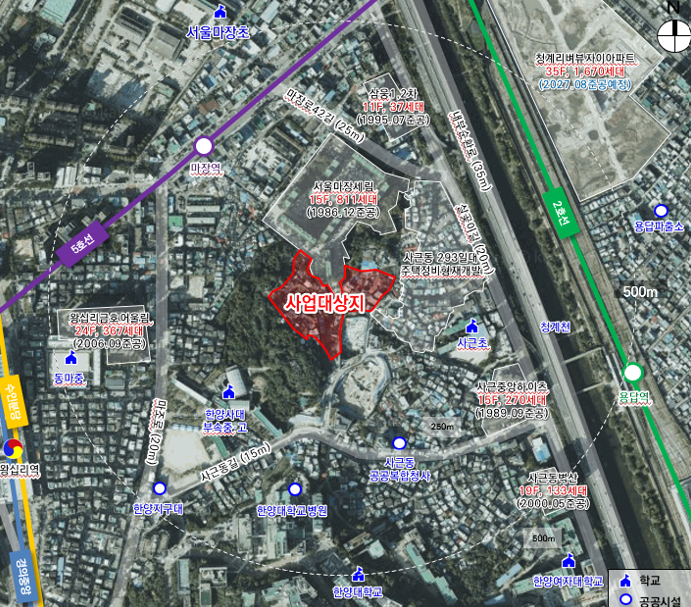
The target site is located in a hilly area north of Hanyang University, and is a residential area with poor living conditions, where 97% of buildings are considered deteriorated. Previously, the city selected this site as a candidate for the expedited integrated planning project in December 2021, and in July 2023, established the expedited integrated planning guidelines to develop the maintenance plan.
Through this maintenance project, a topography-adaptive residential complex consisting of six buildings, up to 24 stories high, and a total of 262 households will be created in the Majangdong 382 area. Of these, 40 units will be public rental housing. The project feasibility was enhanced by applying a business feasibility adjustment factor to the site, which increased the permissible floor area ratio from the original 200% to 238.40%.
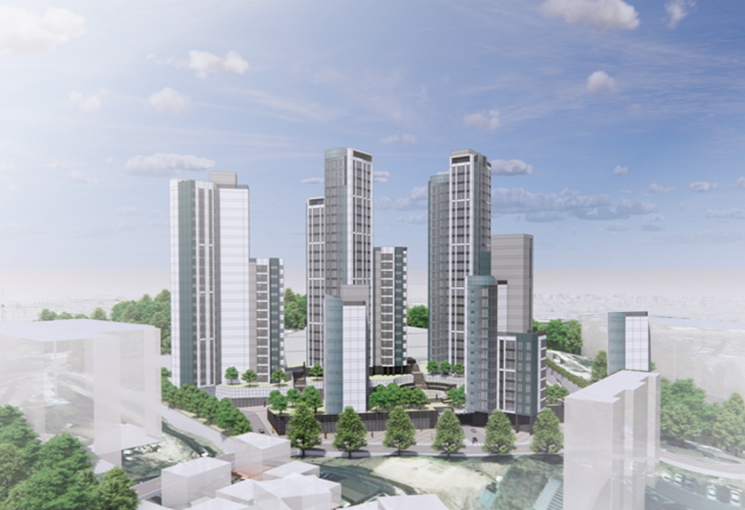
Additionally, the city took into consideration the site's topographical feature of a 35-meter elevation difference. Accordingly, a deck will be constructed to overcome the elevation gap, and the elevation difference will be utilized to create diverse low-rise spaces. These spaces will be used as community and shared facilities for residents. Furthermore, the height and layout plans were established to ensure harmony with adjacent reconstruction and redevelopment projects.
Choi Jinseok, Director of Housing at Seoul Metropolitan Government, stated, "With the designation of this maintenance area, we expect to improve the residential environment in deteriorated housing areas and expand the supply of quality housing that takes into account both the urban landscape and the topography."
© The Asia Business Daily(www.asiae.co.kr). All rights reserved.
![Clutching a Stolen Dior Bag, Saying "I Hate Being Poor but Real"... The Grotesque Con of a "Human Knockoff" [Slate]](https://cwcontent.asiae.co.kr/asiaresize/183/2026021902243444107_1771435474.jpg)
















