Besant: "Easing of U.S.-China Tensions Depends on China"
Hints at First Trade Agreement with India Within Days
Microsoft, Meta, Apple, and Amazon to Announce Earnings Starting April 30
Focus on Q1 GDP Growth Rate and April Employment Report
The three major indexes on the New York Stock Exchange showed mixed movements in early trading on April 28 (local time). Investors are taking a wait-and-see approach as they monitor progress in tariff negotiations between the United States and other countries, while also awaiting this week's big tech earnings reports and the release of key economic indicators.
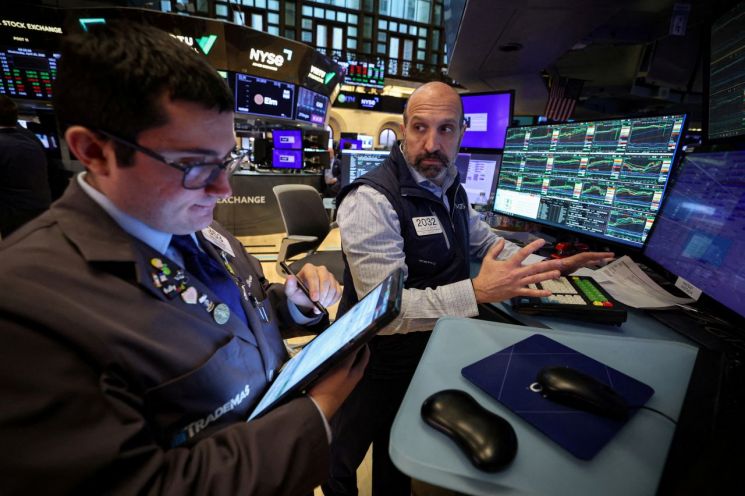
As of 11:23 a.m. on this day in the New York stock market, the blue-chip Dow Jones Industrial Average (Dow) was up 22.61 points (0.06%) from the previous trading day, standing at 40,136.11. The large-cap S&P 500 Index was down 26.38 points (0.48%) at 5,498.83, while the tech-heavy Nasdaq Index was trading at 17,214.24, down 168.7 points (0.97%).
The market is once again focusing on tariff developments this week. U.S. Treasury Secretary Scott Besant stated that easing U.S.-China trade tensions "depends on China." In an interview with CNBC, he said, "China sells five times more products to the U.S. than we sell to China," arguing that "tariffs of 120% and 145% are unsustainable." Regarding trade negotiations with other countries, he noted that progress has been made and said he expects to sign the first trade agreement with India within a few days.
Previously, on April 9, the United States granted a 90-day country-by-country suspension of reciprocal tariffs for countries other than China, just 13 hours after fully implementing reciprocal tariffs. As financial market turmoil continued, President Donald Trump has repeatedly sent conciliatory messages, calling for dialogue with China.
Jonathan Miller, an economist at Barclays, commented, "There are signs that U.S.-China trade tensions are easing somewhat," adding, "Both sides are gradually trying to lower the unsustainable tariff rates implemented earlier this month, and the U.S. has indicated its willingness to reduce tariffs." He continued, "For now, most of this remains just discussion," and expressed skepticism about whether there is enough concrete momentum in trade negotiations for the U.S. to avoid a recession.
Attention is also focused on the big tech earnings reports scheduled for this week. More than 180 S&P 500 companies will announce their results. On April 30, Microsoft (MS) and Meta Platforms, the parent company of Facebook, will release their quarterly earnings, followed by Apple and Amazon on May 1. Earnings from Visa, Coca-Cola, and Eli Lilly are also scheduled.
According to market research firm FactSet, 73% of all companies have reported earnings that beat market expectations, which is lower than the five-year average of 77%. As aggressive tariff policies increase uncertainty, Wall Street is lowering its earnings forecasts for the second quarter and for the full year.
Key economic indicators will also be released throughout the week. On April 29, the Conference Board (CB) will release the April Consumer Confidence Index, and the U.S. Department of Labor will publish the March Job Openings and Labor Turnover Survey (JOLTs). On April 30, the preliminary U.S. first-quarter gross domestic product (GDP) growth rate and the April employment report from private labor market research firm ADP will be released. On May 1, S&P and the Institute for Supply Management (ISM) will announce the April Manufacturing Purchasing Managers' Index (PMI). The Department of Labor will also release weekly initial jobless claims on the same day. On May 2, the most important employment indicator, the Department of Labor's April employment report, will be published. The market expects nonfarm payrolls to increase by only 129,000 this month, a significant drop from 228,000 in March. The unemployment rate is projected to remain at 4.2%.
U.S. Treasury yields are on the decline. The 10-year U.S. Treasury yield, the global benchmark for bond yields, fell by 3 basis points (1bp = 0.01 percentage point) from the previous trading day to 4.23%. The 2-year U.S. Treasury yield, which is sensitive to monetary policy, also dropped by 3 basis points to 3.72%.
© The Asia Business Daily(www.asiae.co.kr). All rights reserved.
![Clutching a Stolen Dior Bag, Saying "I Hate Being Poor but Real"... The Grotesque Con of a "Human Knockoff" [Slate]](https://cwcontent.asiae.co.kr/asiaresize/183/2026021902243444107_1771435474.jpg)















