Securing a Competitive Edge in Linker Technology, the Core of ADC Therapeutics
"Diversifying the Technology Portfolio Across Linkers, Drugs, and Modalities"
Intocell, an antibody-drug conjugate (ADC) platform company, has announced its vision to achieve the commercialization of more than 10 technologies by 2028. The company expressed strong confidence in reaching this goal, particularly emphasizing its competitive edge in linker technology, which is central to ADC therapeutics.
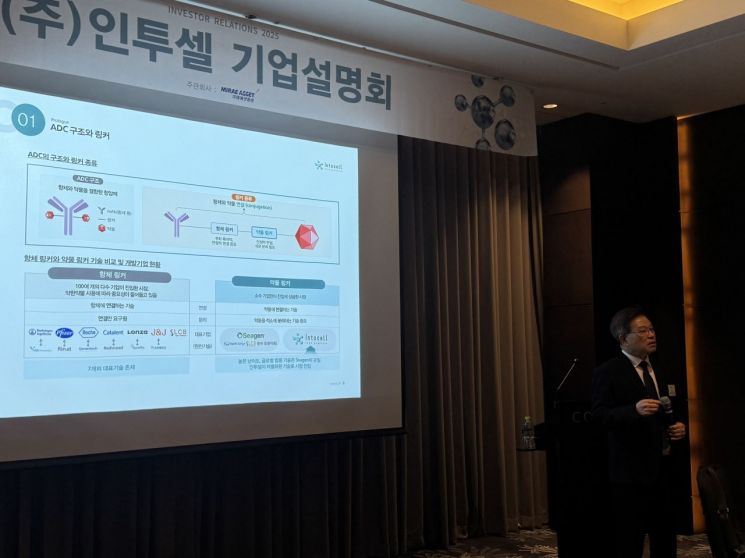 Park Taegyo, CEO of Intocell, held a corporate presentation on the 28th at the Conrad Hotel in Yeongdeungpo-gu, Seoul, explaining the structure of antibody-drug conjugates (ADC). Intocell
On April 28, Intocell held a corporate presentation at the Conrad Hotel in Yeongdeungpo-gu, Seoul, where it introduced three technology commercialization achievements, including its next-generation linker platform. Intocell plans to be listed on KOSDAQ on May 23 through a special technology listing. The company aims to use the funds raised from its initial public offering (IPO) to further advance its ADC platform, which is designed to significantly reduce toxicity and maximize anticancer efficacy compared to existing ADC cancer drugs.
ADC is a next-generation precision anticancer therapy and is a rapidly growing field in the global pharmaceutical and biotech industry. By combining the targeting ability of antibodies with highly cytotoxic drugs, ADCs can selectively eliminate only cancer cells. According to Evaluate, a global pharmaceutical market research agency, the market size for ADC therapeutics approved by the U.S. Food and Drug Administration (FDA) grew rapidly from approximately $1 billion in 2015 to $10 billion in 2023, and is projected to reach around $28 billion by 2028.
Intocell has drawn particular attention in the ADC therapeutics market for its linker technology. In ADCs, the linker is a core technology that determines the efficiency and safety of drug delivery. The linker precisely controls when, where, and how the drug is released, playing a decisive role in the safety and therapeutic effectiveness of ADCs.
Intocell specializes in drug-connecting linker technology, known as the "rear linker." Through its OHPAS (OHPAS) technology, the company has developed a structure that allows for the broad application of not only phenolic drugs, which were previously difficult to conjugate, but also amine-based drugs. This serves as a key competitive advantage for the development of customized ADCs, particularly in situations where drug application needs to be tailored to specific cancer types.
Accordingly, Intocell expects OHPAS to emerge as a next-generation platform due to its strengths, which include high drug versatility, excellent stability in the bloodstream, and sustained efficacy. Seo Youngseok, Executive Director at Intocell, stated, "The 'rear linker' is a universal technology currently held only by Seegene. Compared to the front linker technology, which attaches antibodies and is held by over 40 companies, the rear linker is a much more advanced technology."
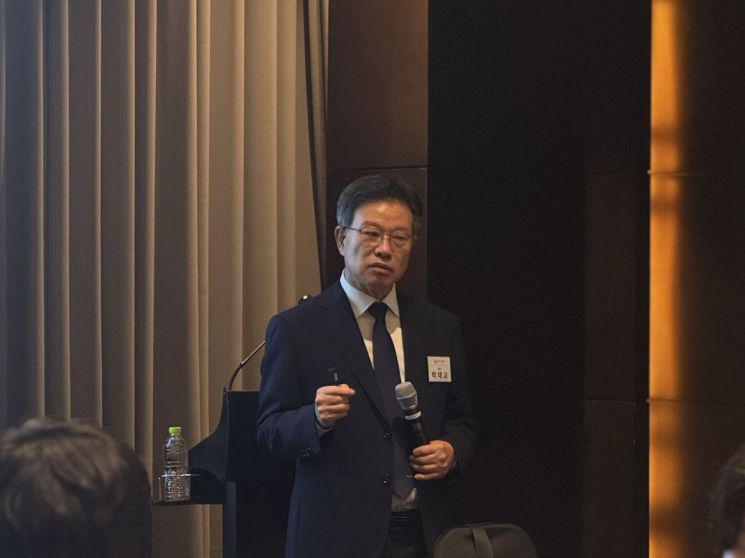 Park Taegyo, CEO of Intocell, is holding a corporate briefing session at Conrad Hotel in Yeongdeungpo-gu, Seoul on the 28th and answering questions from the press. Intocell
In addition, Intocell has secured differentiated ADC platform technologies such as PMT technology, which minimizes non-selective intracellular uptake by normal cells, and Nexatecan, an OHPAS-based optimized camptothecin drug platform.
PMT technology is a platform that addresses the selectivity issue of ADCs by utilizing the hydrophilicity of the Modifying Group (MG) to significantly reduce toxicity to normal cells. Experimental results have demonstrated that the likelihood of drug uptake by normal cells is reduced by approximately 172 times, while selectivity is increased by 115 times.
Nexatecan is a phenolic camptothecin-based drug platform. According to Intocell's own experiments, Nexatecan demonstrated superior efficacy and lower toxicity compared to the blockbuster ADC therapeutic Enhertu. It is also highly regarded for its flexibility, as it can be customized to meet various client needs.
On this day, Intocell presented its mid- to long-term vision, the '2030+, into 10-10' strategy, aiming to achieve 10 new drugs and a market capitalization of 10 trillion won before the 2030s. Since 2022, the company has quickly secured initial references by successfully signing three platform technology transfer agreements and has set a cumulative target of five technology commercialization achievements by the end of this year. Afterward, Intocell plans to achieve a cumulative total of more than 10 technology commercialization deals by 2028 through a stable record of two to three technology transfer agreements annually.
A competitive contract structure is also one of Intocell's strengths. The platform contract structure generally consists of four stages: contract signing, target testing, target selection, and pipeline development. Milestone revenue is generated at each stage except for the target testing stage.
However, unlike conventional technology transfer contracts that typically grant exclusivity on a per-target basis, Intocell has established a competitive contract structure that grants dual exclusivity by target and drug, enabling the company to develop multiple partnerships in parallel using a single platform.
Park Taegyo, CEO of Intocell, stated, "Intocell is accelerating its leap to become a global blockbuster ADC company, going beyond simply possessing technology to establish a repeatable technology transfer model, a concrete new drug pipeline, and a proactive technology expansion strategy. We are pursuing continuous technology exports based on the global expansion of our proprietary platform and strategic partnerships."
He added, "Beyond advancing a single technology, we will diversify our technology portfolio across linkers, drugs, and modalities (therapeutic approaches) to secure the optimized technological capabilities needed for the 'next blockbuster ADC' that surpasses existing limitations."
Meanwhile, through this listing, Intocell plans to offer a total of 1.5 million shares, with the desired public offering price ranging from 12,500 won to 17,000 won. The offering is expected to raise between approximately 18.8 billion won and 25.5 billion won, and the anticipated market capitalization after listing is projected to reach between about 185.4 billion won and 252.1 billion won.
© The Asia Business Daily(www.asiae.co.kr). All rights reserved.


















