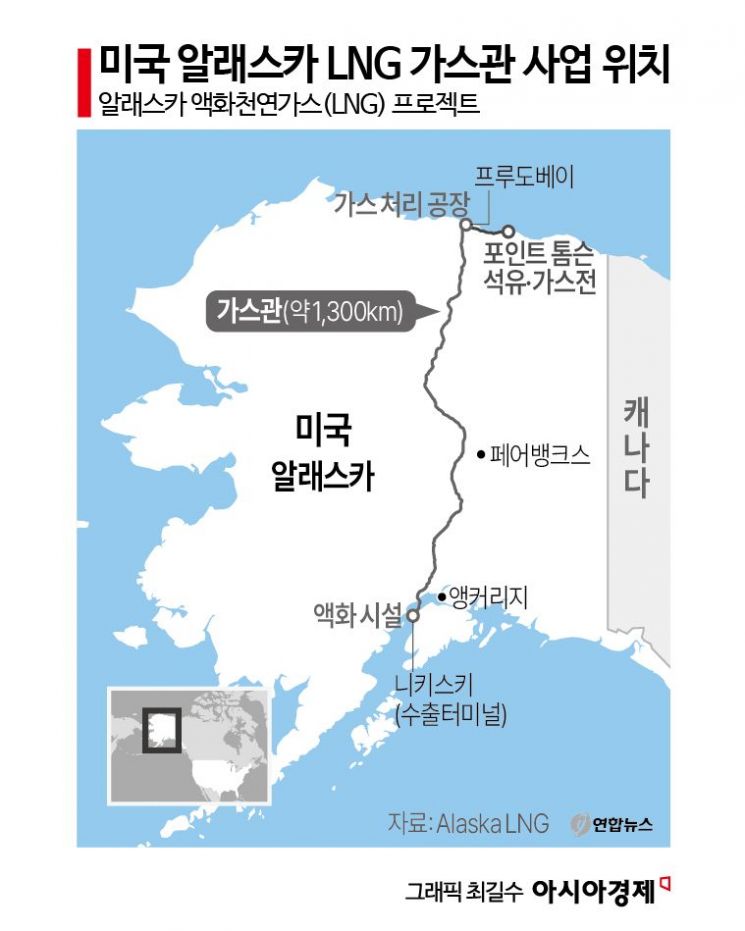
The South Korean government's strategic calculations are becoming increasingly complex regarding participation in the $44 billion Alaska liquefied natural gas (LNG) project. As discussions expand beyond a simple purchase agreement to include various scenarios?such as joint participation with Taiwan and Japan, equity investment, and long-term purchase contracts?the challenge is now to strike a balance between economic viability and energy security.
◆ Joint participation with Taiwan and Japan rapidly gaining traction = According to relevant ministries on April 29, South Korea and the United States recently reached a consensus during the "2+2 Economic Dialogue" to focus discussions on four areas: tariffs and non-tariff measures, economic security, investment cooperation, and exchange rates (monetary policy). Notably, as a result of this meeting, the option of participating in the Alaska LNG project has returned to the government’s review table.
While the South Korean government agrees on the necessity of participating in this project, discussions on the specific mode of participation are ongoing. The most prominent scenario recently is a joint participation model with Taiwan’s CPC Corporation and Japan’s largest power company, JERA. In this structure, South Korea, Taiwan, and Japan would either jointly invest or sign a collective purchase agreement, thereby sharing the burden of participation.
Kyodo News, citing diplomatic sources, also reported that "the South Korean government conveyed to the United States on April 24 that assessing the economic viability of the Alaska LNG development should be prioritized and proposed the formation of a consultative body with major demand countries such as Japan, Taiwan, and Vietnam."
In this case, it is expected that cooperation among Asia’s major energy-consuming countries would be strengthened. Particularly, as both Japan and Taiwan are countries with large-scale LNG demand, their joint participation with South Korea is analyzed to boost market confidence and receive positive evaluations from the United States. Additionally, by distributing the risks of the Alaska LNG project among multiple countries, the burden related to investment and supply stability could be significantly reduced. Forming a joint purchasing bloc could also provide an advantage in future LNG price negotiations.
However, joint participation also presents challenges. Specific terms such as investment ratios, profit distribution, and purchase volume adjustments will require coordination among the participating countries. As each country’s energy supply strategy or preferred contract terms may differ, insufficiently detailed consultations from the early stages could become a source of conflict.
Moreover, if the United States interprets joint participation as "risk-sharing," there is a possibility that South Korea’s strategic value could be diminished.
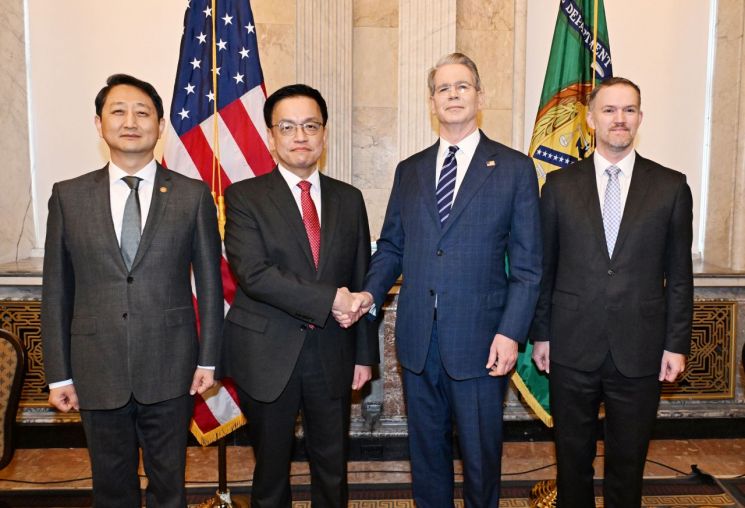
◆ Equity investment: alliance strengthened but economic risk increases = Another scenario involves domestic energy companies such as Korea Gas Corporation acquiring a stake in the project and participating directly. In this case, it would strengthen energy cooperation with the United States and help secure a stable gas import channel. Especially since the concept of "economic security" was emphasized during the recent 2+2 Economic Dialogue, this approach could further enhance strategic trust.
However, economic viability remains a significant obstacle. According to energy consultancy Wood Mackenzie, the supply cost of Alaska LNG is expected to be $8.97 to $12.80 per mmBtu, more than 30% higher than the average export price from the U.S. mainland. Along with the burden of large-scale investment ($44 billion), if the current global LNG oversupply continues, there are concerns that investment profitability could deteriorate.
There is precedent for this: global majors such as ExxonMobil and BP withdrew from the Alaska project in the past due to concerns over business viability. As a result, there are suggestions that separate financial support measures or policy safeguards should be established to help mitigate the loss risk associated with equity investment.
◆ Long-term purchase: lower burden but significant limitations = There is also discussion of a "long-term purchase" model, in which a certain volume is purchased over an extended period without acquiring equity. This approach offers the advantage of securing supply stability without investment risk, resulting in a lighter initial financial burden. However, the political significance of "strategic participation" that the United States expects may be weakened.
Simple purchases may not meet U.S. expectations for initial investment in the project, and South Korea’s position in future energy trade negotiations could be weakened.
Additionally, since logistics costs for Alaska LNG are higher than those from the U.S. mainland, price negotiations are expected to be challenging even when signing a purchase contract. Securing price competitiveness will remain a key issue even with a purchase-based approach.
An official from the government stated, "If we look solely at economic viability and profitability, participating in the Alaska LNG project is not an easy decision," adding, "When both energy security and trade strategy are considered, this is a matter that cannot be judged by simple calculations alone."
© The Asia Business Daily(www.asiae.co.kr). All rights reserved.


















