Number of Involuntary Job Losses Reaches 1.37 Million, Up 8.4%
A study has found that the number of newly hired wage workers in South Korea declined from 2023 through last year.
On April 28, the Korea Employers Federation (KEF) stated in its report, "Key Characteristics and Implications of Recent Employment Trends," that the number of wage workers with less than three months of continuous service?a figure considered indicative of new hires?has decreased for seven consecutive quarters since the first quarter of 2023.
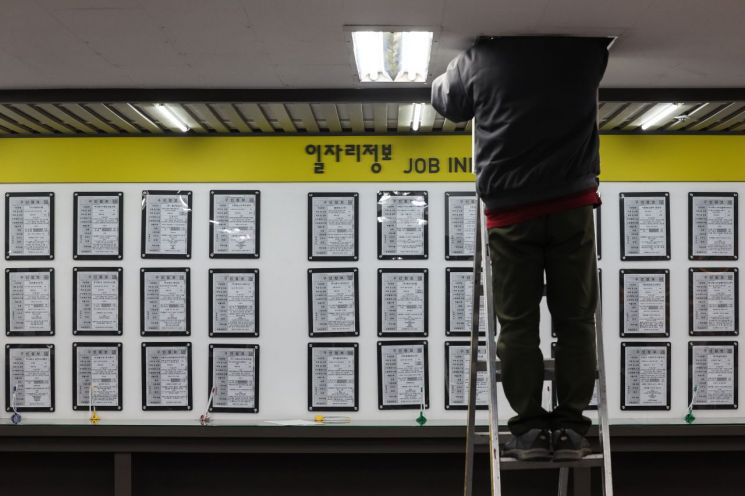
The job vacancy ratio, which is surveyed and published by the Ministry of Employment and Labor, also declined during the same period. The job vacancy ratio refers to the number of job openings per job seeker. The KEF explained, "The recent hiring freeze is the result of a slowdown in corporate demand for new hires, which has been caused by sluggish domestic demand, the strengthening of protectionism, increased uncertainty both domestically and internationally, and declining profitability."
The number of involuntary job losses last year reached approximately 1.37 million, an 8.4% increase compared to 2023. During the same period, the number of unemployed people in the construction sector increased by 39,000, while in manufacturing it rose by 21,000, due to a downturn in the construction market.
Involuntary job loss refers to people who left their jobs due to reasons such as business suspension or closure, voluntary or early retirement, layoffs, the completion of temporary or seasonal work, or lack of work or business downturn. It does not include those who left for personal reasons, household or childcare responsibilities, physical or mental disabilities, retirement at the mandatory age, or dissatisfaction with pay.
Last year, the number of wage workers in ultra-short-hour jobs (less than 15 hours per week) reached 1,406,000, marking an all-time high.
Last year, the proportion of self-employed people among all employed persons in South Korea was 19.8%. This is the first time since relevant statistics began in 1963 that the annual figure has fallen below 20%. According to the KEF, this is because business profits have declined and debt has increased due to sluggish domestic demand and economic recession, leading to more people closing their businesses.
By age group, the number of self-employed people in their 30s and 40s decreased by 35,000 and 12,000, respectively, last year, while the number of those aged 60 and over increased by 23,000. It is estimated that older individuals, who find it difficult to secure quality reemployment, are continuously entering self-employment.
The number of young people postponing graduation to seek employment has increased, and there is also a growing trend of refusing to accept jobs that are not considered high quality even after graduation. Of the 195,000 new university graduates last year, only 77,000, or 39.5%, found employment. The number of job seekers preparing for employment stood at 49,000, exceeding the 36,000 who were unemployed.
Kim Seonae, head of employment policy at the KEF, stated, "The current employment market is characterized by growing instability, such as frozen hiring and unwanted resignations, and a clear trend of labor mobility by demographic group, such as increased entry of older workers into self-employment." She added, "Policy directions should be set to help those facing difficulties due to job loss or business closure quickly re-enter the labor market."
© The Asia Business Daily(www.asiae.co.kr). All rights reserved.
![Clutching a Stolen Dior Bag, Saying "I Hate Being Poor but Real"... The Grotesque Con of a "Human Knockoff" [Slate]](https://cwcontent.asiae.co.kr/asiaresize/183/2026021902243444107_1771435474.jpg)















