10% Production Tax Credit Proposed for Domestic Sales
Samsung Could Save Up to 5 Trillion Won, SK Hynix Up to 4 Trillion Won in Taxes
Industry: "Practical Support Measure, Expected to Strengthen Supply Chain"

It has been analyzed that if Samsung Electronics and SK Hynix were to benefit from the 10% production tax credit proposed by Lee Jae Myung, leader of the Democratic Party of Korea, based on domestic production sales, they could receive a combined maximum tax reduction of approximately 9 trillion won.
According to the semiconductor industry on April 28, Samsung Electronics' semiconductor division (DS division) recorded sales of 111.1 trillion won last year, with an estimated 40 to 45 percent of this amount coming from semiconductor products manufactured at domestic plants in Pyeongtaek and Hwaseong.
Based on this, domestic production sales are estimated to be in the range of approximately 44.4 trillion to 50 trillion won. If the 10% production tax credit is simply applied, Samsung Electronics is expected to save about 4.44 trillion to 5 trillion won in taxes annually.
SK Hynix posted sales of 66.193 trillion won last year. Of this, about 60 percent is estimated to have come from products manufactured at the Icheon and Cheongju plants. Domestic production sales amount to approximately 39.7 trillion won, and with the application of the 10% production tax credit, a tax reduction of about 3.97 trillion won is expected.
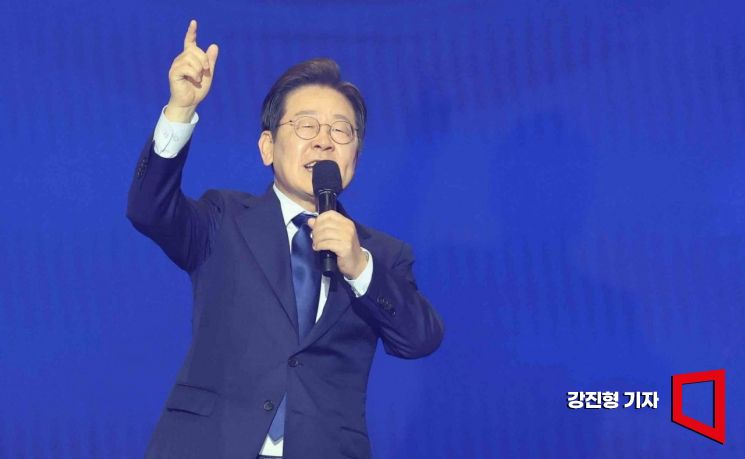 The joint speech event for selecting the Democratic Party of Korea's 21st presidential election candidate for the Seoul metropolitan area, Gangwon, and Jeju was held on the 27th at KINTEX Exhibition Hall 2 in Ilsan, Goyang-si, Gyeonggi-do. Former party leader Lee Jae Myung, who was selected as the presidential candidate, is delivering his acceptance speech. 2025.4.27. Photo by Kang Jinhyung
The production tax credit is a system that deducts taxes based on the sales of semiconductors actually produced at domestic plants. Unlike the existing investment cost deduction method, it directly supports productivity and sales performance.
An official from the semiconductor industry stated, "Unlike declarative support measures, the production tax credit provides tangible tax benefits that can be immediately reflected in corporate management," adding, "It is expected to have a positive ripple effect not only on large companies such as Samsung Electronics and SK Hynix, but also on partner companies in the materials, parts, and equipment sectors."
Kim Jeonghoe, Vice Chairman of the Korea Semiconductor Industry Association, also commented, "The production tax credit is not merely investment support, but a system that improves corporate liquidity and reduces production costs," and evaluated it as "a key tool for enhancing the competitiveness of the domestic semiconductor supply chain ecosystem."
Globally, tax support linked to productivity is also spreading. Since 2024, Japan has applied a basic 10% tax credit for domestic production and sales of strategic industrial products such as semiconductors, with a maximum of 20% for those meeting high-efficiency production facility requirements. In the United States, the Inflation Reduction Act (IRA) provides for investment cost tax credits and the transfer of tax credit rights, but a tax credit system directly linked to productivity has not yet been implemented.
The industry emphasized, "As global competition for semiconductor leadership intensifies, Korea must also swiftly introduce practical tax support measures linked to productivity."
© The Asia Business Daily(www.asiae.co.kr). All rights reserved.
![Clutching a Stolen Dior Bag, Saying "I Hate Being Poor but Real"... The Grotesque Con of a "Human Knockoff" [Slate]](https://cwcontent.asiae.co.kr/asiaresize/183/2026021902243444107_1771435474.jpg)
















