Current Policy Rate at 2.25%
Seven Rate Cuts Since June 2023
Likely to Continue Through Year-End... Higher Chance in June
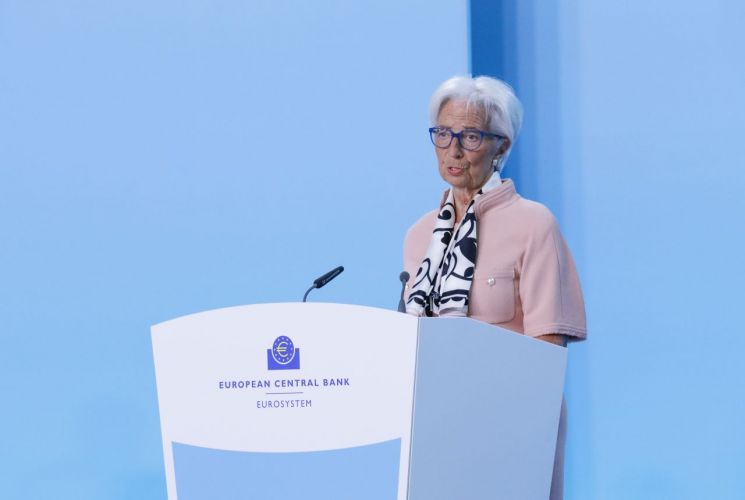 Christine Lagarde, President of the European Central Bank (ECB), is speaking at a press conference held at the ECB headquarters in Frankfurt, Germany, on the 17th (local time). Photo by Xinhua News Agency
The European Central Bank (ECB) is increasingly likely to implement its eighth interest rate cut on June 6 to prepare for the shock from tariff measures by a potential second Trump administration. This is due to inflation approaching 2% and a worsening economic outlook for Europe.
On the 27th (local time), Bloomberg News reported that the ECB is preparing an additional rate cut, anticipating long-term damage to the European economy from U.S.-imposed tariffs. As of this day, the current policy rate stands at 2.25%.
On the 17th, the ECB lowered its key deposit rate, which serves as the benchmark for monetary policy, by 25 basis points (1bp=0.01 percentage point) from 2.50% to 2.25% per annum. Since June 2023, the ECB has cut rates seven times.
Previously, on the 26th, Reuters also noted that ECB policymakers are increasingly confident about a rate cut in June as inflation continues to decline.
Global investment banks (IBs) such as Bank of America, Deutsche Bank, and Morgan Stanley expect the current rate of 2.25% to fall to around 1.5% by the end of this year.
During the International Monetary Fund (IMF) and World Bank Spring Meetings held last week in Washington, D.C., a consensus emerged that global uncertainty related to Trump would persist, leading to increased concerns among European officials.
Christine Lagarde, President of the ECB, has maintained a data-driven approach to rate policy decisions. She stated, "When the magnitude and distribution of shocks are extremely uncertain, it is impossible to commit to a specific rate path," emphasizing that "the ECB must rely extremely heavily on data."
Europe's economic growth momentum is slowing. Purchasing Managers' Index (PMI) surveys have revealed declining confidence and weak demand. The IMF recently lowered its growth forecast for the 20 eurozone countries by 0.2 percentage points, from 1% to 0.8%. Inflation, a key indicator for rate direction, is also decelerating. Both the IMF and the ECB expect inflation to reach the 2% target in the second half of this year.
There have also been statements supporting further rate cuts by the ECB. Olli Rehn, Governor of the Bank of Finland, said, "We must maintain agile and proactive monetary policy without setting specific limits on the rate path." Madis M?ller, Governor of the Bank of Estonia, also commented, "If trade uncertainty intensifies, monetary policy may be eased further."
However, regarding the size of rate cuts, it is widely expected that the ECB will maintain the previous level of 25 basis points. Citing sources, Reuters reported that policymakers see no reason at this time to consider a larger cut of 50 basis points. They also expressed concern that such a move could unnecessarily alarm the market.
© The Asia Business Daily(www.asiae.co.kr). All rights reserved.
![Clutching a Stolen Dior Bag, Saying "I Hate Being Poor but Real"... The Grotesque Con of a "Human Knockoff" [Slate]](https://cwcontent.asiae.co.kr/asiaresize/183/2026021902243444107_1771435474.jpg)















