Patent Registered for "Wet Tensile Strength Measurement"
of Traditional Hanji Paper by National Research Institute of Cultural Heritage
The National Research Institute of Cultural Heritage announced on the 28th that it has developed and registered a patent for a "method of measuring the wet tensile strength (the maximum stress a material can withstand when being pulled) of traditional hanji paper." The institute plans to collaborate with related research organizations and industries to increase practical applications in the field.
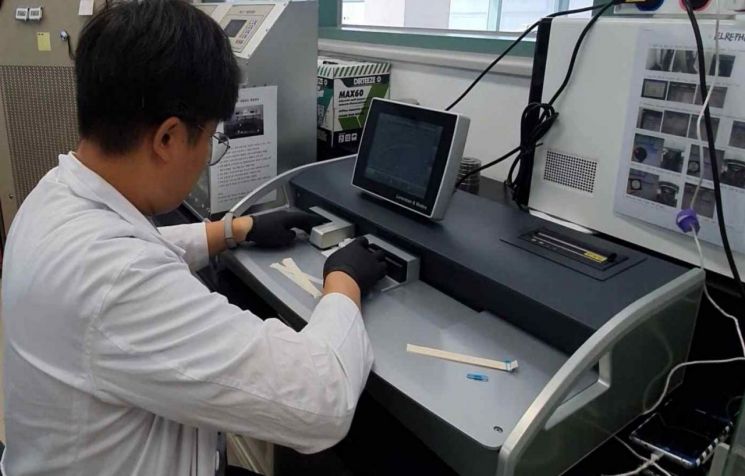 A scene of the National Research Institute of Cultural Heritage measuring the wet tensile strength of hanji paper
This is a test analysis method for scientifically evaluating the durability and quality of hanji paper. Until now, the quality evaluation of hanji was conducted using the "general pulp paper (machine-made paper) test method" specified in the Korean Industrial Standards (KS). However, hanji and Western paper differ in raw materials and manufacturing methods, making it difficult to apply the same criteria to both.
The newly developed method measures the stress hanji can withstand when pulled while wet. Hanji samples, cut to a width of 50 mm, are immersed in water for at least 3,600 seconds. The samples are then pulled from both ends at a speed of 20 mm per minute to measure their resistance.
Wet tensile strength is a measurement standard required for evaluating the quality of hanji used in the repair and restoration of paper-based cultural heritage. The institute explained, "Hanji is not only used to reinforce missing parts of cultural heritage but also for wet cleaning processes that remove contaminants and foreign substances from artifact surfaces, so measuring tear strength when wet is important." The institute added, "Consistent quality control can expand the use of traditional hanji in various fields such as architecture, daily necessities, and art."
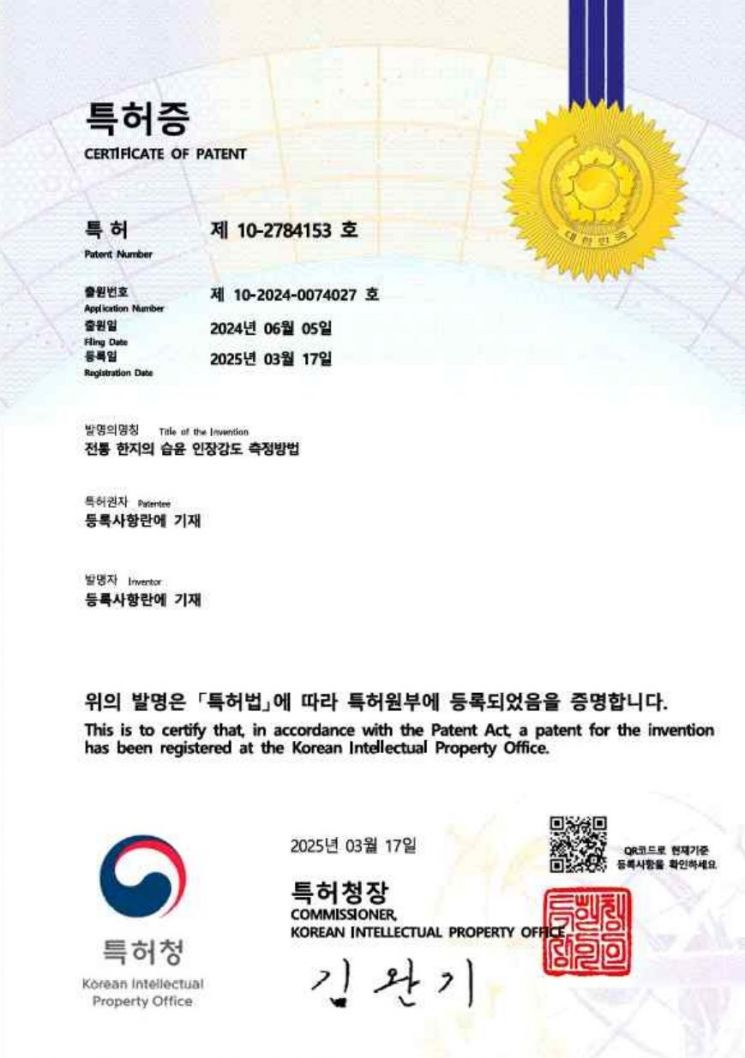
This is the second time a test analysis method for hanji has been registered as a patent. The first patented technology was the "method of measuring the internal tear strength of hanji (handmade paper produced sheet by sheet with a bamboo screen)." In the past, like Western paper, a sample with a width of 15 mm was subjected to a load of 4.91 to 14.72 N and then folded or bent to measure internal tear strength. However, since hanji is produced individually as single sheets of handmade paper (such as suchoji), there is inevitably a large variation in results between samples. To address this, the institute developed a measurement method using an appropriate sample width (10 mm) and load (4.91 N), which was registered as a patent in June 2023.
© The Asia Business Daily(www.asiae.co.kr). All rights reserved.
![Clutching a Stolen Dior Bag, Saying "I Hate Being Poor but Real"... The Grotesque Con of a "Human Knockoff" [Slate]](https://cwcontent.asiae.co.kr/asiaresize/183/2026021902243444107_1771435474.jpg)
















