Korea and the United States have agreed to produce a "July Package" before July 8, the date when the U.S. mutual tariff suspension is set to expire. Through the "Korea-U.S. 2+2 Trade Consultation," a one-month window has been secured for the next Korean administration to make decisions. However, even before the July Package is finalized, active negotiations are required on issues such as expanding imports of liquefied natural gas (LNG) to help reduce the U.S. trade deficit.
On April 27, Kang Insu, a professor at Sookmyung Women's University, stated, "Although the final negotiations have been postponed to July, Korea will inevitably need to lower tariffs on items such as automobiles, which would be impacted, and U.S. President Donald Trump also needs to achieve visible results through tariff measures." He added, "It is important to address at least some of the non-tariff barriers pointed out by the U.S., and efforts such as increasing LNG imports and investments by Korean companies in the U.S. are fully feasible under the current administration, so these efforts should be pursued actively."
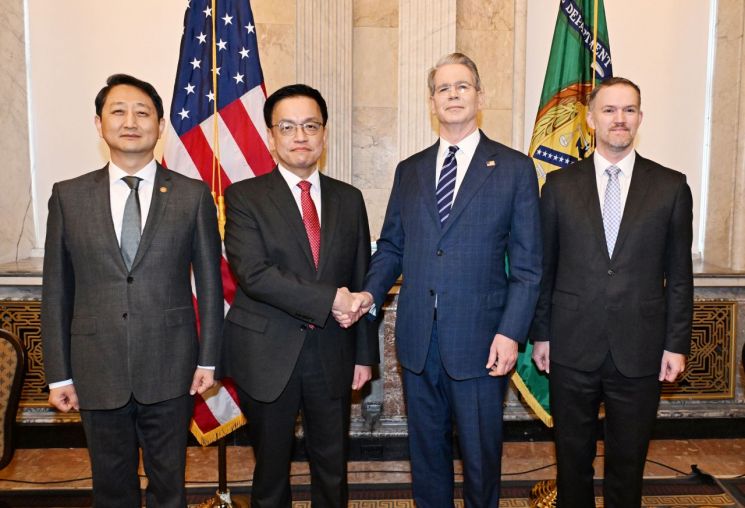 On the 24th (local time), in the Treasury Department meeting room in Washington D.C., USA, An Deokgeun, Minister of Trade, Industry and Energy (from the left), Choi Sangmok, Deputy Prime Minister for Economic Affairs and Minister of Economy and Finance, Steven Mnuchin, U.S. Secretary of the Treasury, and Katherine Tai, U.S. Trade Representative, attended the "Korea-U.S. 2+2 Trade Consultation" and took a commemorative photo.
On April 24 (local time), Choi Sangmok, Deputy Prime Minister for Economic Affairs and Minister of Economy and Finance, and An Deokgeun, Minister of Trade, Industry and Energy, met with Steven Mnuchin, U.S. Secretary of the Treasury, and Katherine Tai, U.S. Trade Representative (USTR), in Washington D.C. to hold a 2+2 Trade Consultation. During this meeting, the Korean government officially requested the elimination of tariffs not only on mutual tariffs but also on key items such as automobiles and steel. However, instead of reaching a concrete agreement on these issues, the two sides established a framework for future discussions and scheduling.
Deputy Prime Minister Choi, in a briefing on the outcome of the Korea-U.S. trade consultation, said, "Through today's 2+2 meeting, which marks the starting point of the Korea-U.S. consultations, we have narrowed down the agenda and established a consensus on the discussion schedule, thereby setting up the 'basic framework for consultation.' We agreed to prepare a July Package aimed at abolishing tariffs before the mutual tariff suspension ends on July 8, and to focus discussions on four key areas: tariffs and non-tariff measures, economic security, investment cooperation, and exchange rates (monetary policy), which are of interest to both sides."
There are expectations that "exchange cards" involving certain concessions could play a significant role in the July Package. For example, the Korean government is employing a strategy to induce the U.S. to lift tariffs by offering a certain level of cooperation in areas where the U.S. needs strategic partners, such as the Alaska LNG project. It is also calculated that expanding cooperation in shipbuilding, increasing investments by Korean companies in the U.S., and boosting LNG imports are politically acceptable domestically, regardless of which administration is in power.
Within and outside the industry, the outcome of this consultation is being interpreted as a "transfer of decision-making authority." Given the Korean political calendar ahead of the presidential election and the fact that the current administration is nearing the end of its term, it is realistically difficult for the current government to unilaterally push through major trade decisions. Therefore, the structure and framework of the negotiations have been established, but the substantive agreement is being left to the next administration. In reality, sensitive issues between Korea and the U.S., such as defense cost-sharing and the renegotiation of the Free Trade Agreement (FTA), were not addressed. Deputy Prime Minister Choi also explained, "I told the U.S. side that Korea's political schedule, including the presidential election, should be taken into account in future Korea-U.S. discussions," and "the U.S. side also agreed that such considerations are necessary."
While the name "July Package" outwardly means "to consult before the suspension ends," its essence is to provide the next Korean president with the space to make a final decision based on the legitimacy of the new administration and coordination with the National Assembly. Fortunately, there is about a month between the launch of the next Korean government in early June and the expiration of the mutual tariff suspension on July 8, giving the next administration ample time to reach an agreement with the U.S. The current administration is laying the groundwork for negotiations as much as possible before the next government takes office, but is designed so that the final decision will be made by the next administration. The U.S. also appears to be taking these circumstances into account. The Trump administration, which is strengthening its protectionist stance, has withheld a clear position on Korea. This is interpreted as an attempt to broaden its options by observing the outcome of Korea's presidential election and the trade policy direction of the next administration.
There is also analysis that this consultation does not simply amount to a "handover." The current administration is not merely buying time in the short term, but is also preparing measures that take into account Korea's national interests. Since a clear goal of eliminating the recently imposed U.S. tariffs has been set and Korea's position has been repeatedly conveyed to the U.S., there remains the possibility of making substantial progress in future negotiations based on these efforts.
© The Asia Business Daily(www.asiae.co.kr). All rights reserved.
![Clutching a Stolen Dior Bag, Saying "I Hate Being Poor but Real"... The Grotesque Con of a "Human Knockoff" [Slate]](https://cwcontent.asiae.co.kr/asiaresize/183/2026021902243444107_1771435474.jpg)















