Five Core Projects for Higher Education Innovation and Regional Coexistence, with 12 Sub-Projects Launched
Six Universities, Including Chungnam National University and Hannam University, to Lead the "Collaborative Research with Government-Funded Institutes" Project
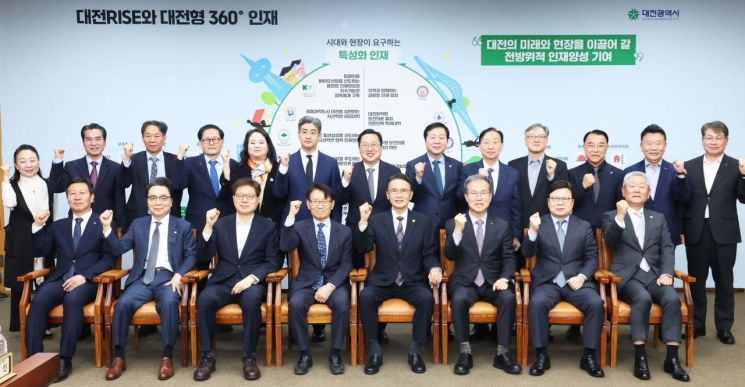 Daejeon City selected 13 universities on the 25th to carry out the Regional Innovation-Centered University Support System (RIES) project. / Daejeon City
Daejeon City announced that it has selected 13 universities to carry out the Regional Innovation-Centered University Support System (RISE) project, which has a budget of 65.5 billion won.
On the 25th, the city held the Daejeon RISE Committee, co-chaired by Daejeon Mayor Lee Jangwoo and Chungnam National University President Kim Jungkyum, and made this decision.
The selected universities are Konyang University (Medical Campus), Korea National University of Transportation, Daedeok University, Daejeon Institute of Science and Technology, Daejeon University, Daejeon Health Institute of Technology, Mokwon University, Paichai University, Woosong University, Woosong Information College, Eulji University, Chungnam National University, and Hannam University.
These universities will collaborate with a variety of organizations and other universities, including government-funded research institutes, regional innovation agencies, local businesses, and Korea Polytechnic IV, to implement five core projects aimed at higher education innovation and regional coexistence.
The five core projects are: ▲ Regional-leading university education specialization (15.4 billion won), ▲ Local settlement-based employment and entrepreneurship promotion (19.2 billion won), ▲ Sustainable advancement of university-industry-research collaboration (17.7 billion won), ▲ Lifelong and career education enhancement (5.1 billion won), and ▲ RISE-driven solutions for local issues and the creation of a vibrant city (6.9 billion won).
In particular, six universities, including Chungnam National University, Korea National University of Transportation, and Hannam University, will undertake the representative Daejeon RISE project, "collaborative research with government-funded research institutes," and will work to establish a regional innovation model that connects talent development, research and development, and commercialization.
To systematically manage the outcomes of the RISE project, the city plans to establish three autonomous performance indicators: the "Daejeon 360-Degree Talent Development Education Innovation Index (D1)," the "University-Industry-Research Collaboration Index (D2)," and the "Regional Vitality Index (D3)." By 2029, these will be integrated into the "Daejeon RISE Ecosystem Index (D-Triple)."
The city will notify each university of the selection results, conduct an objection process, and then sign agreements between the Daejeon RISE Center and the participating universities in May.
Lee Jangwoo, Mayor of Daejeon, stated, "At the beginning of this year, we achieved the additional securing of 12.4 billion won in national funding through the Ministry of Education's evaluation of the RISE plan," and added, "Going forward, local governments, universities, industry, and research institutions will continue to cooperate horizontally to achieve educational innovation, revitalize the region, and pursue sustainable growth together."
© The Asia Business Daily(www.asiae.co.kr). All rights reserved.
![Clutching a Stolen Dior Bag, Saying "I Hate Being Poor but Real"... The Grotesque Con of a "Human Knockoff" [Slate]](https://cwcontent.asiae.co.kr/asiaresize/183/2026021902243444107_1771435474.jpg)















