Factors Behind the Slowdown in Upstream Demand for Electric Vehicles
Samsung SDI announced on the 25th that it recorded an operating loss of 434.1 billion won in the first quarter of this year, turning to a deficit compared to the previous year. The company attributed this to inventory adjustments by major customers and the entry of the energy storage system (ESS) market into its seasonal off-peak period. Samsung SDI expects a gradual improvement in performance starting from the second quarter.
First-quarter sales amounted to 3.7545 trillion won, a decrease of 34.0% compared to last year, while net loss reached 216 billion won, also turning to a deficit during the same period.
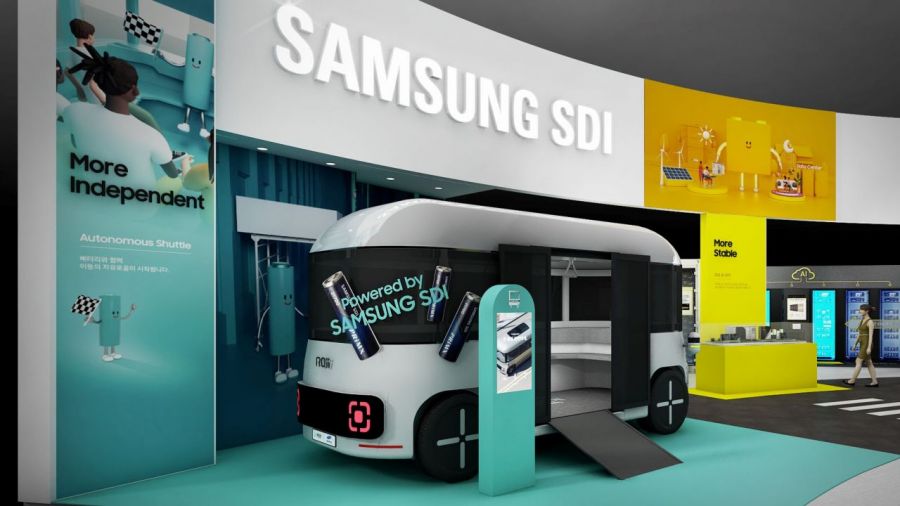 Samsung SDI participated in 'InterBattery 2025,' the largest domestic battery exhibition, which opened on the 5th of last month at COEX in Gangnam-gu, Seoul, unveiling a wide range of innovative battery technologies and products. Photo by Samsung SDI, Yonhap News
By business division, the battery segment posted sales of 2.9809 trillion won, down 34.9% year-on-year, with an operating loss of 452.4 billion won. Samsung SDI explained, "Sales declined due to inventory adjustments by major customers, such as those for electric vehicles and power tools, as well as the seasonal off-peak period in the energy storage system (ESS) market. As a result, profitability deteriorated due to lower utilization rates and increased fixed costs."
The electronic materials segment recorded sales of 195.9 billion won, a 16.4% decrease compared to the same period last year, and operating profit reached 18.3 billion won. The company stated, "Demand, especially for organic light-emitting diode (OLED) materials, increased, resulting in a slight rise in sales and improved profitability compared to the previous quarter."
Samsung SDI also announced that it has completed the early start-up and is operating its joint venture with Stellantis in the United States, and has begun construction of a joint venture with General Motors (GM) with the goal of mass production by 2027. The company further explained that it has started mass production of 46-pi cylindrical batteries and signed a memorandum of understanding (MOU) with Hyundai Motor Group for the joint development of batteries exclusively for robots, thereby pursuing portfolio diversification and securing a competitive edge in its products.
The company expects that, starting from the second quarter of this year, front-end demand will gradually recover, leading to a gradual improvement in performance. However, it also anticipates increased demand volatility due to uncertainties such as recent tariff policies. In the electric vehicle segment, inventory adjustments by major original equipment manufacturers (OEMs) are being completed, and demand is recovering, particularly in Europe, where carbon dioxide regulations and electric vehicle support policies are being implemented. However, demand uncertainty due to U.S. tariff policies is expected to persist.
Regarding its goal for mass production of all-solid-state batteries, the company stated, "We are pursuing key tasks such as stabilizing the manufacturing process and establishing a materials supply chain to ensure smooth progress." It added, "We expect to be able to apply these batteries to areas requiring high energy density, such as robots and urban air mobility (UAM), and are conducting various discussions with customers." For the ESS segment, Samsung SDI forecasted, "Growth centered on the power supply and uninterruptible power supply (UPS) markets will continue, driven by the global expansion of renewable energy and artificial intelligence (AI) data centers. In addition, the finalization of the 11th Basic Plan for Electricity Supply and Demand is expected to expand domestic project opportunities."
Samsung SDI plans to expand sales of the Samsung Battery Box (SBB) for power supply, which features safety and high energy density, as well as high-output batteries for UPS. The company also intends to actively participate in domestic power grid stabilization projects to maintain high growth. In the small battery segment, Samsung SDI aims to expand sales of battery backup units (BBU), which are expected to see increased demand due to the rise in AI data centers, and to secure sales and profitability related to mobile devices. For the electronic materials segment, the company plans to expand sales of high value-added products, such as semiconductor patterning materials and materials for foldable OLEDs, as demand for semiconductors and OLED materials is expected to remain robust.
A Samsung SDI official stated, "Although uncertainty in the business environment remains high in the second quarter, performance is expected to improve from the first quarter, which will serve as the bottom. Samsung SDI will pursue performance improvement while also steadily preparing to secure future competitiveness."
© The Asia Business Daily(www.asiae.co.kr). All rights reserved.
![Clutching a Stolen Dior Bag, Saying "I Hate Being Poor but Real"... The Grotesque Con of a "Human Knockoff" [Slate]](https://cwcontent.asiae.co.kr/asiaresize/183/2026021902243444107_1771435474.jpg)















