Recently Showing Decreased Appetite and Reduced Activity
Strengthened Health Monitoring During Fertile Period
The giant panda "Fubao," born at Everland in Yongin and sent to China due to related policies, has shown signs of pseudopregnancy again this year, following last year. Female pandas often experience pseudopregnancy?a state in which they display pregnancy symptoms without actually being pregnant?during their growth process toward sexual maturity when they become capable of conceiving. On April 24 (local time), the China Conservation and Research Center for the Giant Panda announced on Weibo, "In February of this year, Fubao exhibited normal estrus behavior," and added, "Since the 20th of this month, Fubao has shown a noticeable decrease in appetite, reduced bamboo intake, decreased defecation, lower activity levels, and increased rest time."
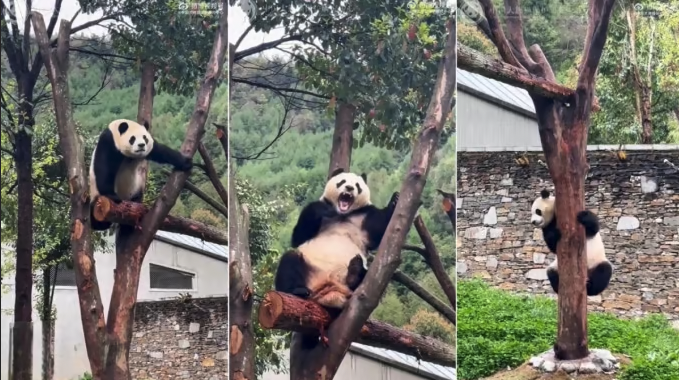 The giant panda "Fubao," born at Everland in Yongin and sent to China due to related policies, showed signs of pseudopregnancy again last year. Female pandas often experience pseudopregnancy, a state where they exhibit pregnancy symptoms without actually being pregnant, during their growth process toward sexual maturity when they become capable of pregnancy. Weibo
The center continued, "According to examinations by the husbandry and health management team, Fubao has entered a state of pseudopregnancy, as clear physiological changes were observed in her vulva and hormone levels," and added, "We will continue to closely monitor the progress of this pseudopregnancy. We will also do our best to help Fubao safely get through this period."
Pandas are known to be animals for whom natural pregnancy is extremely difficult. The estrus period comes only once a year and lasts for only about one to three days, and each panda lives a solitary life. Even if fertilization occurs through mating, the fertilized egg often does not immediately implant in the panda's uterus and instead floats for several months, making it difficult to predict the exact timing of birth. This phenomenon is called "delayed implantation." As a result, female pandas often show signs of pseudopregnancy even if they have not mated.
Previously, Fubao experienced pseudopregnancy symptoms for over a month starting at the end of August last year. Because false pregnancy and true pregnancy in pandas are nearly indistinguishable, it is known to be difficult to confirm pregnancy until just before birth. Since the symptoms are identical to those of actual pregnancy, the panda must refrain from activity and focus on sleep and rest during the two-month period in which the symptoms persist. Fubao's mother, Aibao, also experienced pseudopregnancy symptoms in 2017. Even in cases of pseudopregnancy, because the symptoms are the same as actual pregnancy, the panda must limit activity and prioritize sleep and rest for the two months that the symptoms continue.
Fubao's mother, Aibao, also exhibited these symptoms in 2017. Fubao was born in 2020 to Le Bao and Ai Bao, who were sent by Chinese President Xi Jinping in 2016 as part of a Korea-China friendship and diplomatic initiative. Having become a star attraction at Everland and beloved by the public, Fubao was sent to China in April last year under the "Giant Panda Conservation and Research Agreement."
© The Asia Business Daily(www.asiae.co.kr). All rights reserved.
![Clutching a Stolen Dior Bag, Saying "I Hate Being Poor but Real"... The Grotesque Con of a "Human Knockoff" [Slate]](https://cwcontent.asiae.co.kr/asiaresize/183/2026021902243444107_1771435474.jpg)















