Increase of 364 Billion Won Compared to the Original Budget This Year... Local Bonds to Be Issued
"Focus on Livelihood Stabilization and Local Economic Revitalization"
On April 25, Gangwon Special Self-Governing Province (Governor Kim Jin-tae) announced that it has drawn up the first supplementary budget proposal for 2025, totaling 8.1698 trillion won, and will submit it to the provincial council on April 28. This represents an increase of 364 billion won (4.7%) compared to the original 2025 budget of 7.8059 trillion won.
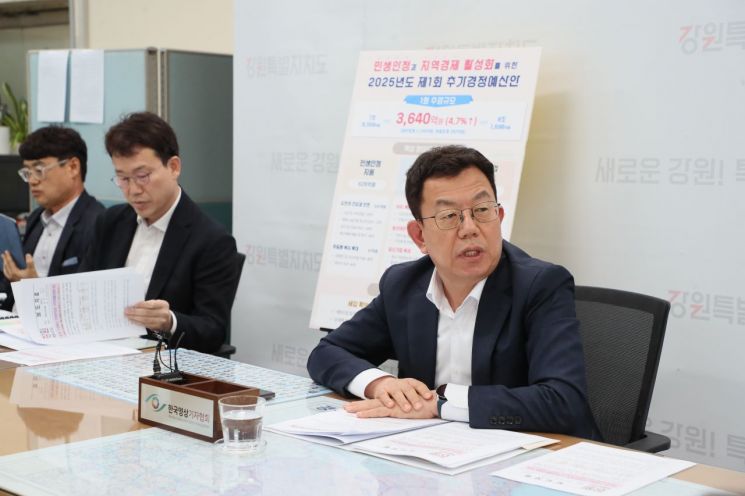 Lee Heeyeol, Director of Planning and Coordination at Gangwon Special Self-Governing Province, held a press briefing on the 25th at the Gangwon Provincial Government press room to explain the first supplementary budget proposal of the year. Photo by Gangwon Provincial Government
Gangwon Province also added that, due to difficult fiscal conditions such as decreases in acquisition tax, general grants, and net world surplus, it is inevitably issuing local bonds. The total issuance amounts to 190 billion won, consisting of 52.8 billion won for the Co-Prosperity Development Fund and 137.2 billion won from financial institutions. This is the first time in four years that Gangwon Province has issued local bonds, with the last issuance being 100 billion won in 2021.
This supplementary budget was prepared using funds from central government subsidies allocated after the original budget, increases in general grants, net world surplus, and local bonds.
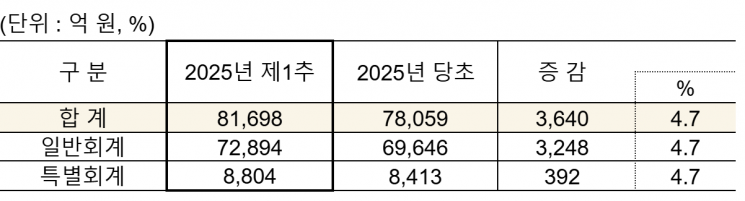 Gangwon Special Self-Governing Province 2025 First Supplementary Budget. Data provided by Gangwon Special Self-Governing Province Office.
The province's main tax revenue source, acquisition tax, was 730.6 billion won in 2021 but has decreased to 579.5 billion won in 2025 due to a slowdown in real estate transactions. General grants also declined from 1.1171 trillion won in 2021 to 1.0767 trillion won this year, resulting in continued fiscal difficulties.
In addition, the net world surplus, a major resource for the supplementary budget, decreased by more than 100 billion won compared to the previous year, making the issuance of local bonds inevitable to stabilize livelihoods and revitalize the local economy.
The first supplementary budget proposal focuses on investment in livelihood stabilization and local economic revitalization projects (244.5 billion won), future investments such as advanced industries (28.6 billion won), and statutory essential projects (51.7 billion won).
First, livelihood stabilization projects include initiatives for the safety and health of residents and customized welfare programs.
Specifically, 53.1 billion won will be allocated to safety and health for Gangwon residents, 12.3 billion won to fire and autonomous police services, 7.2 billion won to the construction and maintenance of sports facilities, 6.4 billion won to strengthening public medical services including the operation of the Regional Essential Doctor System, 1.5 billion won to stormwater runoff reduction facilities, and 1.5 billion won to deploying wildfire monitors in wildfire-prone areas. The welfare sector will receive an investment of 9.6 billion won.
For local economic revitalization, the budget includes improvements to SOC infrastructure, increased income for rural, fishing, and agricultural communities, and the promotion of Gangwon tourism.
In the SOC sector, 92.9 billion won will be invested. Of this, 51.7 billion won will go to road infrastructure improvements, 19.6 billion won to local river maintenance for flood prevention and the creation of waterfront spaces, and 12.3 billion won to the construction of the new Gangwon Provincial Government office building. Investment in SOC infrastructure improvement projects is expected to contribute to increased orders for local construction companies.
In addition, 65.2 billion won is allocated for boosting the economic vitality and stabilizing the incomes of rural, fishing, and agricultural communities. The tourism sector, aimed at revitalizing the local economy, will receive 11.4 billion won.
For future investments such as advanced industries, a total of 28.6 billion won will be allocated, including 11.4 billion won for local investment promotion subsidies, 3.2 billion won for regional specialized lease-type smart farms, and 1.1 billion won for the establishment of the Korea Semiconductor Training Center. This supplementary budget is expected to continue investments in future growth engines.
Lee Heeyeol, Director of Planning and Coordination, said, "Since the launch of the 8th popularly elected administration, we have made significant efforts to improve our fiscal situation, including debt management, and have achieved visible results." He added, "However, as the economic downturn continues, we have inevitably decided to issue local bonds to support the livelihood economy and future growth engines." He continued, "We will strive to efficiently manage the projects in this supplementary budget so that all residents can truly feel the benefits."
© The Asia Business Daily(www.asiae.co.kr). All rights reserved.


















