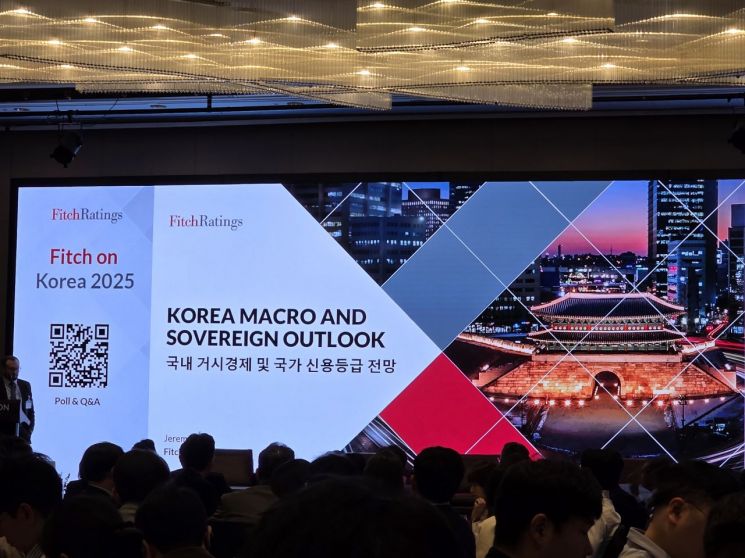
'Fitch on Korea 2025'
Recent forecast expects Korea's 2025 growth at 1%...Concerns over tariff uncertainty
"Bank of Korea to cut rates by 1 percentage point by year-end...Expecting 1.75% by year-end"
Global credit rating agency Fitch Ratings has indicated that if the United States implements reciprocal tariffs, South Korea's economic growth forecast for this year could be further downgraded to the 0% range. Fitch assessed that if, following the Trump-era universal tariffs, additional measures such as a 25% reciprocal tariff and item-specific tariffs are imposed, it would deal a direct blow to growth. While Fitch viewed the growing expectations for a 'package agreement in early July' following the recent U.S.-Korea 2+2 trade talks as positive, it also warned of the uncertainties facing the Korean economy, noting that it will take considerable time until the next administration is in place and that Korea's negotiating power is inevitably limited.
Recent forecast expects Korea's 2025 growth at 1%...Concerns over tariff uncertainty
Jeremy Zook, Director for Asia-Pacific at Fitch, made these remarks during the 'Fitch on Korea 2025' conference held at the Conrad Hotel in Yeouido on April 25, speaking on the topic of 'Korea's Macroeconomy and Sovereign Credit Outlook.' Director Zook stated, "If the U.S. implements reciprocal tariffs, it could significantly impact export-oriented countries in the Asia-Pacific region such as Vietnam and Korea," adding, "This month, Fitch has downgraded growth forecasts across the board, and if reciprocal tariffs are introduced, there is a possibility of further downward revisions."
In its economic outlook report released last week, Fitch lowered its global economic growth forecast for this year from 2.3%?projected just a month ago?to 1.9%. Korea's growth forecast was also revised downward from 1.3% to 1.0%. Director Zook explained the rationale for the recent downgrade, saying, "Both globally and in terms of Korea's economic and political situation, we are at a critical juncture. One clear fact amid the constantly changing tariff outlook is that U.S. trade policy itself has fundamentally changed from the past."
He also suggested the possibility of further adjustments if the U.S. reciprocal tariffs, currently suspended until early July, are implemented. He pointed out, "Even aside from the 10% universal tariff and 25% reciprocal tariff, Korea is also subject to item-specific tariffs, such as on automobiles."
Director Zook referenced the recently released figure showing Korea's real GDP growth rate for the first quarter was -0.2% quarter-on-quarter, noting, "Weakness in domestic demand has been confirmed, and external challenges have also increased significantly." He particularly expressed concern about the high level of uncertainty in trade due to the Trump tariffs. He said, "While the U.S.-Korea 2+2 trade talks last night have raised some expectations for an agreement in early July, uncertainty remains high. With the presidential election in June, the ability to reach a swift agreement is inevitably constrained, and it will take time until the new administration is established."
However, he assessed that sluggish domestic demand could rebound by the end of this year. Director Zook explained, "With the Bank of Korea lowering the base interest rate, households will have greater spending capacity. The labor market is also fairly robust, and political uncertainty (as seen during the impeachment period) has eased." Nevertheless, he added that uncertainty remains on the global policy front, including tariffs, and thus the scale of the rebound is unlikely to be large.
"Bank of Korea to cut rates by 1 percentage point by year-end...Expecting 1.75% by year-end"
Director Zook also predicted that the Korean government will adopt further monetary easing (rate cuts) and expansionary fiscal policies, while noting that Fitch will closely monitor risks related to household and national debt in its credit rating assessments.
Regarding monetary policy, he forecast an additional 100 basis points of rate cuts within the year, which would bring the year-end base rate to 1.75%. He explained, "With the growth outlook weakening and inflation well-contained, the Bank of Korea is likely to move further toward monetary easing." On fiscal policy, he said, "A substantial supplementary budget is likely to be implemented. While there may be economic side effects, from a credit rating perspective, Korea has fiscal space."
He continued, "While Korea still has fiscal space in terms of national debt, the situation has worsened compared to five years ago. Ultimately, this will be an important factor in future credit rating assessments," adding, "We will wait for the new administration's medium-term fiscal outlook plans. Fundamentally, I expect the trajectory to continue upward."
Director Zook also emphasized that despite recent domestic and external uncertainties, Korea still has ample credit strength to manage these risks. In February, Fitch maintained Korea's sovereign credit rating at 'AA- (Stable).' He explained, "Despite increased political volatility, we maintained a stable outlook because, from a fundamentals and feasibility perspective, these factors do not impact Korean governance," adding, "Korea has resilience."
He also warned that for Korea's future sovereign credit outlook, "If political division and gridlock persist for an extended period, the effectiveness of economic policy management will decline," and "If the national debt ratio rises sharply from a fiscal perspective, it will act as a negative trigger." He further added, "In terms of geopolitical risk, a further escalation of North Korea-related risks or developments in U.S.-China relations could also become issues."
© The Asia Business Daily(www.asiae.co.kr). All rights reserved.
![Clutching a Stolen Dior Bag, Saying "I Hate Being Poor but Real"... The Grotesque Con of a "Human Knockoff" [Slate]](https://cwcontent.asiae.co.kr/asiaresize/183/2026021902243444107_1771435474.jpg)















