KITA: "Core Agendas Clearly Defined"
KEF Also "Expecting Constructive Discussions"
Companies Watching With Mixed Expectations and Concerns
Close Attention to Possible Exclusion of Tariffs on Automobiles and Other Items
The business community has expressed optimism regarding the Korea-US '2+2 Trade Consultation' that began in the United States. Although specific details of the negotiations have not yet been disclosed, there is a consensus that Korea performed well in setting the agenda and roadmap, which are crucial in trade negotiations where nuanced direction and leadership are important. However, there are also calls for a meticulous strategy to achieve concrete objectives, such as abolishing tariffs and reciprocal tariffs on automotive products, which have a significant negative impact on the Korean economy.
On the 24th (local time), the Korea-US 2+2 Trade Consultation began at the US Department of the Treasury. The Korean delegation included Choi Sangmok, Deputy Prime Minister and Minister of Economy and Finance, and Ahn Deokgeun, Minister of Trade, Industry and Energy. The US side was represented by Wally Adeyemo, Deputy Secretary of the Treasury, and Jamieson Greer, Acting United States Trade Representative (USTR).
According to the Ministry of Economy and Finance, both sides agreed to prepare a 'July Package' aimed at abolishing tariffs before July 8, when the US reciprocal tariff waiver expires. They also agreed to focus discussions on four key areas: tariffs and non-tariff measures, economic security, investment cooperation, and currency (exchange rate) policy.
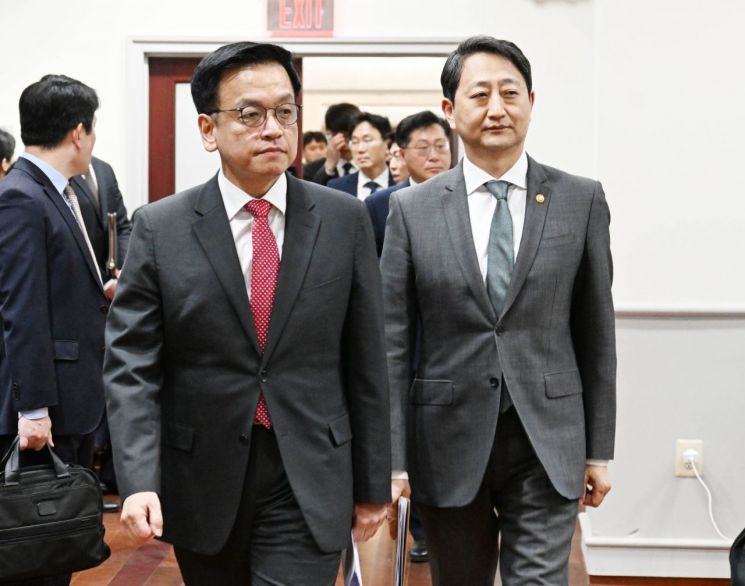 Choi Sangmok, Deputy Prime Minister and Minister of Economy and Finance (left), is attending the briefing on the results of the Korea-US 2+2 Trade Consultation held at the Embassy of the Republic of Korea in Washington DC on the 24th (local time). Photo by Yonhap News
Jang Sangshik, Head of the International Trade and Commerce Research Institute at the Korea International Trade Association, commented, "The Korea-US 2+2 Trade Consultation stands out for clearly defining four core agendas?tariffs, non-tariff measures, investment, and currency policy?and for establishing a systematic negotiation roadmap by introducing a concrete deadline, the 'July Package.' In particular, I positively assess that the discussions were conducted calmly and orderly, minimizing potential risks even during the presidential election period."
He added, "It appears that the issue of automotive tariffs, which is our greatest concern, will be officially included in the agenda, which is expected to help alleviate industry uncertainty. However, since the US currently holds the overall lead in the negotiations and the unpredictable actions of President Donald Trump remain a major variable, a thorough response and risk management will be necessary going forward."
Shin Wonkyu, Visiting Research Fellow at the Korea Economic Research Institute, also stated, "It is significant that consultations were held with Deputy Secretary Adeyemo, who oversees US economic policy, and with Representative Greer, who can substantively discuss trade policy in a potential second Trump administration. This lays the groundwork for mutual understanding and reciprocal initiatives between the two countries. We hope that constructive discussions will continue in the future."
Regarding the direction of future negotiations, he said, "It is important to identify the minimum requirements that would satisfy the US in order to secure exemptions from reciprocal tariffs and product-specific tariffs such as those on automobiles."
Another business representative commented, "It seems that the four agendas have been set in a balanced manner. However, future discussions should be oriented toward strengthening our industrial competitiveness."
Companies are closely monitoring the negotiation process with a mix of anticipation and concern. A representative from the steel industry explained, "The steel and aluminum sectors were the first to be hit by the US Section 232 measures, resulting in significant damage: POSCO's operating profit declined, and Hyundai Steel even recorded a loss." While evaluating the swift progress of the negotiations positively, the representative added, "If the government's negotiation process leads to improvements in the trade balance and the existing 25% high tariffs are eased or abolished, it would be possible to secure profitability by adjusting export volumes and focusing on premium product exports."
A representative from the finished car industry remarked, "Since the US government may strategically exclude automotive tariffs from the main negotiation topics, it is too early to be relieved. We will respond as a unified team with the government." Some also noted that it is premature to evaluate the negotiations in the absence of concrete details. A POSCO representative stated, "It is currently difficult to say anything definitive. It is still too early to express any expectations, as the results remain unclear."
© The Asia Business Daily(www.asiae.co.kr). All rights reserved.
![Clutching a Stolen Dior Bag, Saying "I Hate Being Poor but Real"... The Grotesque Con of a "Human Knockoff" [Slate]](https://cwcontent.asiae.co.kr/asiaresize/183/2026021902243444107_1771435474.jpg)
















