Carrying Out 59 Scientific Experiments and More... Scheduled to Return in October
Chang'e 8 Lunar Probe to Launch Around 2029
Chang'e 5 Lunar Samples to Be Loaned to U.S. Universities and Others
On April 24, China launched the manned spacecraft Shenzhou 20, which will be used to conduct scientific research and other activities aboard the domestically constructed Tiangong space station.
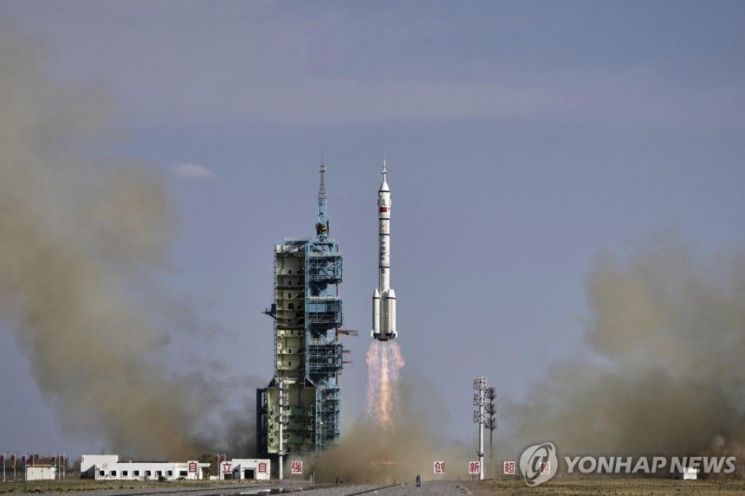 Launch of the manned spacecraft Shenzhou 20 from the Jiuquan Satellite Launch Center in Gansu Province, central-west China. Photo by AP Yonhap News
According to China’s state-run Xinhua News Agency and the Hong Kong-based South China Morning Post (SCMP), at approximately 5:17 p.m. local time, China launched Shenzhou 20 aboard a Long March-2F rocket from the Jiuquan Satellite Launch Center in Gansu Province, central-west China.
The China Manned Space Agency (CMSA) announced that after the spacecraft entered orbit, the launch was successfully completed at 5:36 p.m. Shenzhou 20 is scheduled to dock with the Tiangong space station, which is in low Earth orbit, about six hours and thirty minutes after launch. The crew consists of three male astronauts: Chen Dong (commander), Chen Zhongrui, and Wang Jie. Commander Chen Dong previously participated in the Shenzhou 11 mission in 2016 and the Shenzhou 14 mission in 2022, and has returned as commander after two years. Chen Zhongrui is a former Air Force pilot, while Wang Jie studied aerospace engineering at university and worked as an engineer at the state-owned China Aerospace Science and Technology Corporation (CASC). For both Chen Zhongrui and Wang Jie, this is their first spaceflight.
The crew will stay for six months, conducting 59 experiments in space and life sciences, installing devices to protect Tiangong from space debris, handling cargo, and carrying out maintenance tasks. They are scheduled to return at the end of October. Their experiments include studies on high-temperature superconducting materials, regeneration in planarian flatworms, the effects of microgravity?an environment close to zero gravity?on zebrafish, and research on Streptomyces, a bacterium that produces antibiotics. The crew will also rotate with the Shenzhou 19 astronauts, who left Earth in October last year. The Shenzhou 19 crew is scheduled to return to Earth on April 29.
The launch of Shenzhou 20 coincided with China’s Space Day, which was established ten years ago to commemorate the launch of the country’s first satellite, Dongfanghong 1, in 1970. According to Xinhua News Agency, during Space Day events, the China National Space Administration (CNSA) announced plans to launch the lunar probe Chang’e 8 around 2029. As part of international cooperation, the mission will carry exploration equipment developed by 11 countries and regions, as well as one international organization.
The equipment includes a multifunctional robot designed by researchers from Hong Kong, an exploration rover from T?rkiye, a plasma and dust analyzer from Russia, and a lunar potential monitor from Iran. The CNSA also announced that it will allow seven institutions, including Brown University and Stony Brook University in New York?both of which receive funding from NASA?to borrow lunar samples collected by the Chang’e 5 mission in 2020. Relevant institutions from Japan, France, Germany, the United Kingdom, and Pakistan will also be able to borrow lunar samples. China began its lunar exploration project Chang’e (named after the moon goddess in Chinese mythology) in 2004, launched the unmanned Chang’e 1 probe in 2007, and succeeded in landing Chang’e 3 on the near side of the moon in 2013. Chang’e 4, launched in December 2018, became the first spacecraft in history to land on the far side of the moon in January of the following year. Chang’e 5, launched in 2020, collected about 2 kilograms of lunar samples and returned to Earth. Last year, Chang’e 6 became the first mission to collect samples from the far side of the moon and bring them back to Earth. China plans to launch Chang’e 7 in 2026 and Chang’e 8 in 2029, laying the groundwork to build a crewed research base near the lunar south pole by 2035.
© The Asia Business Daily(www.asiae.co.kr). All rights reserved.

















