U.S. Residential Energy Business: Profitability on the Rise
Module Prices and Sales Expected to Increase in Q2
Hanwha Solutions returned to profitability year-on-year in the first quarter, driven by improved profitability in its renewable energy business. The company’s competitiveness has increased as the U.S. tariff policy has blocked the influx of low-priced solar module products from China and Southeast Asia. As a result, Hanwha Solutions is expected to continue its trend of mid- to long-term performance improvement.
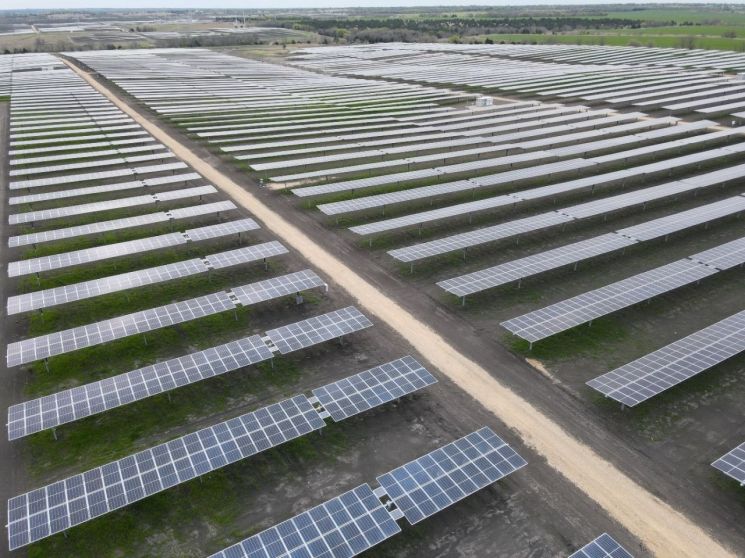 A 168MW solar power plant in Texas, USA, constructed and operated by Hanwha Q Cells. Provided by Hanwha Solutions
On April 24, Hanwha Solutions announced that its consolidated sales for the first quarter of this year reached KRW 3.0945 trillion, with an operating profit of KRW 30.3 billion. Sales increased by 31% compared to the same period last year, and the company returned to operating profit.
By business segment, the renewable energy division posted sales of KRW 1.5992 trillion and operating profit of KRW 136.2 billion, up 125% from the previous quarter. Hanwha Solutions explained, "The profitability improvement in the U.S. residential energy business drove both sales and operating profit higher than in the same period last year."
The achievements in the renewable energy segment are the result of Hanwha Solutions’ efforts to establish a production system and make proactive investments in the United States. The company currently operates large-scale manufacturing facilities in the U.S., running a portfolio that includes profits from subsidiary materials.
Two factors acted as favorable conditions: the average price of local solar modules in the U.S. increased as the country blocked the influx of low-priced products from China and Southeast Asia, and Hanwha Solutions received KRW 183.9 billion in Advanced Manufacturing Production Credit (AMPC) under the U.S. Inflation Reduction Act (IRA) in the first quarter.
A Hanwha Solutions representative said, "It is difficult to disclose U.S. module prices, but they are rebounding from their lowest point," adding, "Recently, some companies have been losing competitiveness in the U.S. market due to tariffs on products from Southeast Asia."
The chemical segment recorded sales of KRW 1.0736 trillion and an operating loss of KRW 91.2 billion. The company explained, "Ongoing oversupply of major products led to lower selling prices, and large-scale regular maintenance further weakened profitability." The company added, "In the second quarter, we expect profitability to improve, supported by the base effect from maintenance and solid market conditions for major products."
The advanced materials segment posted sales of KRW 273.8 billion and an operating loss of KRW 1.8 billion. Hanwha Solutions stated, "Although there was a burden from rising costs of lightweight composite materials, improved operating rates at the new U.S. solar material plant and other factors led to a slight improvement in operating losses." The company added, "In the second quarter, we expect operating profit to improve, driven by increased sales to major customers."
Yoon Ansik, Executive Vice President and Chief Financial Officer (CFO) of Hanwha Solutions, said, "In the second quarter, we expect continued growth in operating profit for the renewable energy segment, as module prices and sales volumes are expected to rise." He added, "We are targeting KRW 400 billion to KRW 500 billion in sales from asset divestitures and engineering, procurement, and construction (EPC) business in the second quarter."
© The Asia Business Daily(www.asiae.co.kr). All rights reserved.
![Clutching a Stolen Dior Bag, Saying "I Hate Being Poor but Real"... The Grotesque Con of a "Human Knockoff" [Slate]](https://cwcontent.asiae.co.kr/asiaresize/183/2026021902243444107_1771435474.jpg)















