There is a tent village consisting of 15 tents gathered under the western pillars of Seoul Station in Yongsan-gu, Seoul. When visited on May 1, twelve homeless people were struggling to survive in tents barely large enough to lie down in.
Um, a 50-year-old man who has been living in a waist-high tent, said, "If too many people find out about this place, sometimes we can't wash, so I have no choice but to get up at dawn when no one is around to wash myself," adding, "I also have to wash my hair quickly." On both sides of the tent village, there are construction sites and logistics unloading yards, and a busy road with cars speeding by is also nearby. The tents are set up on planks to avoid the cold, damp ground and rats, and several suitcases containing personal belongings are tied up next to them. Here, 'hygiene' is a luxury.
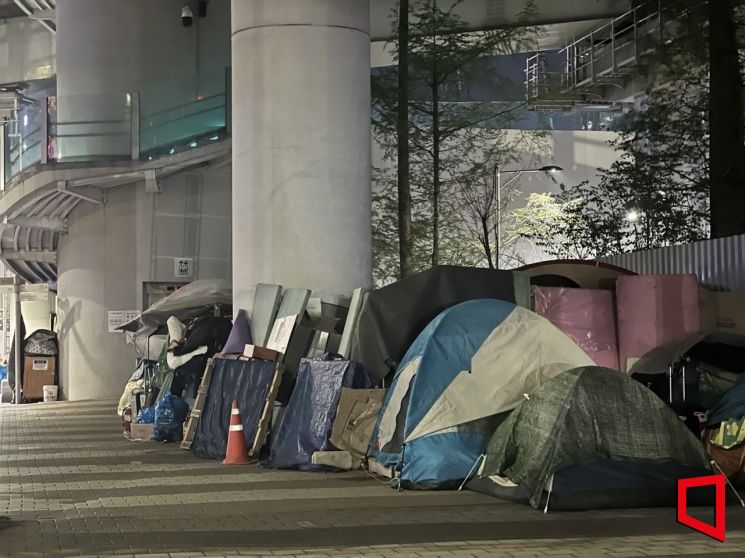
Although the conditions are extremely poor, the homeless people in the tent village cannot leave. There are places with better environments, such as shelters, small rooms, or gosiwon, but most cannot afford the cost or feel uncomfortable with communal living.
According to the Dasiseogi Comprehensive Support Center, a support facility for the homeless, there are about 200 homeless people living in the Seoul Station area, including those in the tent village. The center has been working to protect the homeless in the Seoul Station area and support their independence through housing, medical, and job assistance. Through daytime, nighttime, and late-night outreach activities, staff visit the homeless directly to build relationships, deliver daily necessities, or provide welfare service consultations.
However, the center has designated sleeping hours and restricts going out or staying out overnight. As a result, many homeless people who cannot adapt to the shelter facilities return to Seoul Station. A representative from the Dasiseogi Comprehensive Support Center said, "Some homeless people do go to shelter facilities, but most feel stifled by communal living," adding, "We do not force support policies, but we help them maintain a minimum quality of life and provide counseling if they request assistance."
Kim, a 68-year-old resident of the tent village, said, "You can live in a tent even without money, but you have to pay to stay in a small room or gosiwon," and added, "I used to sleep anywhere, even on the street or in the subway, but I think living with five people in a shelter would be uncomfortable." Jin, a 60-year-old also living in a tent patched with tape in various places, said, "I can't even afford a single room, and since I have no income, I can't go to a small room or gosiwon either."
Homeless people who cannot leave the tent village fall into various administrative blind spots. Bae, a 73-year-old whose resident registration was erased after continuing to live homeless since the days of the Chungjeongno tent village, is a prime example. Bae said, "I got injured doing construction work, hanging in dangerous places," and added, "My resident registration was erased, and I don't have a cell phone, so I can't even go to the hospital." There are also countless cases where it is difficult to find a job. Um said, "I was beaten by my family and had to have surgery on my arm, leg, and back," adding, "Since I can't work, I think I'll have to stay here for the time being."
Nam Ki-chul, a professor of social welfare at Dongduk Women's University, pointed out the limited housing options available to the homeless. Professor Nam said, "Although the housing facilities provided for the homeless, such as small rooms, are structurally poor, their costs often exceed the minimum housing benefit, and it is unclear whether they meet the legal minimum housing standards," adding, "There are housing projects run by the private sector and housing welfare centers, but local governments need to become more actively involved in management."
© The Asia Business Daily(www.asiae.co.kr). All rights reserved.
![Clutching a Stolen Dior Bag, Saying "I Hate Being Poor but Real"... The Grotesque Con of a "Human Knockoff" [Slate]](https://cwcontent.asiae.co.kr/asiaresize/183/2026021902243444107_1771435474.jpg)















