European Commission Imposes 813.3 Billion Won on Apple and 325.2 Billion Won on Meta
First Sanctions Under the Big Tech Anti-Bullying Law
The White House has pushed back against the European Union (EU) after it imposed fines totaling more than 1 trillion won on U.S. big tech companies Apple and Meta for violating the so-called "anti-bullying law," calling the move "economic extortion."
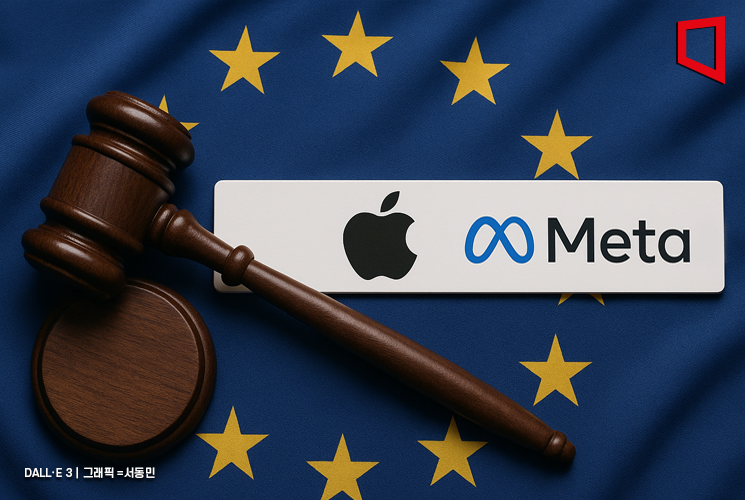
According to Reuters, on April 23 (local time), the White House stated its position regarding the fines imposed by the EU on Apple and Meta, describing them as "a new form of economic extortion" and declaring, "We will not tolerate it."
The White House spokesperson said, "Especially, extraterritorial regulations that target U.S. companies, stifle innovation, and force censorship are considered trade barriers," adding, "They will be perceived as a direct threat to a free civil society."
Additionally, the spokesperson argued that the Digital Markets Act (DMA) is discriminatory.
The DMA, commonly referred to as the big tech anti-bullying law, aims to prevent the abuse of market dominance by major platform operators. It designates seven companies, including Apple and Meta, as "gatekeepers" and subjects them to special regulations. Of these seven companies, five are headquartered in the United States.
On this day, the European Commission announced the results of its DMA violation investigation and decided to impose fines of 500 million euros (approximately 813.3 billion won) on Apple and 200 million euros (approximately 325.2 billion won) on Meta, respectively. This is the first time fines have been imposed on Apple and Meta since the full implementation of the DMA in March of last year. The EU has emphasized big tech companies as leverage in tariff negotiations with the United States.
The Commission determined that Apple's own "anti-steering" provision, which prohibits external payment inducement, violated the DMA. Application developers must be allowed to inform customers if there are cheaper app purchase options than the Apple App Store and must be able to direct them from the App Store to other external payment sites. However, Apple blocked this. Regarding Meta, the Commission took issue with the "pay or consent" model introduced in November 2023.
However, some analysts suggest that the relatively small amount of the fines and the repeated delays in announcing the investigation results indicate that the European Commission was being mindful of the United States.
© The Asia Business Daily(www.asiae.co.kr). All rights reserved.
![Clutching a Stolen Dior Bag, Saying "I Hate Being Poor but Real"... The Grotesque Con of a "Human Knockoff" [Slate]](https://cwcontent.asiae.co.kr/asiaresize/183/2026021902243444107_1771435474.jpg)















