Discovery of a Long-Period Super-Earth Beyond Saturn's Orbit
KMTNet Provides Evidence for More Earth-like Exoplanets in the Universe
KMTNet, a Dedicated Exoplanet Search System, Discovers OGLE-2016-BLG-0007Lb
Smallest and Most Distant Long-Period Super-Earth Found to Date
Statistical Analysis Confirms Prevalence of Long-Period Super-Earths
Different Formation Processes for Earth-like and Jupiter-like Planets Supported
KMTNet Optimized for Microlensing Method in Exoplanet Discovery
KMTNet Installed at Three Southern Hemisphere Observatories
KMTNet Directly Discovers 227 Exoplanets Since Operations Began
Observational Evidence Confirms Theoretical Predictions on Planet Formation
Research Team Includes Jeong Yeongil, Lee Chunguk, and Wei-Cheng Zhang
Korea Aerospace Administration Leads in Exoplanet Discovery with KMTNet
An international research team, including the Korea Astronomy and Space Science Institute (KASI), has discovered a long-period super-Earth exoplanet orbiting beyond Saturn's orbit using the exoplanet search system KMTNet.
This discovery is significant because it provides evidence for the previously unproven theory that there are more Earth-like long-period exoplanets in the universe than previously thought.
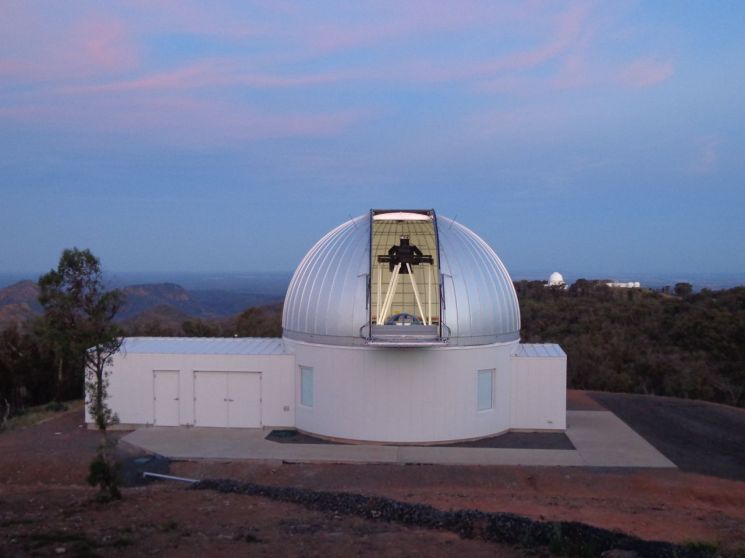 Alien Planet Exploration System installed at the Australian SSO Observatory. Provided by the Alien Planet Exploration System website.
The Korea Aerospace Administration announced that using KMTNet, KASI's dedicated exoplanet search telescope system, the team discovered 'OGLE-2016-BLG-0007Lb,' an exoplanet orbiting a star other than the Sun with a period of over one year. The findings were published in Science on April 25.
The newly discovered exoplanet is a super-Earth with a mass about 1.3 times that of Earth. It is located approximately 1.5 billion kilometers from its host star, which has about 60% of the Sun's mass?about ten times the distance between the Earth and the Sun?and is approximately 14,000 light-years from Earth. Among long-period super-Earths with an orbital period of over one year discovered so far, it has the smallest mass and is the most distant from its host star, with an estimated orbital period of about 40 years.
The research team used KMTNet to discover numerous long-period super-Earths that were difficult to detect with previous observation systems. Through this, they established a sample of long-period exoplanets that includes both Earth-like and Jupiter-like planets.
Based on a sample of 63 exoplanets discovered between 2016 and 2019, statistical analysis showed that most were super-Earths, composed of rock and with masses between 1 and 10 times that of Earth, or Jupiter-like planets.
Statistically, out of every 100 stars, about 35 have super-Earths and about 12 have Jupiter-like planets. This supports the theoretical prediction that Earth-like and Jupiter-like planets form through different processes, and indicates that there are more long-period Earth-like exoplanets in the universe.
Planets are generally classified as either Earth-like (rocky) or Jupiter-like (gaseous), and these two types are formed through different processes. If long-period Earth-like and Jupiter-like planets are formed through different processes, their frequencies would be expected to be similar. However, no observational evidence had been found to support this until now.
Previous studies predicted that many long-period exoplanets would be Earth-like, but in reality, most discovered were Jupiter-like, leaving a significant discrepancy between observation and theory that astronomers needed to resolve.
To date, various observation methods have been developed to discover exoplanets, and these methods are complementary, as the characteristics of exoplanets discovered by each method differ.
KMTNet, developed and operated by KASI, is optimized for discovering long-period exoplanets using the microlensing method. KMTNet is a dedicated exoplanet search telescope system whose development began in 2009 as a major project of KASI. The system was designed to find exoplanets with environments similar to Earth's, where the existence of life is possible.
In May 2015, KMTNet was installed at three observatories in the Southern Hemisphere: CTIO (Cerro Tololo Inter-American Observatory) in Chile, SAAO (South African Astronomical Observatory) in South Africa, and SSO (Siding Spring Observatory) in Australia. After several months of test observations, full-scale operations began on October 2 of that year.
To date, about 300 exoplanets have been discovered using the microlensing method in academia, and since KMTNet began operations, it has directly discovered a total of 227 exoplanets.
Jeong Yeongil, the lead researcher at KASI who led this study, emphasized, "We have provided observational evidence that Earth-like and Jupiter-like planets are formed through different processes, as predicted by theory, and have confirmed that there are many long-period super-Earths in the universe. Exoplanets are important clues for understanding the formation and evolution of planets."
This study involved 68 researchers, including Wei-Cheng Zhang of Tsinghua University in China, and Jeong Yeongil and Lee Chunguk of KASI. The team plans to secure more exoplanet samples through KMTNet and continue with more precise observations and analyses based on these samples.
Yoon Youngbin, Administrator of the Korea Aerospace Administration, stated, "Thanks to the excellent performance of KMTNet, which was developed and is operated by our country, we are leading exoplanet discoveries using the microlensing method. We look forward to continued scientific achievements using our equipment in the future."
© The Asia Business Daily(www.asiae.co.kr). All rights reserved.
![Clutching a Stolen Dior Bag, Saying "I Hate Being Poor but Real"... The Grotesque Con of a "Human Knockoff" [Slate]](https://cwcontent.asiae.co.kr/asiaresize/183/2026021902243444107_1771435474.jpg)















